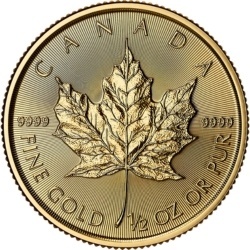
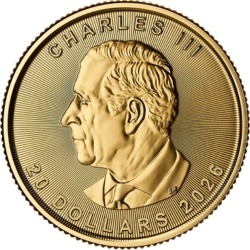
1/2 oz Maple Leaf gold coin 2026 — fractional sweet spot of the Maple Leaf series, optimal balance between premium and Au mass for DCA strategy
The 1/2 oz Maple Leaf gold coin is the strategic middle of the entire fractional Maple Leaf series, in which the Royal Canadian Mint issues five sizes: 1 oz, 1/2 oz, 1/4 oz, 1/10 oz and 1/25 oz. The coin contains 15.55 g of 999.9/1000 fineness pure gold in a format with diameter 25 mm and thickness 2.23 mm with face value 20 CAD as legal tender of Canada. The 2026 vintage is the third year of King Charles III's portrait on the obverse (since 2024) by Steve Rosati — the first portrait of a deceased monarch on Maple Leaf coins since the series debut in 1979.
The price of 1/2 oz Maple Leaf 2026 is linked to the current gold price at LBMA, with market premium of 6-8% over spot — the key analytical point of this product. In the Maple Leaf series, premium scales inversely to mass: 1 oz premium 5-7%, 1/2 oz premium 6-8% (sweet spot), 1/4 oz premium 7-10%, 1/10 oz premium 10-14%, 1/25 oz premium 18-25%. The 1/2 oz fraction retains substantial gold mass (half ounce is still a solid piece of bullion) at premium under 8% — that's optimal for monthly DCA (Dollar-Cost Averaging) strategy with a budget of a few thousand euros.
Why 1/2 oz Maple Leaf gold coin 2026?
- 15.55 g of 999.9/1000 fineness pure gold (.9999, 24 karat) — Royal Canadian Mint, highest bullion fineness worldwide since 1982
- Sweet spot of 1/2 oz fraction — premium 6-8% is optimal balance between 1 oz (5-7%) and 1/4 oz (7-10%) for DCA
- Charles III, year 3 (since 2024) — Steve Rosati portrait, numismatic classic in the making
- Maple leaf — Walter Ott design (1979), unchanged for 47 years — longest-running bullion motif in the world
- Bullion DNA + radial lines (since 2013) — most advanced optical security system in 1/2 oz coins
GoldInvest24 expert recommends — expert commentary
The Maple Leaf series was launched in 1979 as Royal Canadian Mint's response to the success of the South African Krugerrand — with one fundamental advantage: 999/1000 fineness (24 karat) instead of 916.7/1000 (22 karat Crown Gold). The first 1979 vintage contained 999 fineness; in 1982 Royal Canadian Mint introduced 999.9/1000 fineness — the highest bullion fineness in the world at that time. This decision was technologically pioneering: refining to 999.9 required the triple Wohlwill method (electrolytic gold refining), which raised production costs by about 0.5-1% per ounce — Royal Canadian Mint accepted this cost as a competitive distinguisher. To this day, only Royal Canadian Mint (Maple Leaf), Perth Mint (Kangaroo) and Royal Mint (Britannia since 2013) use 999.9 fineness in mass bullion production. The maple leaf on the reverse was designed by Walter Ott, chief engraver at Royal Canadian Mint from 1979 to 1985 — the same leaf (Canadian sugar maple, Acer saccharum) appears on the coin since the series premiere without the slightest modification. This is the longest-unchanged bullion motif in the world (47 years: 1979-2026).
The obverse of Maple Leaf depicts Canada's reigning monarch. Portrait sequence: Arnold Machin (1965, used until 1989), Dora de Pédery-Hunt (1990-2003) — first Canadian woman to design a portrait for Maple Leaf coins, Susanna Blunt (2003-2023) — fourth canonical portrait of Elizabeth II, Steve Rosati (since 2024) — designer of the first Charles III portrait. Steve Rosati is master engraver at Royal Canadian Mint, working in Ottawa since 2008. His Charles III portrait shows the monarch at age 76 (2024 vintage), with crown and mantle — classic heraldic portrait in British tradition. The 2026 vintage is the third year with Rosati's portrait — coins of vintages 2024-2026 will hold collector value as "early years of Charles III" — analogous to 1953-1955 for Elizabeth II.
The year 2013 brought a revolution in Maple Leaf security technology: introduction of Bullion DNA (micro-engraved MapleLeaf logo visible under 20× loupe) and radial lines (radially diverging lines on the leaf background, laser-generated with nanometric precision). The system verifies manually under loupe and angled light — radial lines are impossible to reproduce with classic counterfeiting equipment (require laser milling with precision below 0.01 mm). In 2019, Royal Canadian Mint added micro-text "CANADA" in three locations on the reverse, creating a three-layer security system — Bullion DNA + radial lines + micro-text.
Premium scaling analysis in the Maple Leaf series — 1 oz → 1/2 → 1/4 → 1/10 → 1/25
Royal Canadian Mint issues the Maple Leaf series in five fractional sizes with constant 999.9/1000 fineness and identical obverse/reverse design. Market premium table (averaged for European market, status 2026):
1 oz (31.103 g Au, face 50 CAD) — premium 5-7% — reference standard, cheapest gold gram in the series.
1/2 oz (15.55 g Au, face 20 CAD) — premium 6-8% — sweet spot of the fraction, mass/premium balance.
1/4 oz (7.776 g Au, face 10 CAD) — premium 7-10% — popular "small" fraction, premium rises by 1-2% over 1/2 oz.
1/10 oz (3.110 g Au, face 5 CAD) — premium 10-14% — clear premium jump (fixed-cost-per-coin-strike effect vs Au mass).
1/25 oz (1.244 g Au, face 0.50 CAD) — premium 18-25% — smallest Maple Leaf fraction, premium comparable to numismatic coins.
Structural logic of premium scaling: the cost of physically striking one coin is more or less constant (about 1.5-2.5 USD per coin) regardless of mass. For 1 oz (~3000 USD Au value) this fixed cost is 0.05-0.08% of value. For 1/25 oz (~120 USD Au value) the same fixed cost is 1.3-2.1% of value — so premium rises significantly. Plus design, security, packaging and distribution margin costs scale similarly. Therefore 1/2 oz fraction is mathematically "light" — premium only 1-3% higher than 1 oz, but Au mass allows DCA strategies.
Practical implication: for accumulation strategy with budget of 50 000+ EUR, 1 oz coins are preferred (cheapest gold gram). For monthly DCA strategy with budget 1500-3000 EUR, 1/2 oz or mix 1/2 + 1/4 oz are preferred. For dividend strategy (selling small fractions without disturbing large positions), 1/10 or 1/25 oz are preferred. Maple Leaf 1/2 oz positions itself exactly on the sweet spot: substantial Au mass (15.55 g) at moderate premium (6-8%).
What to consider when buying 1/2 oz Maple Leaf 2026?
First: premium 6-8% is negotiable at GoldInvest24 for orders above 5 pieces. Standard 1/2 oz Maple Leaf costs 6-8% over spot. For wholesale orders (10+ pieces) premium drops to 5.5-7%. For even larger orders (50+ pieces) — to 5-6.5%. The 1/2 oz fraction is popular among DCA investors, so the distribution market is liquid — price differences between premium dealers should not exceed 1-2%.
Second: keep the capsule and Royal Canadian Mint certificate. 1/2 oz coins are standardly delivered in plastic capsule without paper certificate (unlike 1 oz, which often comes in capsule + small card with serial number). The capsule is dry, hermetic and protects from fingerprints and micro-damages. Don't remove the coin from the capsule without specific need — fingerprint can lower resale value by 1-3%.
Third: Bullion DNA verification requires 20× loupe, not 10×. Micro-engraved "MapleLeaf" logo is deliberately very small (under 0.1 mm) to make reproduction difficult. Jeweler's 10× loupe will only show outline, 20× loupe (or good watchmaker's glass) will show details. Radial lines are visible under angled light from 20-30 cm without loupe.
Why GoldInvest24?
- Shipment of coins in original Royal Canadian Mint capsules — full protection from fingerprints and micro-damages
- Dynamic price linked to precious metal prices at LBMA, updated in real time
- Verification of Bullion DNA + radial lines for each coin under professional loupe before shipment
- Premium negotiation for orders above 5 pieces — contact our premium team for DCA strategies
- Secure courier shipment with full insurance and discrete packaging
Technical data 1/2 oz Maple Leaf gold coin 2026
| Parameter |
Value |
| Gold mass (Au) |
15.55 g (0.500 troy oz) |
| Fineness |
999.9/1000 (.9999, 24 karat) |
| Diameter |
25 mm |
| Thickness |
2.23 mm |
| Face value |
20 CAD — legal tender of Canada |
| Obverse |
Charles III — Steve Rosati portrait (since 2024), vintage 2026 = third year |
| Reverse |
Maple leaf (sugar maple, Acer saccharum) — Walter Ott design (since 1979) |
| Manufacturer |
Royal Canadian Mint (Ottawa, Canada) — since 1908 |
| Security features |
Bullion DNA + radial lines (since 2013) + micro-text "CANADA" (since 2019) |
| Packaging |
Royal Canadian Mint plastic capsule |
| Market premium |
6-8% over spot — sweet spot of the fraction |
| VAT |
Exempt (Council Directive 98/80/EC EU) |
1/2 oz Maple Leaf vs competition 1/2 oz gold coins
| Feature |
Maple Leaf 1/2 oz |
Britannia 1/2 oz |
Krugerrand 1/2 oz |
Philharmoniker 1/2 oz |
American Eagle 1/2 oz |
| Fineness |
999.9/1000 |
999.9/1000 |
916.7/1000 (22 kt) |
999.9/1000 |
916.7/1000 (22 kt) |
| Au mass |
15.55 g |
15.55 g |
15.55 g (16.97 g gross) |
15.55 g |
15.55 g (16.97 g gross) |
| Manufacturer |
Royal Canadian Mint |
Royal Mint UK |
SA Mint |
Münze Österreich |
US Mint |
| Security |
Bullion DNA + radial + micro |
4-layer system |
No optical |
No optical |
No optical |
| Tradition |
Since 1979 (47 yrs) |
Since 1987 (39 yrs) |
Since 1967 (59 yrs) |
Since 1989 (37 yrs) |
Since 1986 (40 yrs) |
| Premium 1/2 oz |
6-8% |
7-10% |
5-7% |
6-8% |
8-12% |
Frequently asked questions (FAQ)
Why is 1/2 oz Maple Leaf the "sweet spot" of the fractional series?
Sweet spot is the optimal balance between premium per gram and gold mass in the coin. 1 oz Maple Leaf has cheapest Au gram (premium 5-7%), but requires single budget of about 3000 EUR — too expensive for monthly DCA. 1/4 oz has premium 7-10% and requires 800 EUR. 1/2 oz is the middle: premium 6-8% (only 1-3% higher than 1 oz), budget about 1500 EUR — typical monthly DCA. Therefore 1/2 oz is most often chosen in systematic accumulation strategies.
How does 1/2 oz Maple Leaf 2026 differ from older vintages?
Technical specification identical since 2019 (Bullion DNA + radial lines + micro-text, fineness 999.9). Main differences: vintage 2026 has Charles III on obverse (since 2024), older vintages (until 2023) have Elizabeth II in Susanna Blunt portrait. Between 2024 and 2026 no changes in Charles III portrait or reverse design. Vintages 2024-2026 may hold collector value in future as "early Charles III years".
Is 1/2 oz Maple Leaf VAT-exempt in the EU?
YES — fineness 999.9/1000 significantly exceeds minimum 900/1000 required for VAT exemption on coins minted after 1800 (Council Directive 98/80/EC in the EU). Plus the coin has face value 20 CAD as legal tender of Canada.
Maple Leaf 1/2 oz vs Britannia 1/2 oz — which to choose?
Both 999.9 fineness and 15.55 g mass. Differences: (a) tradition (Maple Leaf 1979 — 47 years, Britannia 1987 — 39 years), (b) security (Maple Leaf 3-layer since 2019, Britannia 4-layer since 2021), (c) premium (Maple Leaf 6-8%, Britannia 7-10%), (d) CGT-free status (Maple Leaf — no, Britannia — YES in UK). For EU investor without UK CGT exposure: Maple Leaf (1-2% cheaper in premium). For investor with British tax residency: Britannia.
Are Bullion DNA and radial lines verifiable without special equipment?
Yes, manually. Bullion DNA requires 20× jeweler's loupe (10× loupe only shows outline, 20× shows micro-engraved "MapleLeaf"). Radial lines visible under angled light from 20-30 cm without loupe — 30-45° angle shows radially diverging lines. Micro-text "CANADA" (since 2019) in three locations on reverse — visible under 10× or 20× loupe.
How many 1/2 oz Maple Leaf in DCA strategy?
For monthly DCA budget 1500-3000 EUR: 1 piece 1/2 oz monthly. For 3000-6000 EUR monthly: 2 pieces or mix 1 oz + 1/2 oz (more mass diversification). Above 6000 EUR: recommended transition to 1 oz coins or mix 1 oz + 1/2 oz to maintain liquidity. 12-month DCA with 1500 EUR/month yields 12 pieces 1/2 oz Maple Leaf — equivalent of about 186.6 g accumulated net gold.