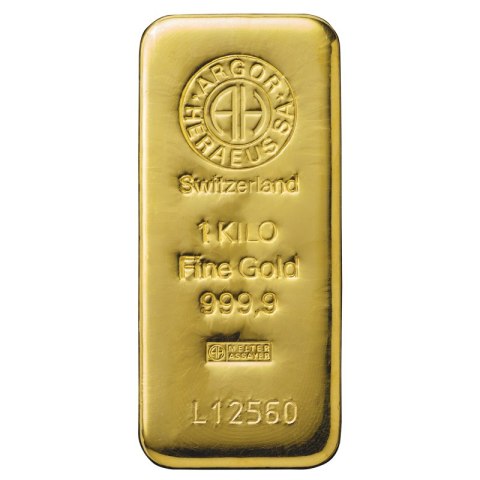
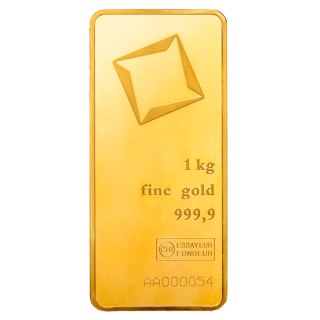
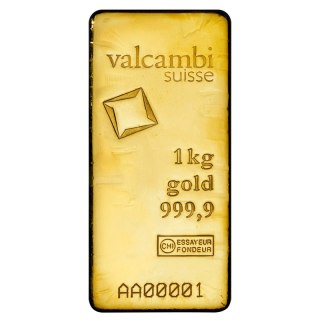
Argor-Heraeus 1 kg cast gold bar — 999.9/1000 fineness, one kilogram of pure gold in a single unit, LBMA Good Delivery
1000 grams of gold, 999.9/1000 fineness (.9999), in cast bar form from Argor-Heraeus SA — a Swiss refinery based in Mendrisio, Canton Ticino, founded in 1951 and LBMA Good Delivery accredited since 1961. Argor-Heraeus is part of Heraeus Holding GmbH — a German group with a precious metals processing tradition dating back to 1851. Each bar carries an individual serial number stamped directly on the surface and is delivered with a manufacturer's assay card confirming weight, fineness, and authenticity.
The 1 kg format (32.15073 troy ounces) is the largest denomination in the Argor-Heraeus retail range — measuring 116.5 × 51 × 8.7 mm. The kilogram cast bar is the flagship of the cast series and offers the lowest percentage premium per gram of any format from this producer. The rough, matte surface with pronounced casting marks is most prominent at this format — the largest front surface of any denomination displays the full characteristics of the casting process. Available exclusively in casting technology — the Argor-Heraeus minted and Kinebar series ends at 100 g.
Technical specification
| Parameter |
Value |
| Product type |
Gold bullion bar — cast |
| Producer / refinery |
Argor-Heraeus SA |
| Producer headquarters |
Mendrisio, Canton Ticino, Switzerland |
| Year founded |
1951 |
| Accreditation |
LBMA Good Delivery (gold) since 1961 |
| Precious metal |
Gold (Au) |
| Fineness |
999.9/1000 (.9999) |
| Weight |
1000 g / 1 kg (32.15073 troy oz) |
| Dimensions |
116.5 × 51 × 8.7 mm |
| Form |
Cast bar with individual serial number |
| Surface |
Rough, matte — visible casting marks |
| Markings |
Argor-Heraeus logo, weight, fineness, serial number — stamped on surface |
| Packaging |
Manufacturer's protective foil with assay card |
| Serial number |
Individual — stamped on bar and repeated on assay card |
| VAT |
Exempt (Council Directive 2006/112/EC, Art. 346) |
Why the 1 kg cast gold bar from Argor-Heraeus
The 1 kg format (32.15073 troy oz) concentrates over thirty-two troy ounces in a single unit — one kilogram of gold at the lowest percentage premium in the entire Argor-Heraeus range. No other format from this producer offers a lower markup per gram. Available exclusively as a cast bar — the minted and Kinebar series ends at 100 g. Argor-Heraeus SA processes over 400 tonnes of gold annually and holds simultaneous LBMA Good Delivery accreditation for gold, silver, platinum, and palladium. The 116.5 × 51 × 8.7 mm dimensions mean that despite weighing a full kilogram, the bar fits in the palm. The 1 kg format is the reference trading unit on global precious metals exchanges (LBMA, COMEX, SGE), serving as the basis for spot and forward contract settlement.
Argor-Heraeus SA — over seven decades of precious metal refining
The Argor-Heraeus SA refinery was founded in 1951 in Mendrisio, Canton Ticino, southern Switzerland. It initially operated as Argor SA, offering gold and silver refining for the Swiss banking sector. In 1999, a merger with the precious metals division of Heraeus Holding GmbH — a German industrial group with a tradition dating back to 1851 — created the present-day corporate structure. The company is part of the Heraeus group and ranks among the world's largest gold processors, with an annual refining capacity exceeding 400 tonnes.
Argor-Heraeus obtained LBMA Good Delivery accreditation for gold in 1961. The refinery also holds LBMA accreditations for silver, platinum, and palladium, as well as Responsible Jewellery Council (RJC) certification and compliance with the LBMA Responsible Gold Guidance. The product portfolio includes minted bars (1 g — 100 g), the Kinebar series with KineGram hologram (1 g — 100 g), and cast bars from 100 g to 1 kg.
Casting technology — the oldest method of gold bar production
Casting is the oldest and simplest technique for producing gold bars, practised for thousands of years. The process involves melting gold in a crucible and pouring the liquid metal into a mould (ingot mould). After cooling, the bar is removed, cleaned, and marked — the producer's logo, weight, fineness, and serial number are stamped directly onto the surface using an engraving die.
At the 1 kg denomination, the surface displays the rough, matte texture over the largest area of any format in the Argor-Heraeus series. The 116.5 × 51 mm dimensions yield a front surface area exceeding 59 cm² — more than double that of the 250 g format (63 × 36 mm ≈ 22.7 cm²). Casting traces — irregularities, wavy solidification lines, and rounded edges — form the most pronounced pattern of any denomination in the series.
Despite the simpler aesthetics, Argor-Heraeus cast bars are subject to identical quality standards as the minted and Kinebar series — the same 999.9/1000 fineness, the same refining process, and the same LBMA Good Delivery accreditation.
Denominations in the Argor-Heraeus cast series
The Argor-Heraeus cast series encompasses four denominations: 100 g, 250 g, 500 g, and 1 kg. Minted bars and Kinebar are available up to 100 g — above that, only casting technology is employed. The 1 kg format is the flagship of the series — the largest denomination with the lowest premium per gram. Explore the full selection of gold bullion bars at GoldInvest24.
One kilogram of gold in a single bar is a format intended for buyers who prefer maximum value concentration at the minimum markup. The percentage premium per gram is at its lowest, but the entry threshold is the highest — and the pool of secondary-market buyers is smaller than for 100 g or 250 g. Current gold quotes on the precious metals prices page.
What to look for when buying a cast 1 kg bar
Packaging completeness — the bar should be in the manufacturer's protective foil with assay card. The serial number stamped on the surface must match the number on the assay card. The surface of a cast bar is naturally rough and matte — irregularities and casting traces are a design feature, not a defect.
At the 1 kg denomination, authenticity verification is particularly important — due to the high unit value, XRF analysis or ultrasonic testing is recommended for every secondary-market transaction. The presence of the Argor-Heraeus assay card with a matching serial number significantly simplifies the process. Consider whether a single 1 kg bar (indivisible) better suits your needs than two 500 g bars or four 250 g bars — smaller formats offer flexibility for partial liquidation at a higher combined premium.
Why GoldInvest24
GoldInvest24 offers exclusively original Argor-Heraeus bars with full manufacturer packaging and assay card. Every product originates from the authorised distribution chain and is backed by an authenticity guarantee. Insured shipping in discreet packaging ensures safe delivery. Explore also gold bullion coins and silver bullion bars available in the store.
Comparison of Argor-Heraeus cast bars — cast series and 100 g minted reference
| Denomination / variant |
Dimensions (mm) |
Troy ounces |
Fineness |
Surface |
| 100 g Minted |
31 × 54 × 3.0 |
3.21507 |
999.9 |
Smooth, mirror-finish |
| 100 g Cast |
44 × 25 × 7 |
3.21507 |
999.9 |
Rough, matte |
| 250 g Cast |
63 × 36 × 9 |
8.03768 |
999.9 |
Rough, matte |
| 500 g Cast |
78 × 41 × 12 |
16.07536 |
999.9 |
Rough, matte |
| 1 kg Cast |
116.5 × 51 × 8.7 |
32.15073 |
999.9 |
Rough, matte |
Frequently asked questions — 1 kg cast gold bar Argor-Heraeus
Is the 1 kg cast bar from Argor-Heraeus VAT-exempt?
Yes. The bar meets the definition of gold bullion (minimum 995/1000 fineness, market-accepted weight) and is exempt from VAT under Council Directive 2006/112/EC (Art. 346). The buyer pays only the net product price.
How many troy ounces does a 1 kg bar weigh?
A 1 kg bar equals 32.15073 troy ounces — over thirty-two troy ounces concentrated in a single unit measuring 116.5 × 51 × 8.7 mm. The troy ounce (31.1035 g) is the standard trading unit on global precious metals exchanges. The kilogram is also the reference unit for spot and forward contracts on the LBMA market.
Why is the 1 kg available only as a cast bar?
The Argor-Heraeus minted and Kinebar series ends at 100 g. Above that, the manufacturer offers exclusively casting technology. All four cast series denominations (100 g, 250 g, 500 g, 1 kg) undergo the same production process.
Is the 1 kg bar an LBMA Good Delivery format?
The 1 kg Argor-Heraeus bar carries LBMA Good Delivery accreditation, but it is not the same as the Good Delivery bar traded on the London OTC market (approximately 400 troy oz / 12.4 kg). The 1 kg format is the retail and institutional market standard — accepted by exchanges such as SGE (Shanghai) and TOCOM (Tokyo) and by dealers worldwide.
How to verify the authenticity of a 1 kg bar?
The first step is to match the serial number stamped on the bar with the number on the Argor-Heraeus assay card. At the 1 kg denomination, instrumental verification is recommended — XRF analysis (X-ray fluorescence) or ultrasonic testing. The 116.5 × 51 × 8.7 mm dimensions and 1000 g weight serve as additional control parameters.
One 1 kg bar or smaller formats totalling 1 kg?
A single 1 kg bar offers the lowest percentage premium per gram — lower than four 250 g bars or two 500 g bars. In return, it is indivisible. Smaller formats allow partial liquidation but at a higher combined premium. The choice depends on time horizon and planned exit strategy.
How should a cast 1 kg bar be stored?
In the manufacturer's original protective foil, in a dry location. At this value, a safe rated at least class S2 (EN 14450) or a bank deposit box is mandatory. Given the high value, dedicated vault storage may be considered. Avoid contact with other metals. Do not remove the protective foil or tamper with the assay card.