20 Dollars Double Eagle Liberty Head USA (1850-1907) — the largest circulating gold coin of the United States in the 19th century with the Liberty portrait by James Barton Longacre
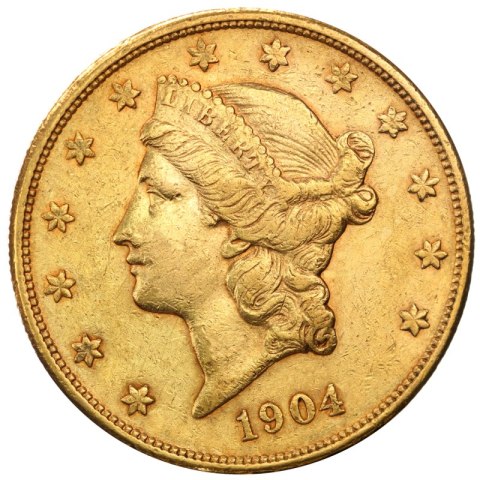
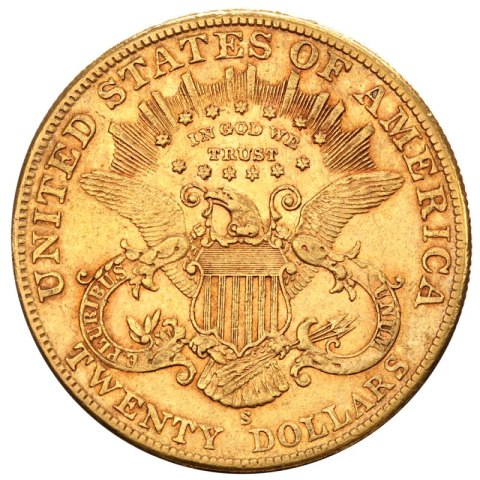
The 20 Dollars Double Eagle Liberty Head gold coin is a classic American circulating denomination struck by the U.S. Mint between 1850 and 1907 — the largest circulating gold coin of the United States in the 19th century, with a gross mass of 33.4362 g, a pure-gold mass of 30.0926 g (= 0.9675 troy oz), 0.900 fineness (Coronet Gold, U.S. Mint standard 1834-1933), 34.0 mm diameter and a face value of 20 US dollars as historic legal tender. The obverse features the head of Liberty facing left with a coronet bearing the inscription LIBERTY and 13 stars (the 13 founding states); the reverse — the American eagle (Bald Eagle) with a heraldic shield, an olive branch and 13 arrows; the motto "IN GOD WE TRUST" was added in 1866. The designer was James Barton Longacre (1794-1869), Chief Engraver of the U.S. Mint from 1844 to 1869. The coin is VAT-exempt in the EU as a legal-tender coin with a fineness ≥0.900 struck after 1800, with a typical market premium of 6-12% over spot due to its status as a historic symbol of American gold and a smaller production scale compared to modern bullion coins.
Technical specification
| Parameter |
Value |
| Manufacturer |
U.S. Mint — Philadelphia (P), San Francisco (S), Carson City (CC), New Orleans (O), Denver (D) |
| Series |
20 Dollars Liberty Head "Double Eagle" — Coronet type |
| Mintage years |
1850-1907 (Liberty Head type designed in 1849 by James Barton Longacre) |
| Standard |
Coronet Gold — U.S. Mint standard 1834-1933 (0.900 fineness) |
| Gross mass |
33.4362 g (gold + copper) |
| Pure gold mass |
30.0926 g (= 0.9675 troy oz) |
| Fineness |
0.900 (22 carats Coronet, Au 90% + Cu 10%) |
| Diameter |
34.0 mm |
| Thickness |
approx. 2.4 mm |
| Face value |
20 US dollars (historic legal tender until 1933) |
| Obverse |
Head of Liberty facing left with coronet LIBERTY, 13 stars, year — James Barton Longacre |
| Reverse |
Bald Eagle with heraldic shield, olive branch, 13 arrows; UNITED STATES OF AMERICA, TWENTY DOLLARS, motto "IN GOD WE TRUST" (from 1866) |
| Historic status |
Legal tender of the USA until 1933 (Executive Order 6102 by Roosevelt — gold confiscation) |
| VAT in the EU |
Exempt (legal-tender coin, 0.900 fineness, struck after 1800, EU Directive 2006/112/EC Art. 344) |
| UK status |
NOT CGT-free (CGT exemption applies only to British legal tender) |
| USA status |
NOT IRA-eligible (historic coins are not on the IRS-approved list) |
| Packaging |
Individual protective capsule |
Why 20 Dollars Double Eagle Liberty Head deserves a place in your portfolio
- Largest circulating gold coin of the USA in the 19th century — almost 1 troy oz of pure gold: the Double Eagle (20 dollars) contains 30.0926 g of pure gold (= 0.9675 troy oz) — the highest face value of a circulating gold coin of the United States in the gold-standard era 1850-1933. Larger than the 10-dollar Eagle (15.0463 g), the 5-dollar Half Eagle (7.5232 g) or the 2.5-dollar Quarter Eagle (3.7616 g) — all of the same 0.900 fineness Coronet Gold.
- Designer James Barton Longacre — Chief Engraver of the U.S. Mint 1844-1869: the Liberty Head design was conceived by Longacre in 1849 — the same artist who created the iconic 1-cent Indian Head (1859-1909), the Flying Eagle Cent (1856-1858) and the 2.5-dollar gold Liberty (1849). Longacre served as chief engraver of the Philadelphia Mint for 25 years — his Liberty portrait became a classic icon of 19th-century American numismatics.
- Historic symbol of American pre-war gold — before Executive Order 6102: the Double Eagle is a physical artefact of the classic US gold-standard era (1834-1933) — before President Franklin D. Roosevelt's gold confiscation in 1933 (Executive Order 6102 of 5 April 1933). Owning an original Double Eagle is a direct connection to the era of the American California Gold Rush (1848-1855), the Civil War (1861-1865), the Gilded Age (1865-1900) and the Progressive Era (1900-1920).
- Five mints — collector differences by mint mark: the Double Eagle was struck in five U.S. Mint facilities: Philadelphia (no letter), San Francisco (S — from 1854), Carson City (CC — 1870-1893, the rarest and most collectible), New Orleans (O — 1850-1861, before and shortly after the Civil War), Denver (D — from 1906). Carson City (CC) issues are particularly valued by collectors due to the small production scale (the Nevada mint operated only 23 years, 1870-1893) and the connection to the Comstock Lode — the major silver and gold discovery in Nevada.
- Market premium 6-12% over spot — a good compromise between history and bullion: the Double Eagle has a higher premium than modern bullion coins (Krugerrand, Maple Leaf typically 4-7%) due to historic status and smaller production scale, but lower than rare collector varieties (e.g. CC from the 1870s can have a premium of 50-200%). For an investor seeking historic gold with a known and acceptable premium, the Double Eagle Liberty offers the optimal balance of prestige and bullion.
History of the 20 Dollars Double Eagle (1850-1907) — the birth of the golden era of the United States
The 20-dollar "Double Eagle" gold coin was introduced by an Act of the United States Congress of 3 March 1849 in response to the enormous influx of gold from California after the discovery at Sutter's Mill in 1848 (California Gold Rush). Before 1849, the highest denomination of a U.S. gold coin was the 10-dollar Eagle (from 1795); the 1849 Act introduced the "double eagle" worth 20 dollars and the 1-dollar gold coin. Purpose: faster processing of California gold into circulating coins — higher single-coin weight accelerated conversion of bullion into currency.
The Liberty Head design by James Barton Longacre, chief engraver of the U.S. Mint since 1844, was already designed in 1849 — the first pattern issue was struck in November of that year, but regular production began in 1850 at the Philadelphia and New Orleans mints. Longacre modelled the Liberty head on classic European numismatic portraits, but gave it an American character — a coronet inscribed LIBERTY (instead of an imperial diadem) and 13 stars representing the 13 founding states of the Union. The reverse featured the American eagle (Bald Eagle) with a heraldic shield, olive branch and 13 arrows — the classic American Eagle motif introduced into American numismatics from 1795.
The Double Eagle was struck continuously for 57 years (1850-1907) at five U.S. Mint facilities: Philadelphia (P, no letter on the coin — the default federal mint), San Francisco (S, from 1854 — in response to California gold), Carson City (CC, 1870-1893 — in the heart of the Comstock Lode of Nevada), New Orleans (O, 1850-1861 and briefly after the Civil War), Denver (D, from 1906 — in response to Colorado gold). The rarest and most collectible are the Carson City issues — the mint operated only 23 years, with relatively small mintages, which makes CC issues today particularly valuable (collector premium may be 50-200% or more for the rarest years).
In 1866 — after the Civil War — the motto "IN GOD WE TRUST" was added to the reverse of the Double Eagle (proposed by Treasury Secretary Salmon P. Chase). Earlier issues 1850-1865 did not include this motto; issues 1866-1907 have the motto on the reverse. This change created two varieties of the Liberty type: "No Motto" (1850-1865) and "With Motto" (1866-1907). Both varieties are original circulation types, but "No Motto" is particularly valued by collectors as rarer and historically earlier.
In 1907 production of the Liberty Head type was ended — President Theodore Roosevelt ordered the renewal of American gold coin design, commissioning a new Double Eagle from Augustus Saint-Gaudens. The Saint-Gaudens Double Eagle (1907-1933) retained the same technical specification (33.4362 g gross, 30.0926 g pure gold, 0.900 fineness, 34.0 mm diameter), but introduced a new design — a standing Liberty with torch and olive branch on the obverse and a flying eagle on the reverse. The Saint-Gaudens was struck until 1933, when Franklin D. Roosevelt's Executive Order 6102 ended the era of American circulating gold coins.
Obverse — Liberty Head by James Barton Longacre
The obverse of the 20 Dollars Double Eagle Liberty Head coin features the profile of the Liberty Head facing left — a classic allegory of American freedom in 19th-century neoclassical style. Liberty wears a coronet inscribed LIBERTY (instead of a traditional imperial diadem), with hair gathered at the back in a bun, and around the head are placed 13 stars representing the 13 founding states of the Union (Connecticut, Delaware, Georgia, Maryland, Massachusetts, New Hampshire, New Jersey, New York, North Carolina, Pennsylvania, Rhode Island, South Carolina, Virginia). The year of mintage appears below the portrait.
The designer of the obverse is James Barton Longacre (1794-1869) — American engraver and medallist, chief engraver of the U.S. Mint from 1844 until his death in 1869. Longacre was one of the most important American medallists of the 19th century — he also designed the 1-cent "Flying Eagle" (1856-1858), the 1-cent "Indian Head" (1859-1909, one of the most recognisable U.S. cents), the 2-cent (1864-1873), the 3-cent silver (1851-1873), the 2.5-dollar gold "Liberty" (1849), the Half Eagle (5 USD), the Eagle (10 USD) and the 20-dollar Double Eagle. His style was characterised by American neoclassicism — allegorical female figures representing Liberty with symbolic elements (stars, LIBERTY coronet, 13 states).
The coronet bearing the inscription LIBERTY — instead of the imperial diadem used in European coinage with monarch portraits — is an American answer to classic European power portraits. Liberty is not a historical figure, but an allegory — the personification of the idea of civic liberty that the United States embodied in the 19th century. The LIBERTY coronet functions as an American substitute for the royal crown, emphasising that the source of authority in the republic is civic liberty, not the divine sanction of a monarch.
The 13 stars around the Liberty portrait represent the 13 original states of the American Union of 1776 — the foundations of the United States. Although by 1850 the number of states had risen to 31 (and by 1907 to 46), the symbolic "13 stars" were retained on the Double Eagle as a reference to the original Declaration of Independence and the U.S. Constitution of 1787. The same number 13 recurs on the reverse of the coin: 13 stars around the eagle (in some types), 13 arrows in the eagle's talons and 13 stripes on the heraldic shield — multiple references to the 13 founding states as the foundation of the Republic.
Reverse — American eagle (Bald Eagle) with heraldic shield and motto "IN GOD WE TRUST"
The reverse of the 20 Dollars Double Eagle Liberty Head coin features the American eagle — the bald eagle (Haliaeetus leucocephalus) — with a heraldic shield on its breast, an olive branch in one talon and a bundle of 13 arrows in the other. Around the eagle is the inscription UNITED STATES OF AMERICA (above) and the denomination TWENTY DOLLARS (below). From 1866 the motto "IN GOD WE TRUST" was added on a scroll above the eagle's head.
The Bald Eagle has been the national symbol of the United States since 1782, when the Great Seal of the United States established the eagle with heraldic shield, olive branch and arrows as the federal coat of arms. The olive branch symbolises peace, the arrows — war; the eagle holds both symbols simultaneously, expressing the American doctrine of "peace through strength" — readiness for peace but also for defence against aggression. The heraldic shield on the eagle's breast contains 13 stripes (pales) symbolising the 13 founding states, joined into a single shield (the Union).
The 13 arrows in the eagle's talons are another multiple reference to the 13 founding states — symbol of the Union's military strength, but also of unity (13 arrows gathered into a single bundle = 13 states united in one Republic). The motif of 13 arrows comes from Roman heraldry (fasces — lictor's bundles of rods), adapted to the American context with the addition of the Bald Eagle (instead of the Roman eagle) and the heraldic shield (instead of Latin emblems). The whole composition symbolises the American idea "E Pluribus Unum" — "out of many, one", the federal motto on the Great Seal of the USA from 1782.
The motto "IN GOD WE TRUST" was added to the reverse of the Double Eagle in 1866 — in the post-Civil War period (1861-1865), when Treasury Secretary Salmon P. Chase proposed placing a religious motto on American coins as an expression of national moral regeneration after the Civil War. The motto first appeared on the 2-cent (1864), and in 1866 was extended to most silver and gold coins, including the Double Eagle. Earlier Double Eagle issues 1850-1865 (type "No Motto") do not contain this inscription — which is an important classification criterion for collectors (No Motto vs With Motto).
What to look out for when buying
Check the Double Eagle type — "No Motto" (1850-1865, without "IN GOD WE TRUST") vs "With Motto" (1866-1907, with motto). The No Motto type is historically earlier and rarer — all issues before the Civil War (until 1861) and war-era issues (1861-1865) belong to this variety. The With Motto type (1866-1907) is longer in production (41 years) and accounts for the majority of the total number of Liberty Double Eagles struck. For the bullion-focused investor both types are equivalent (identical specification: 33.4362 g gross, 30.0926 g pure gold, 0.900 fineness); for the collector the type difference affects price and collector value.
Check the mint — the mint letter on the reverse below the eagle identifies the mint: no letter = Philadelphia (P), S = San Francisco, CC = Carson City, O = New Orleans, D = Denver. Carson City (CC) issues are particularly collectible — low mintages, short mint lifespan (1870-1893), connection to the history of the Comstock Lode in Nevada. The price for CC can be many times that of P (Philadelphia) for the same year. For an investment strategy focused on bullion, choosing without preference for the mint minimises the premium.
Check the year and state of preservation — the Double Eagle has a 57-year production period (1850-1907) with significant differences in mintages and collector prices between years. The most common and cheapest are Philadelphia issues from 1900-1907 (high mintages, good preservation). The rarest are the Civil War years (1861-1865, low mintages) and early Carson City issues (1870-1880). State of preservation (PCGS/NGC grading: VF, EF, AU, MS) affects the premium — for the bullion strategy a VF-EF (Very Fine - Extremely Fine) condition is acceptable, for the collector strategy MS (Mint State) is preferred.
Check authenticity — the Double Eagle weighs 33.4362 g gross with the tolerance of the 19th-century U.S. mint. The 0.900 fineness (Au 90% + Cu 10%) is constant for the entire production 1850-1907 — Coronet Gold standard established by the Coinage Act of 1834. Diameter 34.0 mm and thickness approx. 2.4 mm are also constant. Counterfeits of the Double Eagle are known on the market — particularly copies from the 1960s from Lebanon and Italy with lower fineness (sometimes 0.750-0.850 instead of 0.900). Therefore purchase documents from a certified gold dealer are important, as is possible PCGS or NGC grading for valuable years.
Why GoldInvest24
- Full offer of historic world gold coins: our catalogue features not only the American Double Eagle Liberty, but also other key great historic coins — the Mexican 50 Peso Centenario (37.5 g pure gold), the Dutch 10 Guilders, the German 20 Marks of Wilhelm I and the South African 2 Rand Springbok. A full cross-section allows building a balanced portfolio of historic world gold.
- U.S. Mint federal mint — full coverage of five locations: Double Eagle issues from Philadelphia (P), San Francisco (S), Carson City (CC), New Orleans (O) and Denver (D) are available — with different mintages and collector values. The U.S. Mint is one of the oldest national mints in the world (established 1792) and one of the largest producers of investment gold today (American Gold Eagle, American Buffalo).
- PL / DE / EN language versions: full technical descriptions and specifications in three languages for convenient service of the Polish, German and international markets — particularly valuable for American historic coins with English numismatic terminology (Double Eagle, Liberty Head, Coronet Gold).
- Current precious-metals quotes: spot data for comparing offer prices with current market valuation — check the current precious-metals prices before purchase to assess the effective premium on the Double Eagle relative to the current gold price.
- Full precious-metal categories in one shop: access to gold investment coins, bars, silver, platinum and palladium — all from a single customer account, with full PL/DE/EN support and unified ordering policy across all product categories.
Comparison of 5 great historic world gold coins of package 107
| Feature |
20 USD Double Eagle Liberty |
2 Rand RSA Springbok |
20 Marks Wilhelm I |
10 Guilders Netherlands |
50 Peso Centenario |
| Country |
USA |
South Africa |
German Empire |
Netherlands |
Mexico |
| Mintage years |
1850-1907 |
1961-1983 |
1871-1888 |
1875-1933 |
1921-1947 (restrike 1949-1972) |
| Pure gold |
30.0926 g |
7.3224 g |
7.1685 g |
6.048 g |
37.5000 g |
| Gross mass |
33.4362 g |
7.9881 g |
7.9650 g |
6.720 g |
41.6666 g |
| Fineness |
0.900 |
0.9167 |
0.900 |
0.900 |
0.900 |
| Diameter |
34.0 mm |
22.07 mm |
22.5 mm |
22.5 mm |
37.0 mm |
| Obverse |
Liberty Head |
Jan van Riebeeck |
Wilhelm I |
Wilhelm III / Wilhelmina |
Angel of Independence |
| Reverse |
Bald Eagle |
Springbok |
Reichsadler |
Heraldic shield |
Águila Mexicana |
| Typical premium |
6-12% |
5-10% |
4-9% |
4-8% |
3-7% |
See the entire gold investment coins category available at GoldInvest24.
FAQ — common questions about the 20 Dollars Double Eagle Liberty Head
What is the 20 Dollars Double Eagle Liberty Head?
The 20 Dollars Double Eagle Liberty Head is an American circulating gold coin struck by the U.S. Mint from 1850 to 1907 — the largest circulating gold coin of the United States in the 19th century. Gross mass 33.4362 g, pure gold 30.0926 g (= 0.9675 troy oz), 0.900 fineness (Coronet Gold), 34.0 mm diameter. Obverse: head of Liberty with coronet LIBERTY and 13 stars (James Barton Longacre, 1849). Reverse: Bald Eagle with heraldic shield, olive branch and 13 arrows; from 1866 the motto "IN GOD WE TRUST". Legal tender of the USA until 1933 (Executive Order 6102 by Roosevelt — gold confiscation).
What is the technical specification of the 20 Dollars Double Eagle?
Gross mass 33.4362 g (gold + copper), pure-gold mass 30.0926 g (= 0.9675 troy oz), 0.900 fineness (Coronet Gold, U.S. Mint standard 1834-1933), 34.0 mm diameter, approx. 2.4 mm thickness. Manufacturer: U.S. Mint at five locations (Philadelphia, San Francisco, Carson City, New Orleans, Denver). Obverse: head of Liberty (Longacre, 1849), 13 stars. Reverse: Bald Eagle, UNITED STATES OF AMERICA, TWENTY DOLLARS, motto "IN GOD WE TRUST" (from 1866).
What is the history of the 20 Dollars Double Eagle Liberty Head?
Introduced by an Act of the U.S. Congress in 1849 in response to the California Gold Rush (1848+). Liberty Head design by James Barton Longacre (chief engraver of the U.S. Mint 1844-1869). Struck 1850-1907 at five mints: Philadelphia, San Francisco (1854+), Carson City (1870-1893, the rarest), New Orleans (1850-1861), Denver (1906+). 1866 — addition of the motto "IN GOD WE TRUST" (No Motto type 1850-1865 vs With Motto 1866-1907). 1907 — replaced by the Saint-Gaudens Double Eagle (1907-1933). 1933 — Executive Order 6102 by Roosevelt ended the era of American circulating gold coins.
How does the Double Eagle Liberty differ from the Saint-Gaudens Double Eagle?
Double Eagle Liberty (1850-1907) — design by James Barton Longacre, head of Liberty with coronet LIBERTY on the obverse and Bald Eagle with heraldic shield on the reverse. Saint-Gaudens Double Eagle (1907-1933) — design by Augustus Saint-Gaudens (commissioned by Theodore Roosevelt), standing Liberty with torch and olive branch on the obverse and flying eagle on the reverse. Identical technical specification: 33.4362 g gross, 30.0926 g pure gold, 0.900 fineness, 34.0 mm diameter. The Liberty is historically earlier (1850-1907 = 57 years); the Saint-Gaudens ends the era of American gold (1907-1933 = 26 years).
For whom is the 20 Dollars Double Eagle Liberty a practical choice?
For investors valuing historic American gold of the 19th century — the Double Eagle is a physical artefact of the U.S. gold-standard era (1834-1933) before Roosevelt's gold confiscation. For numismatic collectors seeking classic designs by James Barton Longacre. For building a diversified portfolio of historic world gold — Double Eagle as the American representation alongside German 20 Marks, French 20 Francs LMU, Mexican 50 Peso Centenario. Less practical for purely bullion-focused strategies (premium 6-12% higher than 4-7% on bullion).
What is the VAT, CGT and IRA status of the 20 Dollars Double Eagle Liberty?
VAT in the EU — EXEMPT (historic legal-tender coin, 0.900 fineness ≥ 0.900, struck after 1800, market price ≤180% of gold value — meets EU Directive 2006/112/EC Art. 344 and Polish VAT Act Art. 122). CGT-free in the UK — NO (CGT-free status applies only to British legal tender — Sovereign, Britannia, Lunar UK). IRA-eligible in the USA — NO (the IRS admits only American coins listed — American Gold Eagle, American Buffalo and selected modern bullion; historic coins, including the Double Eagle, are NOT among the approved).
How do I buy the 20 Dollars Double Eagle Liberty at GoldInvest24?
Place an order in our shop with access to the full gold investment coins category, the complete offer of great historic world gold coins (Double Eagle USA, 50 Peso Mexico, 20 Marks Germany, 10 Guilders Netherlands, 2 Rand RSA) and products of modern LBMA mints. Check the current gold quotes to compare the premium against the current spot price. Technical descriptions and specifications are available in PL / DE / EN language versions — particularly valuable for American historic coins with numismatic terminology in three languages.
![[{[item.product.name]}]]([{[item.product.photo.url]}] 75w)