20 French Francs Marianne and Rooster French Third Republic (1899-1914) — the last French 20-franc coin of the Latin Monetary Union before World War I with the portrait of Marianne in a Phrygian cap and the Gallic rooster on the reverse
The 20 French Francs Marianne and Rooster (Coq) gold coin is a classic French 20-franc piece in the Latin Monetary Union (LMU) standard, struck at the Monnaie de Paris between 1899 and 1914 — the last French 20-franc issue before the outbreak of World War I, with a gross mass of 6.4516 g, a pure-gold mass of 5.80645 g, a 0.900 fineness (Crown-Gold-style alloy), a 21.0 mm diameter and a face value of 20 French francs as historic legal tender of the Third Republic. The obverse features the profile of Marianne — the allegory of the French Republic — in a Phrygian cap with the inscription REPUBLIQUE FRANÇAISE, and the reverse the Gallic rooster (Gallus) with the motto LIBERTÉ EGALITÉ FRATERNITÉ and the face value 20 FRANCS. The designer of the pattern is Jules-Clément Chaplain (1839-1909) — French medallist, author of coins and medals of the Third Republic, signed J.C. CHAPLAIN on the obverse. The coin is VAT-exempt in the EU as a legal-tender coin with 0.900 fineness struck after 1800, with a typical market premium of 3-6% over spot — the most commonly encountered French LMU 20F on the secondary market, combining the history of the Third Republic (1870-1940) with deep liquidity and a low spread on resale.
Technical specification
| Parameter |
Value |
| Manufacturer |
Monnaie de Paris (France, mintmark "A" — Paris) |
| Series |
20 Francs Marianne et Coq — French Third Republic |
| Mintage years |
1899-1914 (until the outbreak of World War I) |
| Standard |
Latin Monetary Union (LMU, established 23.12.1865 in Paris) |
| Gross mass |
6.4516 g (gold + copper) |
| Pure gold mass |
5.80645 g |
| Fineness |
0.900 fineness (Crown-Gold-style alloy) |
| Alloy |
Au 90% + Cu 10% |
| Diameter |
21.0 mm |
| Thickness |
approx. 1.3 mm |
| Face value |
20 French francs (historic legal tender of the Third Republic) |
| Obverse |
Profile of Marianne in a Phrygian cap, REPUBLIQUE FRANÇAISE — Jules-Clément Chaplain (sig. J.C. CHAPLAIN) |
| Reverse |
Gallic rooster (Gallus) standing, LIBERTÉ EGALITÉ FRATERNITÉ, 20 FRANCS, year |
| Designer |
Jules-Clément Chaplain (1839-1909) — French medallist |
| LBMA status |
Not directly (historic coin, not a current bullion issue) |
| VAT in the EU |
Exempt (legal-tender coin, 0.900 fineness = minimum, struck after 1800, EU Directive 2006/112/EC Art. 344) |
| UK status |
NOT CGT-free (CGT exemption applies only to British legal tender) |
| USA status |
NOT IRA-eligible (IRS admits only American coins and selected bullion) |
| Packaging |
Individual protective capsule |
Why 20 French Francs Marianne and Rooster deserve a place in your portfolio
- Most commonly encountered French LMU 20F — highest liquidity among French 20-franc coins: 20 French Francs Marianne and Rooster of the Third Republic (1899-1914) is the highest-mintage French 20-franc LMU coin on the European secondary market — the total mintage of the 16-year production exceeded 117 million pieces. Market depth ensures a very low spread on resale, reliable valuation by any gold dealer in the EU and Switzerland, and reference status for the other LMU 20F coins.
- LMU 20F standard — 5.80645 g of pure gold, 0.900 fineness since 1865: the coin retains the original Latin Monetary Union specification from 1865 — 6.4516 g gross, 5.80645 g of pure gold, 0.900 fineness, 21.0 mm diameter. The Crown-Gold-style alloy (Au 90% + Cu 10%) combines scratch resistance (a harder alloy than pure 999.9 gold) with high precious-metal content. After more than 100 years since striking, the coin retains the full content of 5.80645 g of gold.
- Designer Jules-Clément Chaplain — leading French medallist of the Third Republic: Jules-Clément Chaplain (1839-1909) was one of the most important French medallists at the turn of the 19th and 20th centuries — laureate of the Prix de Rome (1863), member of the Académie des Beaux-Arts (1881), author of numerous commemorative and numismatic medals of the Third Republic. The Marianne and Rooster pattern introduced in 1898 (regular issue from 1899) replaced the earlier Angel pattern (Augustin Dupré, 1871-1898) as the standard reverse of the French 20-franc coin.
- Marianne and Gallic rooster — dual symbolism of the French Republic: Marianne on the obverse and the Gallic rooster on the reverse are the two most important symbols of the French Republic, present simultaneously on the coin. Marianne — the allegory of the French Republic since the First Republic (1792) — with a Phrygian cap symbolising freedom. The Gallic rooster (gallus) — a symbol of France since the Middle Ages, officially adopted by the Third Republic (1870). The motto LIBERTÉ EGALITÉ FRATERNITÉ (Liberty, Equality, Fraternity) — the revolutionary slogan of 1789 — completes the revolutionary character of the reverse.
- Market premium 3-6% over spot — very good historic value: Marianne and Rooster has a typical premium of 3-6% over spot — higher than Vreneli (2-5%, the cheapest LMU 20F) but lower than Helvetia (5-10%, lower mintages) or Leopold II (4-8%). The premium reflects the very high liquidity of the series (117 million pieces) while preserving the classic status of a French historic 20-franc coin. For an investor seeking a balance between price and history, Marianne and Rooster offers the optimal ratio.
History of the 20 French Francs Marianne and Rooster (1899-1914) — the last French LMU 20F
The Marianne and Rooster pattern was introduced in 1898 (regular production from 1899) as the third type of French 20-franc coin of the Third Republic — it replaced the earlier Angel pattern by Augustin Dupré (struck 1871-1898), which in turn had replaced the 20-franc coins of the Second Empire of Napoleon III (1853-1870). The decision to change the design resulted from the desire to refresh the iconography of the French circulating coin at the turn of the century and to strengthen the republican character of the currency — Marianne and the Gallic rooster are more unambiguously republican symbols than the iconographically neutral Genius of Liberty (Angel).
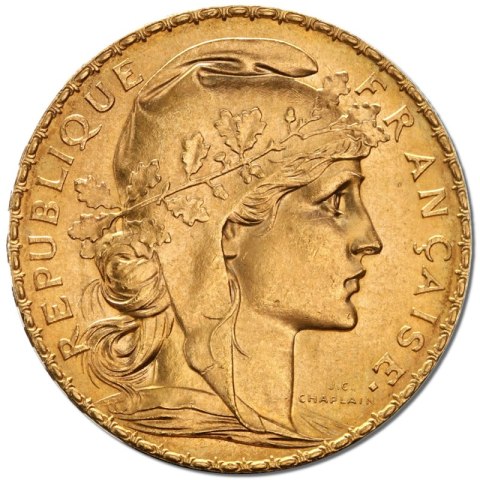
The Monnaie de Paris announced the competition for a new 20-franc design in 1895 — the design by Jules-Clément Chaplain (1839-1909) won and was accepted for production. The first trial issue was struck in 1898 (essai — trial coin), regular production began in 1899. The Chaplain design remained unchanged for the 16-year production (1899-1914) — all vintages have an identical portrait of Marianne in a Phrygian cap on the obverse and the Gallic rooster on the reverse. The artist's signature "J.C. CHAPLAIN" is visible on the obverse, under the portrait of Marianne.
The production of the 20-franc Marianne and Rooster was conducted exclusively at the Monnaie de Paris (mintmark "A" — historic Parisian mint, operating continuously since 864). Unlike the American Double Eagle (5 mints) or the German 20-mark coin (5 regional mints), the French 20-franc coin was centralised in a single capital mint — which corresponded to the centralised administrative tradition of republican France. All coins have the identical mintmark — they differ only in the year of striking (1899-1914) and minor mint features (cornucopia, torch — symbols of the mint's general engraver).
The total mintage of the 16-year production 1899-1914 exceeded 117 million pieces — making the 20-franc Marianne and Rooster the highest-mintage French LMU 20F. The highest mintages fell in the years 1908-1914 (12-15 million pieces per year) — France massively accumulated gold reserves in the face of mounting international tensions before the outbreak of World War I. The lowest mintages are in the years 1903-1907 (1-3 million pieces per year) — when production slowed due to a decline in domestic demand.
The outbreak of World War I in August 1914 ended the production of the French 20-franc Marianne and Rooster — the Bank of France suspended the convertibility of gold into paper currency (paper franc), and the gold was gathered in the national treasury as a strategic reserve of the warring state. After the war, the French gold currency was not restored — the Poincaré franc (1928) was a paper currency with significantly reduced gold parity value (one fifth of the pre-war germinal franc). The 20-franc Marianne and Rooster from 1899-1914 is the last French gold circulating coin of the LMU standard — a symbol of the end of the era of the European classical gold standard.
Obverse — Marianne in a Phrygian cap by Jules-Clément Chaplain (1899)
The obverse of the 20 French Francs Marianne and Rooster coin features the profile of Marianne — the allegory of the French Republic — facing right, in a Phrygian cap (cap of liberty). Marianne has long, flowing hair falling onto her shoulder, with a Phrygian cap on her head decorated with a band bearing the inscription REPUBLIQUE FRANÇAISE (French Republic). Around the portrait runs the inscription REPUBLIQUE FRANÇAISE in a semicircle from the top. The artist's signature "J.C. CHAPLAIN" is visible under the portrait, under Marianne's arm.
The obverse designer is Jules-Clément Chaplain (1839-1909) — French sculptor, medallist and engraver, one of the most important medallist artists of the Third French Republic. Chaplain was born in Mortagne-au-Perche and trained at the École des Beaux-Arts in Paris under Jouffroy. In 1863 he received the Prix de Rome (the highest French artistic award for young artists) — his stay at the Villa Médicis in Rome influenced his classicist portrait style. In 1881 he was elected a member of the Académie des Beaux-Arts (Section of Sculpture), in 1893 — Officier de la Légion d'Honneur. His works include commemorative medals of the 1889 Paris World Exhibition, portraits of distinguished politicians and artists of the Third Republic, and designs for circulating coins — including the 20-franc Marianne and Rooster (1898).
Marianne as the allegory of the French Republic first appeared after the French Revolution of 1789 — the proclamation of the First Republic on 22 September 1792 led to the need for a female symbol of the new form of government, in contrast to male monarchs. Originally the figure had no name — she was simply "the Republic" or "Liberty". The name "Marianne" began to be used from the Second Republic (1848-1851) — the most popular interpretation states that "Marie-Anne" was a very common female name in 18th-19th century France and became synonymous with an ordinary French republican woman. Marianne is the official state symbol of France — she appears on the state seal, postage stamps, coins and the French euro.
The Phrygian cap (bonnet phrygien) on Marianne's head — a key element of republican iconography — derives from ancient Rome, where the pileus libertatis (cap of liberty) was given to slaves freed from slavery as a symbol of newly acquired civic freedom. The Phrygian cap appeared in French revolutionary iconography in 1789 — sansculottes (Parisian revolutionaries) wore it during republican demonstrations. From 1792 (First Republic) it became the official symbol of republican freedom, retaining this status in the Second Republic (1848), Third Republic (1870-1940) and all subsequent French republics. On the coins of the Third Republic, Marianne is always depicted in a Phrygian cap — the Chaplain design (1898) continues this tradition.
Reverse — Gallic rooster (Gallus) with the motto LIBERTÉ EGALITÉ FRATERNITÉ
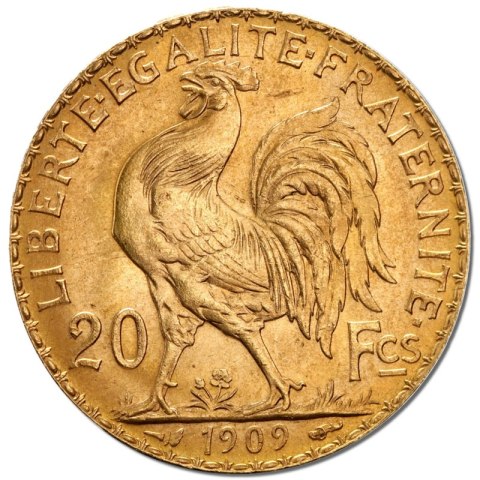
The reverse of the 20 French Francs Marianne and Rooster coin features the Gallic rooster (le Coq Gaulois, Gallus) standing in full profile to the left, with raised head and spread tail. Above the rooster runs the motto LIBERTÉ EGALITÉ FRATERNITÉ (Liberty, Equality, Fraternity) — the revolutionary slogan of 1789 — in three lines. Under the rooster appears the face value 20 FRANCS and the year of striking (e.g. 1909, 1912, 1914). The mintmark "A" (Paris) and the symbols of the general engraver are discreetly placed next to the date.
The Gallic rooster (le Coq Gaulois) is one of the most important symbols of France — it derives from a Latin pun: the word "gallus" in Latin means both "Gaul" (inhabitant of Gaul — pre-Roman France) and "rooster" (Gallus gallus, the domestic chicken). The Romans used this pun in antiquity as a humorous way of describing the Gauls. In the Middle Ages, the rooster symbol began to function as the emblem of France — the Gallic rooster was already present on royal seals in the 14th century (Charles V), although it was not an official state symbol.
The official status of the Gallic rooster as a symbol of France was established by the Third Republic (1870-1940) — the rooster replaced the Angel of Augustin Dupré as the reverse of the French 20-franc coin in 1898 (regular issue from 1899). The choice of the rooster for the reverse of the French gold circulating coin was a declaration of republican patriotism — the rooster is a symbol of vigilance, courage, national pride and valour (the rooster wakes at dawn and defends its territory). Today, the Gallic rooster is the official symbol of France in sport (French national teams in football, rugby, cycling use the rooster as an emblem), although the formal state coat of arms of France is the lictor's fasces (faisceau de licteur) on the republic's coat of arms.
The motto LIBERTÉ EGALITÉ FRATERNITÉ (Liberty, Equality, Fraternity) is the official motto of the French Republic — proclaimed during the French Revolution of 1789, introduced into the French constitution in 1848 (Second Republic), preserved by all subsequent French republics. On the reverse of the 20-franc Marianne and Rooster coin, the motto runs in a semicircle above the rooster — linking the symbol of France (rooster) with the fundamental values of the Republic (liberty, equality, fraternity). Together with the inscription REPUBLIQUE FRANÇAISE on the obverse, it forms a complete declaration of the republican identity of the coin — stronger than on earlier designs of the Second Empire (where the monarch's portrait dominated) or the Third Republic Angel (where the allegorical figure was iconographically neutral).
What to look out for when buying
Check the vintage of the 20 French Francs Marianne and Rooster coin — the issue was conducted for 16 years (1899-1914) with varying annual mintages. The highest-mintage are the years 1908-1914 (12-15 million pieces per year) — these are the most commonly encountered vintages in mixed years on the secondary market, with the lowest market premium (3-5% over spot). The rarest are the years 1903-1907 (1-3 million pieces) — they may have a collector value slightly higher than mixed years, but the difference is small due to the mass scale of the entire series (a total of 117 million pieces).
The market premium on 20 French Francs Marianne and Rooster typically holds in the range of 3-6% over spot — a very good historic premium for a French LMU 20F. Higher than Vreneli (2-5%, the cheapest LMU 20F) due to additional historic status (last French 20-franc coin before WWI) and richer iconography (Marianne + rooster + revolutionary motto). Lower than Helvetia (5-10%) or Leopold II (4-8%) due to the mass scale of production (117 million pieces vs about 4 million Helvetia). For an investment strategy (accumulation of historic gold with low premium), Marianne and Rooster offers the optimal balance.
Check the mint of striking — all 20-franc Marianne and Rooster coins are struck exclusively at the Monnaie de Paris (mintmark "A" — Paris, historic French mint operating since 864). The absence of the "A" mintmark or another mintmark most likely indicates a counterfeit or modern restrike. The Monnaie de Paris is the oldest operating financial institution in France — it has been striking circulating coins continuously since the times of Charles the Bald (9th century). The mint preserves a register of every official issue of the 20-franc coin from the 16-year production, enabling verification of the authenticity of a specific vintage.
Check the condition of the coin and authenticity — the 20-franc Marianne and Rooster coin in the 0.900 alloy is harder than pure 999.9 gold, but after 110-125 years since striking retains typical circulation traces: light wear, fine scratches, natural surface patina. For an investment strategy, VF (Very Fine) and EF (Extremely Fine) grades are acceptable — sufficient to confirm authenticity and gold content. AU (About Uncirculated) and UNC (Uncirculated) grades are sought after by collectors and have a higher premium. Each coin is delivered in an individual protective capsule to preserve the surface.
Why GoldInvest24
- Full cross-section of coins of European monetary unions of the 19th/20th centuries: in our catalogue you will find all 5 coins of package 108 — 20F Marianne and Rooster (France), 20F Cérès Second Republic (France), 10F Marianne and Rooster (France), 20 Lire Umberto I (Italy), 20 Kroner Frederik VIII (Denmark) — which allows building an LMU + SMU portfolio as a direct reference to 19th-century European monetary integration.
- Mixed years for optimal premium: 20F Marianne and Rooster offer in mixed-years format (various vintages 1899-1914) with a 3-6% premium over spot — the most popular French LMU 20F on the secondary market. For vintage collectors, specific vintages in AU/UNC grades are also available in the higher price range.
- PL / DE / EN language versions: full technical descriptions and specifications in three languages for convenient service of the Polish, German and international markets — particularly valuable for historic coins with numismatic terminology in three languages (French Marianne, German Marianne, English Marianne).
- Current precious-metals quotes: spot data for comparing offer prices with current market valuation — check the current precious-metals prices before purchase to assess the effective premium on historic LMU coins.
- Full precious-metal categories in one shop: access to gold investment coins, bars, silver, platinum and palladium — all from a single customer account, with full PL/DE/EN support.
Comparison of 5 coins in package 108 — Marianne and Rooster, Cérès II Rep., 10F Marianne, Umberto I, Frederik VIII
| Feature |
20F Marianne+Rooster (FR) |
20F Cérès II Rep. (FR) |
10F Marianne+Rooster (FR) |
20 Lire Umberto I (IT) |
20 Kroner Frederik VIII (DK) |
| Mintage years |
1899-1914 |
1848-1851 |
1899-1914 |
1879-1897 |
1908-1912 |
| Standard |
LMU 20F |
Pre-LMU 20F |
LMU 10F |
LMU 20F |
SMU 20 Kroner |
| Mint |
Monnaie de Paris (A) |
Monnaie de Paris (A) |
Monnaie de Paris (A) |
Rome Mint (R) |
Copenhagen Mint (♥) |
| Obverse |
Marianne in Phrygian cap |
Cérès with grain crown |
Marianne in Phrygian cap |
Umberto I (bearded) |
Frederik VIII (profile) |
| Designer |
Jules-Clément Chaplain |
Louis Merley |
Jules-Clément Chaplain |
Filippo Speranza |
Heinrich Goldschmidt |
| Gross mass |
6.4516 g |
6.4516 g |
3.2258 g |
6.4516 g |
8.9606 g |
| Pure gold |
5.80645 g |
5.80645 g |
2.9032 g |
5.80645 g |
8.0645 g |
| Fineness |
0.900 |
0.900 |
0.900 |
0.900 |
0.900 |
| Diameter |
21.0 mm |
21.0 mm |
19.0 mm |
21.0 mm |
23.0 mm |
| Typical premium |
3-6% |
5-10% |
8-15% |
5-10% |
6-12% |
See the entire gold investment coins category available at GoldInvest24.
FAQ — common questions about 20 French Francs Marianne and Rooster
What is the 20 French Francs Marianne and Rooster?
The 20 French Francs Marianne and Rooster (Coq) is a French historic gold coin of the Latin Monetary Union standard, struck at the Monnaie de Paris between 1899 and 1914 with a gross mass of 6.4516 g, a pure-gold mass of 5.80645 g, a 0.900 fineness and a 21.0 mm diameter. The obverse features the profile of Marianne in a Phrygian cap with the inscription REPUBLIQUE FRANÇAISE, the reverse the Gallic rooster with the motto LIBERTÉ EGALITÉ FRATERNITÉ and the face value 20 FRANCS. The designer of the pattern is Jules-Clément Chaplain (1839-1909). The most commonly encountered French LMU 20F — the last French 20-franc issue before World War I.
What is the technical specification of the 20 French Francs Marianne and Rooster?
Gross mass 6.4516 g (gold + copper), pure-gold mass 5.80645 g, 0.900 fineness (Au 90% + Cu 10%, Crown-Gold-style alloy), 21.0 mm diameter, approx. 1.3 mm thickness, face value 20 French francs. Mint: Monnaie de Paris (mintmark "A"). Obverse: Marianne in a Phrygian cap, REPUBLIQUE FRANÇAISE — Jules-Clément Chaplain. Reverse: Gallic rooster, LIBERTÉ EGALITÉ FRATERNITÉ, 20 FRANCS, year.
What is the history of the 20 French Francs Marianne and Rooster?
The Chaplain design was introduced in 1898 (regular issue 1899) as the third type of French 20-franc coin of the Third Republic — it replaced the Angel of Augustin Dupré (1871-1898). Struck at the Monnaie de Paris between 1899 and 1914 — the total mintage of over 117 million pieces makes it the highest-mintage French LMU 20F. Production ended with the outbreak of World War I (August 1914) — the Bank of France suspended gold convertibility. Marianne and Rooster is the last French gold circulating coin of the LMU standard.
How does 20F Marianne and Rooster differ from the other coins in package 108?
20F Marianne and Rooster (FR, 1899-1914) — the highest-mintage French LMU 20F (117 million pieces), premium 3-6%. 20F Cérès II Rep. (FR, 1848-1851) — short 4-year issue of the Second Republic, higher premium 5-10%. 10F Marianne and Rooster (FR, 1899-1914) — small LMU fraction (2.9032 g gold), higher premium 8-15%. 20 Lire Umberto I (IT, 1879-1897) — Italian LMU 20F, Rome Mint, premium 5-10%. 20 Kroner Frederik VIII (DK, 1908-1912) — Scandinavian Monetary Union SMU (not LMU), 8.0645 g gold, premium 6-12%.
For whom is 20F Marianne and Rooster a practical choice?
For individual investors looking for the classic French historic 20-franc LMU coin with very high secondary liquidity (highest-mintage French LMU 20F, premium 3-6%), for those building a portfolio of historic LMU 20F coins (Marianne and Rooster as the French core alongside the Swiss Vreneli), and for collectors interested in the period of the Third French Republic (1870-1940) and the last French gold issue before World War I.
What is the LBMA, VAT, CGT and IRA status of 20F Marianne and Rooster?
LBMA Good Delivery — NOT directly (historic coin, not a current bullion issue; the Monnaie de Paris has had the status historically, but current LBMA refers to ongoing production). VAT in the EU — EXEMPT (historic legal-tender coin, 0.900 fineness = minimum, struck after 1800, market price ≤180% of gold value — meets EU Directive 2006/112/EC Art. 344 and the Polish VAT Act Art. 122). CGT-free in the UK — NO (CGT-free status applies only to British legal tender). IRA-eligible in the USA — NO (the IRS admits only American coins and selected modern bullion).
How do I buy 20 French Francs Marianne and Rooster at GoldInvest24?
Place an order in our shop with access to the gold investment coins category, the full range of historic LMU 20-franc coins and coins of European monetary unions of the 19th/20th centuries (Marianne and Rooster, Cérès Second Republic, 10F Marianne and Rooster, 20 Lire Umberto I, 20 Kroner Frederik VIII). Check the current gold quotes to compare the premium against the current spot price. Technical descriptions and specifications are available in PL / DE / EN language versions.
![[{[item.product.name]}]]([{[item.product.photo.url]}] 75w)