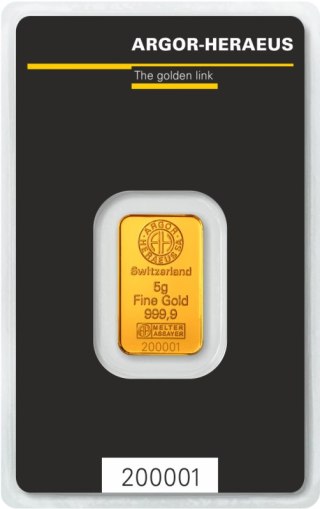
50 g Minted Gold Bar Argor-Heraeus — 999.9/1000 fineness, LBMA Good Delivery, assay card with serial number
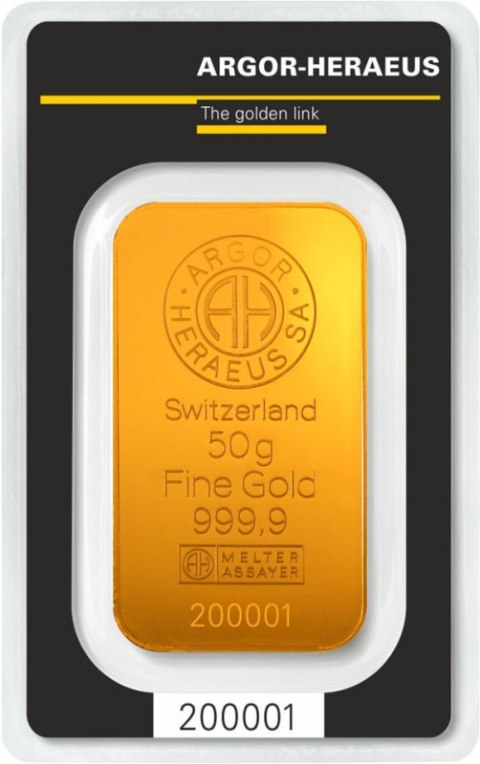
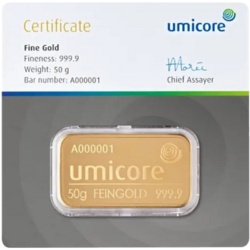
50 g of gold, 999.9/1000 fineness (.9999), in minted bar form from Argor-Heraeus SA — a Swiss refinery based in Mendrisio, Canton Ticino, founded in 1951 and LBMA Good Delivery accredited since 1961. Argor-Heraeus is part of Heraeus Holding GmbH — a German group with a precious metals processing tradition dating back to 1851. Each bar carries an individual serial number and is delivered in a blister with an assay card confirming weight, fineness, and authenticity.
The 50 g format is the second-largest denomination in the Argor-Heraeus minted series — a bar exceeding one and a half troy ounces (1.60750 oz t) with dimensions of 28.50 × 49.70 × 2.00 mm. At this weight, the percentage premium over the spot price reaches one of its lowest values across the entire minted product range. The 50 g bar is chosen by buyers building substantial bullion positions — it combines a low unit premium with a format still convenient enough for selective partial liquidation without splitting a single large bar.
Technical specification
| Parameter |
Value |
| Product type |
Gold bullion bar — minted |
| Producer / refinery |
Argor-Heraeus SA |
| Producer headquarters |
Mendrisio, Canton Ticino, Switzerland |
| Year founded |
1951 |
| Accreditation |
LBMA Good Delivery (gold) since 1961 |
| Precious metal |
Gold (Au) |
| Fineness |
999.9/1000 (.9999) |
| Weight |
50 g (1.60750 troy oz) |
| Dimensions |
approx. 28.50 × 49.70 × 2.00 mm |
| Form |
Minted bar with individual serial number |
| Surface |
Smooth, mirror-finish — standard minting technique |
| Packaging |
Blister with Argor-Heraeus assay card |
| Serial number |
Individual — stamped on bar and repeated on assay card |
| VAT |
Exempt (Council Directive 2006/112/EC, Art. 346) |
Why the 50 g Minted Gold Bar from Argor-Heraeus
The 50 g format ranks among the most cost-efficient denominations in the Argor-Heraeus range — the percentage premium approaches that of the 100 g format at half the financial outlay. Argor-Heraeus SA processes over 400 tonnes of gold annually and is one of the few entities worldwide holding simultaneous LBMA Good Delivery accreditation for gold, silver, platinum, and palladium. The assay card with serial number eliminates the need for additional verification upon resale. The 50 g bar is especially popular among buyers consolidating their bullion portfolio — it allows accumulating more metal in fewer units, simplifying storage and record-keeping while retaining full selling flexibility.
Argor-Heraeus SA — over seven decades of precious metal refining
The Argor-Heraeus SA refinery was founded in 1951 in Mendrisio, Canton Ticino, southern Switzerland. It initially operated as Argor SA, offering gold and silver refining for the Swiss banking sector. In 1999, a merger with the precious metals division of Heraeus Holding GmbH — a German industrial group with a tradition dating back to 1851 — created the present-day corporate structure. The company is part of the Heraeus group and ranks among the world's largest gold processors, with an annual refining capacity exceeding 400 tonnes.
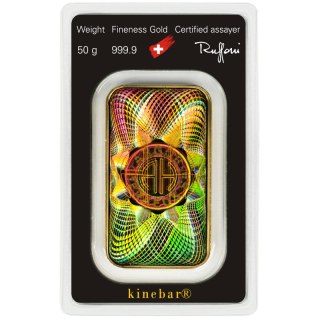
Argor-Heraeus obtained LBMA Good Delivery accreditation for gold in 1961 — just a decade after its founding. The refinery also holds LBMA accreditations for silver, platinum, and palladium, as well as Responsible Jewellery Council (RJC) certification and compliance with the LBMA Responsible Gold Guidance. The product portfolio includes minted bars (1 g — 100 g), cast bars in larger formats, and the Kinebar series featuring a KineGram hologram as an additional anti-counterfeiting measure.
Minting technology — precision and production consistency
The Argor-Heraeus minted series comprises bars produced by precision die stamping from a gold strip of 999.9/1000 fineness. The process begins with casting gold refined to .9999 purity, which is then rolled into a thin strip of precisely controlled thickness. Blanks of target weight are cut from the strip, and each blank is stamped in a die to form a rectangular bar bearing the Argor-Heraeus logo, weight designation, fineness marking, and individual serial number.
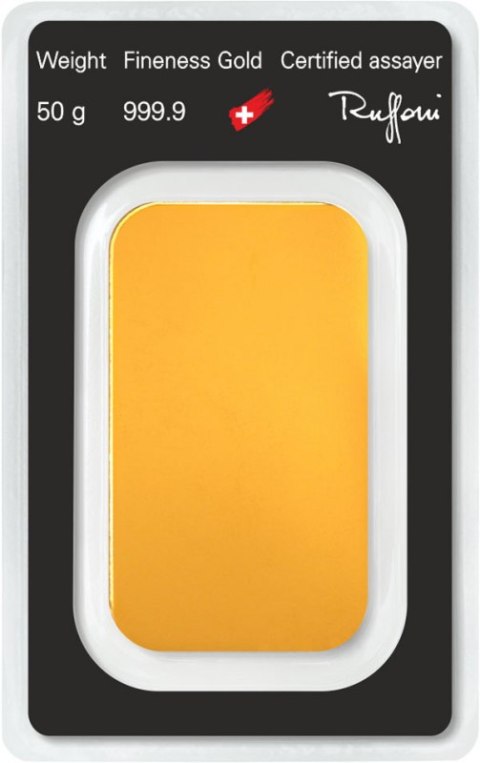
The obverse features the characteristic smooth, mirror-like surface typical of the minting technique. Each bar is placed in a manufacturer's protective blister with an assay card. The blister protects the product from environmental contact and mechanical damage while allowing visual verification without opening the packaging. Unlike the Kinebar series, minted bars do not feature a KineGram hologram — their authenticity relies on the serial number, assay card, and manufacturer's hallmark.
Denominations in the Argor-Heraeus minted series
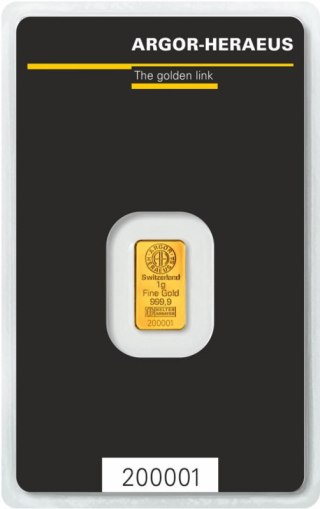
The minted series encompasses seven denominations: 1 g, 2 g, 5 g, 10 g, 20 g, 50 g, and 100 g. Each format is delivered in the same finish with serial number and assay card. The manufacturer also offers the parallel Kinebar line with KineGram hologram and cast bars from 50 g upwards. Explore the full selection of gold bullion bars at GoldInvest24.
The 50 g format opens the large-denomination segment — from this point Argor-Heraeus offers both minted and cast variants. The minted 50 g bar retains the mirror finish and dimensional precision of the die-stamping technique, while the cast variant has a rougher, industrial texture. The percentage premium at 50 g is close to that of 100 g — the difference is often minimal, making 50 g an attractive alternative for buyers preferring a lower one-time outlay. Current gold quotes on the precious metals prices page.
What to look for when buying a 50 g bar
Packaging completeness — the bar should be in its original, unopened manufacturer blister with assay card. The serial number stamped on the bar must match the number on the assay card. Given the significant unit value of a 50 g bar, confirming authorised distribution chain origin is important. The 50 g format offers a premium close to 100 g at lower financial outlay — one of the best cost-efficiency options in the large-denomination segment.
Why GoldInvest24
GoldInvest24 offers exclusively original Argor-Heraeus bars with full manufacturer packaging and assay card. Every product originates from the authorised distribution chain and is backed by an authenticity guarantee. Insured shipping in discreet packaging ensures safe delivery. Explore also gold bullion coins and silver bullion bars available in the store.
Comparison of Argor-Heraeus minted bars — 5 g to 100 g
| Denomination |
Dimensions (mm) |
Troy ounces |
Fineness |
Accreditation |
| 5 g |
14 × 23 × 0.5 |
0.16075 |
999.9 |
LBMA Good Delivery |
| 10 g |
27 × 15 × 0.7 |
0.32150 |
999.9 |
LBMA Good Delivery |
| 20 g |
31 × 18 × 1.1 |
0.64300 |
999.9 |
LBMA Good Delivery |
| 50 g |
28.50 × 49.70 × 2.00 |
1.60750 |
999.9 |
LBMA Good Delivery |
| 100 g |
31 × 54 × 3 |
3.21507 |
999.9 |
LBMA Good Delivery |
Frequently asked questions — 50 g Minted Gold Bar Argor-Heraeus
Is the 50 g Argor-Heraeus gold bar VAT-exempt?
Yes. The bar meets the definition of gold bullion (minimum 995/1000 fineness, market-accepted weight) and is exempt from VAT under Council Directive 2006/112/EC (Art. 346). The buyer pays only the net product price.
What is an assay card and what is its purpose?
An assay card is a manufacturer's certificate confirming the bar's weight, fineness, and authenticity. The serial number on the card matches the number stamped on the bar. The Argor-Heraeus assay card is crucial for resale — its absence may require additional verification, reducing secondary-market liquidity.
What is the difference between a minted 50 g and a cast 50 g bar?
Both variants contain identical 50 g of 999.9/1000 gold with LBMA accreditation. The difference lies in manufacture and finish: the minted bar is die-stamped from a gold strip, featuring a smooth, mirror-like surface. The cast bar is formed by pouring molten gold into a mould, resulting in a rougher, industrial texture. The minted variant may carry a marginally higher premium due to its more complex production process.
What is the difference between the minted and Kinebar series?
The minted series comprises standard bars with a smooth, mirror-like surface, serial number, and assay card. The Kinebar series differs by featuring an additional KineGram hologram on the reverse — a dynamic security element that changes its pattern with the viewing angle. Both share identical 999.9/1000 fineness and LBMA accreditation.
Is one 50 g bar better than several smaller bars totalling 50 g?
A single 50 g bar offers the lowest total premium — production and certification costs fall on one unit. Splitting into smaller formats increases flexibility for partial liquidation but raises the total premium. For long-term positions, the single bar is more cost-efficient.
How should 50 g Argor-Heraeus bars be stored?
Bars should be kept in the original manufacturer blister. Given the considerable metal value of a 50 g bar, a safe rated at least class 0 (EN 1143-1) or a bank deposit box is essential. Home insurance should include a precious metals clause with adequate coverage. Alternatively, professional vaults offer allocated storage with full insurance.
How many troy ounces does a 50 g bar contain?
A 50 g bar contains 1.60750 troy ounces (1 oz t = 31.1035 g). That is over one and a half troy ounces — the standard trading unit for precious metals on global exchanges (LBMA, COMEX, SGE).