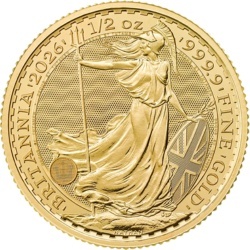
1/2 oz Krugerrand Gold Coin 2025 - Crown Gold 22 karat (916.7/1000) in the 1/2 oz segment, oldest modern gold bullion coin since 1967
The Krugerrand 1/2 oz is a South African gold bullion coin minted by the South African Mint in Pretoria from gold refined by Rand Refinery in Germiston. The coin contains 15.55 g of pure gold in Crown Gold alloy of 916.7/1000 fineness (22 karat) - gross mass of the coin is 16.97 g (15.55 g Au + 1.42 g Cu). The Krugerrand is the oldest modern gold bullion coin in the world - issued since 1967, currently 59 years of tradition.
The price of 1/2 oz Krugerrand 2025 is linked to the current gold price at LBMA with market premium of 5-7% over spot - the lowest in the 1/2 oz bullion coin segment (vs Maple Leaf 6-8%, Britannia 7-10%, American Eagle 8-12%). Rand Refinery has LBMA Good Delivery status since 1965 - one year preceding the issuance of the first Krugerrand 1 oz in 1967. The 1/2 oz variant was added to the offer in 1980 along with 1/4 oz and 1/10 oz.
Technical specification 1/2 oz Krugerrand Gold Coin 2025
| Parameter |
Value |
| Gold weight (Au) |
15.55 g (0.500 troy oz) |
| Gross weight |
16.97 g (Crown Gold: 15.55 g Au + 1.42 g Cu) |
| Fineness |
916.7/1000 (22 karat, Crown Gold) |
| Diameter |
27 mm |
| Thickness |
2.2 mm |
| Face value |
No face value (Krugerrand is legal tender in RSA without digital denomination) |
| Obverse |
Paul Kruger - design Otto Schultz (since 1892, adapted 1967) |
| Reverse |
Springbok (Antidorcas marsupialis) - design Coert Steynberg (since 1947, adapted 1967) |
| Producer |
South African Mint (Pretoria) from Rand Refinery gold (Germiston) - since 1965 |
| Security features |
No optical (Krugerrand relies on recognizability of weight/diameter/color) |
| Packaging |
Individual capsule |
| Status |
LBMA Good Delivery (Rand Refinery since 1965) |
| VAT |
Exempt (Council Directive 98/80/EC across EU) |
Why this coin?
- 15.55 g of pure gold in Crown Gold alloy 22 karat (916.7/1000) - classical British monetary alloy
- 59 years of bullion tradition (1967-2026) - oldest modern bullion coin in the world
- Crown Gold (Au + Cu) - better mechanical resistance than .9999 (lower risk of scratches and fingerprints)
- Premium 5-7% over spot - the lowest in the 1/2 oz bullion coin segment
- Springbok by Coert Steynberg (1947) + Paul Kruger by Otto Schultz (1892) - two classical RSA numismatic icons
History of Krugerrand - 59 years of tradition 1967-2026
Krugerrand was introduced in 1967 by the South African Mint and Rand Refinery as the first modern gold bullion coin in the world. The name of the coin comes from the combination: "Kruger" (Paul Kruger, President of the Transvaal 1883-1900) + "rand" (South African currency introduced 1961). The 1967 premiere included only the 1 oz variant (33.93 g gross, 31.103 g Au, diameter 32.77 mm). In 1980 the South African Mint expanded the offer to include three fractions: 1/2 oz, 1/4 oz and 1/10 oz.
Rand Refinery was founded in 1920 in Germiston (Gauteng province, RSA) - currently one of the largest gold refineries in the world. LBMA Good Delivery status obtained in 1965, two years before the Krugerrand's inauguration. South African Mint is the state mint of RSA - issues the Krugerrand exclusively from Rand Refinery gold since 1967.
Crown Gold is a historic British monetary alloy introduced in 1526 by Henry VIII as the standard for British gold coins. Composition: 11/12 Au (916.7/1000) + 1/12 Cu (83.3/1000) - copper adds hardness and scratch resistance. The Krugerrand inherits this alloy from British Sovereign coins (1817-1932). Practical implication: Krugerrand is mechanically more durable than .9999 coins (Maple Leaf, Britannia 2013+, Philharmonic), which are soft and prone to scratches.
Krugerrand is legal tender in RSA without digital face value - the market value always equals the current gold price plus premium. This is a unique status among bullion coins (Maple Leaf 20 CAD, Britannia 25 GBP, Eagle 25 USD, Philharmonic 50 EUR have digital face values significantly below metal value). In 2017 - to celebrate the 50th anniversary - a special series of silver Krugerrand 1 oz was issued; in 2019 platinum Krugerrand was added; in 2020 - palladium.
Obverse - Paul Kruger by Otto Schultz
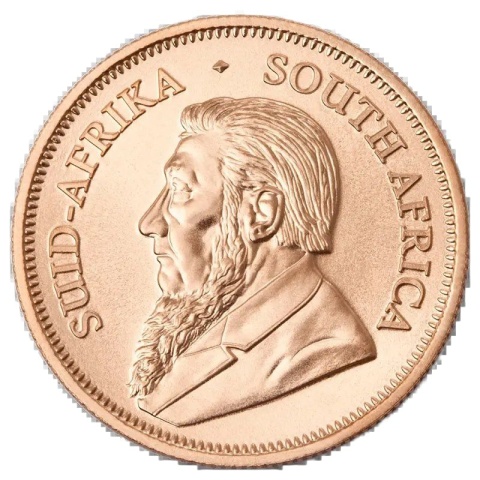
The obverse of the Krugerrand depicts Paul Kruger (1825-1904), President of the Republic of the Transvaal (1883-1900), a heroic figure of South African history. The portrait was designed by Otto Schultz in 1892 for Transvaal coins - the original portrait from the end of the 19th century, adapted for the Krugerrand in 1967. Around the portrait the inscription "SUID-AFRIKA SOUTH AFRICA" (Republic of South Africa in Afrikaans and English).
Paul Kruger was the leader of the Boer resistance against British dominance in the Second Boer War (1899-1902). His portrait on the Krugerrand represents Afrikaner national pride and political independence from colonial Great Britain. The Schultz portrait is one of the longest-used portraits on bullion coins (134 years of history: 1892-2026).
Reverse - springbok by Coert Steynberg
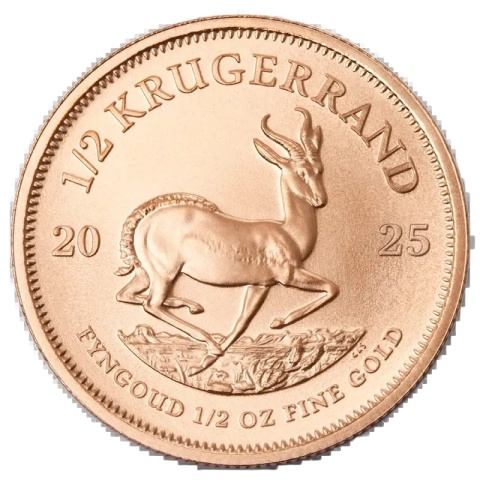
The reverse of the Krugerrand depicts a springbok (Antidorcas marsupialis) - an antelope endemic to southern Africa, national symbol of RSA. The springbok was designed by South African sculptor Coert Steynberg (1905-1982) in 1947 for the state 5 shilling coin - 20 years before the adaptation for the Krugerrand in 1967. Around the springbok the inscription "KRUGERRAND" (upper field) and year of minting (lower field, "2025" for this coin).
The springbok is characteristic of the Karoo and Kalahari plains in RSA - an antelope with white underbelly, brown upper body and a characteristic dark stripe on the side line of the body. The name "springbok" comes from its behavior - the antelope makes vertical jumps 2-3 meters (called "pronking" in English) when alarmed. Coert Steynberg was an outstanding South African classical sculptor.
What to consider when buying 1/2 oz Krugerrand 2025?
First: mechanical resistance of Crown Gold. Unlike .9999 coins (Maple Leaf, Britannia 2013+), the Krugerrand 916.7/1000 is mechanically more durable due to the copper alloy. It can be held in the hand without special gloves (although still recommended), without significant fingerprint risk in the mirror field.
Second: integrity of the individual capsule. Krugerrand 1/2 oz is standardly delivered in a South African Mint plastic capsule. Despite the greater durability of Crown Gold, keep the capsule for collectible value - the original packaging maintains resale value at the maximum level.
Third: premium 5-7% - the lowest in the 1/2 oz segment. Krugerrand 1/2 oz is mathematically the cheapest 1/2 oz bullion format on the market. For cost-optimal accumulation strategies of the 1/2 oz fraction - Krugerrand is the first choice. Fourth: no optical security features - verification relies on recognizability of weight, diameter 27 mm, characteristic color (reddish gold from copper - differs from the .9999 gold of Maple Leaf or Britannia). Weight and diameter are verifiable with laboratory scale (to 0.01 g) and caliper (to 0.1 mm).
Why GoldInvest24?
- Producers with LBMA accreditation - wide selection of mints and refineries in one shop
- Full metal categories in one shop of coins and bars
- Language versions PL / DE / EN for buyers across the EU
- Access to current precious metal prices in real time
- Secure courier shipment with full insurance and discreet packaging
1/2 oz Krugerrand vs competition 1/2 oz gold coins
| Feature |
Krugerrand 1/2 oz |
Maple Leaf 1/2 oz |
Britannia 1/2 oz |
Philharmonic 1/2 oz |
American Eagle 1/2 oz |
| Fineness |
916.7/1000 (22 kt, Crown Gold) |
999.9/1000 (.9999) |
999.9/1000 (.9999) |
999.9/1000 (.9999) |
916.7/1000 (22 kt) |
| Gold mass |
15.55 g (16.97 g gross) |
15.55 g |
15.55 g |
15.55 g |
15.55 g (16.97 g gross) |
| Producer |
SA Mint / Rand Refinery |
Royal Canadian Mint |
Royal Mint UK |
Munze Osterreich |
US Mint |
| Tradition |
Since 1967 (59 years) |
Since 1979 (47 years) |
Since 1987 (39 years) |
Since 1989 (37 years) |
Since 1986 (40 years) |
| Mechanical resistance |
High (Crown Gold + Cu) |
Low (.9999 soft) |
Low (.9999 soft) |
Low (.9999 soft) |
High (22 kt + Cu/Ag) |
| Premium 1/2 oz |
5-7% (lowest) |
6-8% |
7-10% |
7-9% |
8-12% |
Frequently asked questions (FAQ)
What is 1/2 oz Krugerrand 2025?
A South African gold bullion coin minted by the South African Mint in Pretoria from gold refined by Rand Refinery. Contains 15.55 g (0.5 troy oz) of pure gold in Crown Gold alloy 22 karat (916.7/1000) - gross mass 16.97 g. Obverse: Paul Kruger (Otto Schultz, 1892). Reverse: springbok (Coert Steynberg, 1947). No digital face value (legal tender without nominal value). Oldest modern bullion coin in the world (since 1967).
What are the technical parameters of 1/2 oz Krugerrand 2025?
Gold weight: 15.55 g (0.500 troy oz). Gross weight: 16.97 g. Fineness: 916.7/1000 (22 karat). Diameter: 27 mm. Thickness: 2.2 mm. No digital face value. Obverse: Paul Kruger (Otto Schultz 1892). Reverse: springbok (Coert Steynberg 1947). Producer: SA Mint / Rand Refinery (LBMA since 1965). Packaging: individual capsule.
Who are Otto Schultz and Coert Steynberg?
Otto Schultz - graphic artist and medalist from the end of the 19th century, designed the Paul Kruger portrait in 1892 for Transvaal coins. Coert Steynberg (1905-1982) - outstanding South African classical sculptor, designed the springbok in 1947 for the RSA 5 shilling coin. Both designs were adapted for the Krugerrand in 1967.
Krugerrand 1/2 oz vs Maple Leaf 1/2 oz - what to choose?
Both coins: 15.55 g gold mass. Differences: (a) fineness (Krugerrand 916.7/1000 Crown Gold, Maple Leaf 999.9/1000), (b) mechanical resistance (Krugerrand high due to copper, Maple Leaf low), (c) premium (Krugerrand 5-7%, Maple Leaf 6-8%), (d) tradition (Krugerrand 59 years 1967-2026, Maple Leaf 47 years 1979-2026), (e) security features (Krugerrand none, Maple Leaf Bullion DNA + radial). For cost-optimal accumulation: Krugerrand. For highest fineness and modern security features: Maple Leaf.
Who is 1/2 oz Krugerrand for?
The 1/2 oz Krugerrand fraction suits buyers seeking the cheapest 1/2 oz bullion coin on the market (premium 5-7%, vs Maple Leaf 6-8%). Additionally for buyers valuing the mechanical resistance of Crown Gold (better than .9999), a classical numismatic icon with 59-year tradition, and the absence of electronic security features (pure coin relying on recognizability of weight/diameter/color).
Is 1/2 oz Krugerrand VAT-exempt in the EU?
Yes - 916.7/1000 fineness exceeds the 900/1000 minimum required for VAT exemption on coins minted after 1800 (Council Directive 98/80/EC across EU). Krugerrand is legal tender in RSA. Krugerrand is also IRA-eligible in the US (US IRC 408m).
How to buy 1/2 oz Krugerrand at GoldInvest24?
The coin is available in the gold investment coins category alongside the full fractional Krugerrand series (1 oz, 1/2 oz, 1/4 oz, 1/10 oz). Dynamic price from current precious metal prices at LBMA. Shop in PL / DE / EN, silver Krugerrand 1 oz, platinum (since 2019) and palladium (since 2020).
![[{[item.product.name]}]]([{[item.product.photo.url]}] 75w)