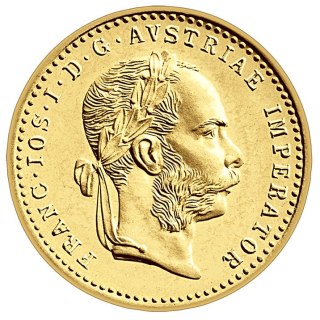
1 Ducat Austria Original Gold Coin — historic original of the Austrian Empire/Austria-Hungary 1872-1915 with the portrait of Franz Joseph I
The 1 Ducat Austria Original gold coin is an original historic issue of the Austrian Empire and the Austro-Hungarian monarchy from the years 1872-1915 — struck at Münze Österreich (Vienna Mint) with a gross mass of 3.4909 g, a pure-gold mass of 3.4421 g, a fineness of 986/1000 (classic Dukatengold, 23.75 carats), 19.75 mm diameter and a face value of 1 ducat as historic legal tender of Austria-Hungary. Original (Originalprägung) ducats bear different annual issue dates (1872, 1880, 1900, 1910, 1915, etc.) and have higher collector value than restrikes — typical market premium 4-8% over spot for mixed years. The obverse features the portrait of Franz Joseph I (design by Anton Scharff, 1872), the reverse — the Habsburg double-headed eagle. The coin is VAT-exempt in the EU as a historic legal-tender coin with a fineness ≥900/1000 struck after 1800.
Technical specification
| Parameter |
Value |
| Manufacturer |
Münze Österreich (Vienna) — Austrian Mint, established 1194 |
| Series |
1 Ducat Austria — Originalprägung (historic original circulation issue) |
| Mintage years |
1872-1915 (originals of the Austrian Empire and Austria-Hungary) |
| Standard |
Dukatengold — established 1612 by Matthias II of Habsburg |
| Gross mass |
3.4909 g (gold + small amount of copper) |
| Pure gold mass |
3.4421 g |
| Fineness |
0.986 fineness (23.75 carats, classic Dukatengold) |
| Diameter |
19.75 mm |
| Thickness |
approx. 1.1 mm |
| Face value |
1 ducat — historic legal tender of the Austrian Empire/Austria-Hungary |
| Obverse |
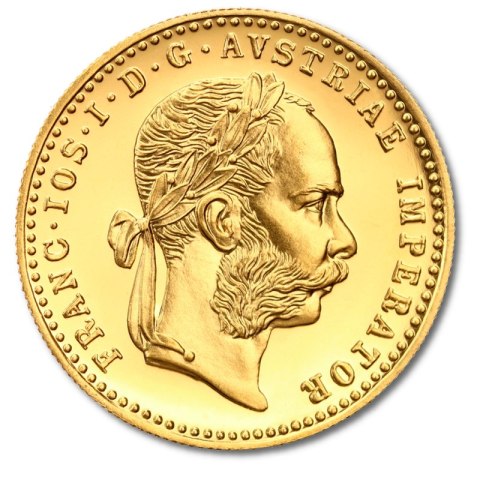
Portrait of Franz Joseph I — Anton Scharff (1872), FRANC IOS I D G AVSTRIAE IMPERATOR |
| Reverse |
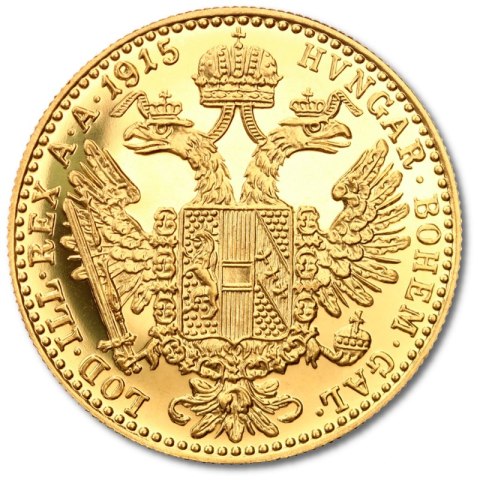
Imperial Habsburg double-headed eagle, HVNGAR BOHEM GAL LOD ILL REX AA, year of mintage (1872-1915) |
| LBMA status |
Münze Österreich LBMA Good Delivery-accredited since 1962 |
| VAT in the EU |
Exempt (legal-tender coin, fineness 986, struck after 1800, EU Directive 2006/112/EC Art. 344) |
| UK status |
NOT CGT-free (CGT exemption applies only to British legal tender) |
| USA status |
NOT IRA-eligible (IRS admits only American coins and selected bullion) |
| Packaging |
Individual protective capsule |
Why 1 Ducat Austria Original deserves a place in your portfolio
- Original historic issue 1872-1915 — collector value beyond gold value: original ducats are original issues of the Austrian Empire and Austria-Hungary from 1872-1915 — each coin has an authentic annual date and historic origin from the Habsburg monarchy. Unlike restrikes, originals bear production dates (1872, 1880, 1900, 1910, 1915) and may have additional collector value tied to a specific vintage, mint and mintage.
- Classic Dukatengold standard 986/1000 — highest fineness of historic European gold coins: The 986/1000 fineness (23.75 carats) established in 1612 by Matthias II of Habsburg — one of the highest finenesses among historic European coins. The ducat as an international trade coin preferred in 18th-19th century commerce due to high purity (above 900/1000 LMU and 916/1000 British sovereigns).
- Market premium 4-8% over spot for mixed years — a compromise between original and cost: original-issue ducats have a higher premium than restrikes (3-5%) due to the collector value of the original historic issue. For mixed years (various 1872-1915 dates mixed in sale), the 4-8% premium is the market standard — individual rare vintages (low-mintage, collectable) may carry a higher numismatic premium of +20-50% over mixed years.
- Witness to the Franz Joseph I era — history in a coin: Original ducats 1872-1915 were struck during the reign of Franz Joseph I (the longest Habsburg reign, 1848-1916) covering key historic events: Ausgleich 1867 (Austro-Hungarian compromise), currency reform 1892 (introduction of the crown), First World War 1914-1918. The last mintage years (1914, 1915) are historically particularly valuable — they were struck during the war that led to the fall of the monarchy.
- Münze Österreich LBMA Good Delivery — authenticity guarantee: The Vienna Mint, as producer of the originals 1872-1915, holds LBMA Good Delivery accreditation since 1962 — the highest international refining standard. Originals bear mint marks of the Habsburg era (signature of medallist Anton Scharff, 1872-1915 mint markings), which enables authenticity verification with a numismatic expert and a gold dealer.
History of the Austrian ducat — from Matthias II of Habsburg to the fall of the monarchy
The ducat — a medieval gold coin introduced in Venice in 1284 (ducato d'oro) — became, over more than 700 years, the main standard European trade coin. The Austrian ducat was introduced in 1612 by Emperor Matthias II of Habsburg (reign 1612-1619), with a 986/1000 fineness (23.75 carats) — higher than most European ducats of the era. The Dukatengold standard (986) was preserved over more than 300 years of continuous production unchanged — a phenomenon unparalleled in European monetary history, where coin finenesses generally fell over time due to fiscal pressures of rulers.
In the period 1612-1872, the Vienna Mint struck ducats of successive Habsburgs — Matthias II, Ferdinand II, Leopold I, Charles VI, Maria Theresa, Joseph II, Leopold II, Francis II/I (Emperor of Austria from 1804), Ferdinand I and Franz Joseph I. Each issue retained the Dukatengold standard (986/1000), differing only in the portrait of the monarch on the obverse and minor stylistic modifications. Ducats were the primary currency of international trade — preferred in trade with the Levant, the Balkans, Italy, Germany and the Netherlands. In the 18th-19th centuries, the Austrian ducat functioned alongside the Dutch ducat and the Venetian ducat as a Central European trade standard.
The 1872 reform introduced new ducat designs (1 and 4 ducats) designed by Anton Scharff (1845-1903), chief medallist of the Vienna Mint at the end of the 19th century. The 1872 design — portrait of older Franz Joseph I (with beard and moustache) on the obverse, Habsburg double-headed eagle on the reverse — became the standard for all subsequent issues 1872-1915 and Münze Österreich restrikes 1920-present. The 1872 reform was technical (unification of dies, modernisation of production) and did not change the Dukatengold standard established in 1612.
In 1892 the Austro-Hungarian monetary reform took place — introduction of the Austro-Hungarian crown (1 gulden = 2 crowns) as the main currency of the monarchy. The ducats, however, remained in production as a trade coin parallel to the crown — fulfilling the function of a gold reserve for citizens and an international currency for foreign trade. In the period 1892-1915, ducats were struck in lower mintages than before, but constantly present in circulation. The last original ducats were struck in 1915 — during the First World War, when Austria-Hungary mobilised gold reserves for war needs.
After the fall of the monarchy in 1918, the production of original ducats ended definitively. The Republic of Austria decided in 1920 to restart ducats with the date 1915 as a fixed inscription — which preserved production continuity, but formally closed the period of original issues 1872-1915. Today, original ducats with various annual dates 1872-1915 are available on the secondary market in grades from F (Fine) to UNC (Uncirculated), with various market premiums depending on vintage, mintage, preservation grade and historic significance of the specific issue.
Obverse — portrait of Franz Joseph I (1830-1916)
The obverse of the 1 Ducat Austria Original coin features the portrait of Franz Joseph I (1830-1916, reign 1848-1916) — the longest-reigning Habsburg (68 years on the throne). The emperor is shown in right profile, with beard and moustache — in the style known from official portraits of the late 19th century. Around the portrait is the Latin inscription FRANC IOS I D G AVSTRIAE IMPERATOR — "Franz Joseph I, by the Grace of God Emperor of Austria" — the standard titular formula used on Austrian coins since the 1872 reform.
The designer of the 1872 obverse design is Anton Scharff (1845-1903) — Viennese medallist and engraver. Scharff designed the obverse with the portrait of Franz Joseph at the age of 42 (1872) — as a mature emperor with the authority of power. Earlier ducat issues (before 1872) presented the portrait of younger Franz Joseph (bare head, without beard) from various periods of his reign from 1848. The 1872 reform unified the portrait as the older head, with beard — and this design dominates production 1872-1915.
Franz Joseph I (Franciscus Iosephus) ascended the throne of the Austrian Empire on 2 December 1848 at the age of 18 — during the Spring of Nations, when his uncle Ferdinand I abdicated in favour of the young Franz Joseph. He reigned 68 years (1848-1916) — the longest in Habsburg history and one of the longest-reigning European monarchs. He went through key historic events: loss of Lombardy (1859), loss of Venetia (1866), Ausgleich 1867 (Austro-Hungarian compromise creating the dualistic monarchy), currency reform 1892, the Sarajevo assassination 1914 (assassination of heir to the throne Franz Ferdinand) and the First World War 1914-1918. He died on 21 November 1916 in Schönbrunn, two years before the fall of the monarchy.
The obverse inscription FRANC IOS I D G AVSTRIAE IMPERATOR (Franciscus Iosephus I Dei Gratia Austriae Imperator) is the standard formula used on Austrian coins since the 1872 reform. The abbreviated form "FRANC IOS I" means Franz Joseph I, "D G" — "Dei Gratia" (by the Grace of God) — the traditional titulature of European monarchs harking back to the medieval theory of the origin of power. "AVSTRIAE IMPERATOR" — Emperor of Austria — is the central title on the obverse, while the full Austro-Hungarian monarch's title (covering Hungary, Bohemia, Galicia, Illyria) is on the reverse of the coin.
Reverse — imperial Habsburg double-headed eagle
The reverse of the 1 Ducat Austria Original coin features the imperial Habsburg double-headed eagle (Doppeladler) — symbol of the Austrian Empire since 1804 and the Austro-Hungarian monarchy since 1867 (after the Ausgleich). The eagle is depicted with two heads turned in opposite directions, crowns above each head, sceptres and a sword in the talons, and smaller arms of the Habsburg states on the shield. The reverse also bears the annual date of issue (different for each vintage 1872-1915) and the inscription HVNGAR BOHEM GAL LOD ILL REX AA.
The two heads of the eagle symbolise the two parts of the dualistic Austro-Hungarian monarchy — the Austrian Empire (eastern head, facing right) and the Kingdom of Hungary (western head, facing left) — joined into a single state organism under one monarch (Franz Joseph I), but with separate administrations, parliaments and partly separate armies. Each head has its own crown: the crown of the Austrian Empire (Hauskrone of Rudolf II from 1602) and the Crown of Saint Stephen (the Crown of the Kingdom of Hungary from the 10th century). The sceptres in the eagle's talons represent imperial (right) and royal (left) authority.
The inscription HVNGAR BOHEM GAL LOD ILL REX AA — the Latin abbreviation Hungariae Bohemiae Galiciae Lodomeriae Illyriae Rex, Archidux Austriae — means "King of Hungary, Bohemia, Galicia, Lodomeria, Illyria, Archduke of Austria". It is the abbreviated title of Franz Joseph I covering the main Habsburg states: Hungary (Hungaria, second part of the dualistic monarchy), Bohemia (Bohemia, the wealthiest industrial region of the monarchy), Galicia and Lodomeria (Austrian province of Poland, today's southern Poland and western Ukraine, including Lviv and Krakow), Illyria (Slovenia, Croatia, parts of Dalmatia). The full imperial title was significantly longer (covered dozens of provinces and titles), abbreviated on coins to the most important parts.
The annual date on the reverse — the most important distinguishing feature between the vintages of original ducats 1872-1915. The most commonly encountered vintages in secondary trade are the years 1880-1910 — with the highest mintages. Rarer are the early vintages (1872-1880) and the late ones (1912-1915, lower mintages due to wartime mobilisation). Some vintages have significantly higher collector value — for example 1872 (first issue after the reform), 1879 (silver imperial wedding anniversary), 1908 (60th anniversary of Franz Joseph's reign). For an investment strategy, mixed years are optimal; for vintage collectors, specific issues may be available in the higher price range.
What to look out for when buying
Check vintage authenticity — original ducats 1872-1915 bear different annual dates on the reverse. Specific collector vintages (low-mintage, anniversary, last issues 1914-1915) may have a numismatic premium of +20-50% over mixed years, depending on the preservation grade (F, VF, EF, AU, UNC). For an investment strategy (gold purchase as a store of value), mixed years are optimal due to the lowest unit cost in the segment of original ducats.
The market premium on Austrian original ducats typically holds in the range of 4-8% over spot for mixed years — higher than on restrikes (3-5%), but lower than on fractional bullion coins (8-15%). The higher premium on originals reflects the collector value of the original historic issue, acquisition costs (secondary market, individual auctions), counterfeiting risk and the need for authenticity verification with an expert. For an investor focused exclusively on bullion, the restrike (Nachprägung) is a cheaper alternative with identical gold content.
Check the preservation grade of the coin — original ducats 1872-1915 spent 100-150 years in circulation and retain typical circulation traces: light wear, fine scratches, natural patina. F (Fine) and VF (Very Fine) grades are typical for mixed years; EF (Extremely Fine), AU (About Uncirculated) and UNC (Uncirculated) grades are sought after by collectors and have a higher premium. For an investment strategy, F-VF grades are acceptable — sufficient to confirm authenticity and gold content. Each coin is delivered in an individual protective capsule.
Check the manufacturer — all authentic original ducats come from Münze Österreich (Vienna) from the period 1872-1915. Ducats struck at Karlsburg (Alba Iulia, for Transylvania) earlier (before 1872) have a different status. Restrikes from various East European mints (most often from the 1990s-2000s) are illegal copies even if they have the correct 986 fineness and weight. Safe purchase from a certified gold dealer with documentation for later resale is the foundation for original historic circulation coins.
Why GoldInvest24
- Full offer of Austrian historic Münze Österreich coins: our catalogue features all key Austrian issues — 1 and 4 ducats (Quadruple ducat), 20 and 100 crowns, both in original (1872-1915 originals) and restrike (1915-dated restrike) variants. A full cross-section allows building a balanced Habsburg gold portfolio adjusted to investment and collector strategy.
- Mixed years for optimal premium on originals: offer of original ducats in mixed-years format (various vintages 1872-1915) with a 4-8% premium over spot — a compromise between original historic issue and acquisition cost. For vintage collectors, specific collector vintages and AU/UNC grades are also available in the higher price range.
- PL / DE / EN language versions: full technical descriptions and specifications in three languages for convenient service of the Polish, German and international markets — particularly valuable for Austrian historic coins with numismatic terminology in German (Dukatengold, Originalprägung, Doppeladler) and Latin (inscriptions on the coin).
- Current precious-metals quotes: spot data for comparing offer prices with current market valuation — check the current precious-metals prices before purchase to assess the effective premium on Austrian coins relative to the current gold price.
- Full precious-metal categories in one shop: access to gold investment coins, bars, silver, platinum and palladium — all from a single customer account, with full PL/DE/EN support.
Comparison of 5 Austrian Habsburg coins
| Feature |
1 Ducat Original |
1 Ducat Restrike |
4 Ducats Original |
4 Ducats Restrike |
20 Crowns |
| Status |
Original 1872-1915 |
Restrike (1920+) |
Original 1872-1915 |
Restrike (1920+) |
Restrike (1920+) |
| Pure gold |
3.4421 g |
3.4421 g |
13.7684 g |
13.7684 g |
6.0975 g |
| Gross mass |
3.4909 g |
3.4909 g |
13.9636 g |
13.9636 g |
6.7751 g |
| Fineness |
0.986 |
0.986 |
0.986 |
0.986 |
0.900 |
| Diameter |
19.75 mm |
19.75 mm |
39.5 mm |
39.5 mm |
21.0 mm |
| Obverse |
Franz Joseph I |
Franz Joseph I |
Franz Joseph I |
Franz Joseph I |
Franz Joseph I |
| Designer |
Anton Scharff |
Anton Scharff |
Anton Scharff |
Anton Scharff |
Anton Scharff |
| Typical premium |
4-8% |
3-5% |
5-10% |
4-7% |
3-6% |
See the entire gold investment coins category available at GoldInvest24.
FAQ — common questions about the 1 Ducat Austria Original
What is the 1 Ducat Austria Original?
The 1 Ducat Austria Original is an original historic issue (Originalprägung) of the Austrian Empire and Austria-Hungary from 1872-1915, struck at Münze Österreich (Vienna Mint). Gross mass 3.4909 g, pure gold 3.4421 g, 0.986 fineness (Dukatengold, 23.75 carats), 19.75 mm diameter. Obverse: portrait of Franz Joseph I, design by Anton Scharff (1872). Reverse: Habsburg double-headed eagle. Status: historic legal tender of Austria-Hungary, mixed years 1872-1915 available for sale.
What is the technical specification of the original 1 ducat?
Gross mass 3.4909 g, pure-gold mass 3.4421 g, 0.986 fineness (classic Dukatengold), 19.75 mm diameter, approx. 1.1 mm thickness. Manufacturer: Münze Österreich (Vienna), LBMA Good Delivery since 1962. Obverse: portrait of Franz Joseph I (Anton Scharff, 1872), inscription FRANC IOS I D G AVSTRIAE IMPERATOR. Reverse: Habsburg double-headed eagle, inscription HVNGAR BOHEM GAL LOD ILL REX AA, annual mintage year 1872-1915.
What is the history of original Austrian ducats?
The Dukatengold standard (fineness 986) was established in 1612 by Matthias II of Habsburg. The 1872 reform introduced new ducat designs (Anton Scharff) — portrait of older Franz Joseph I and Habsburg double-headed eagle. Mintage of originals 1872-1915 (44 years), various vintages, in circulation as an international trade coin parallel to the Austro-Hungarian crown (from 1892). Last vintages 1914-1915 during WWI. After the fall of the monarchy 1918, production of originals ended, Münze Österreich restrike from 1920 with date 1915.
How does the original ducat differ from the restrike ducat?
Original (Originalprägung) — historic 1872-1915 original, various annual issue dates, collector value of original issue. Premium 4-8%. Restrike (Nachprägung) — new strike of Münze Österreich 1920-present with date 1915 as a fixed inscription, no vintage collector value. Premium 3-5%. Technical specification identical (3.4909 g gross, 3.4421 g pure gold, 0.986 fineness). For collectors, the original is preferred; for an investment strategy focused on bullion, the restrike offers a lower premium.
For whom is the 1 Ducat Austria Original a practical choice?
For collectors of Habsburg historic coins valuing the originality of the 1872-1915 issue and the collector value of individual vintages. For investors combining collector and investment goals (accepting the higher 4-8% premium for the authenticity of historic issue). For those building a portfolio of Austrian coins with a mix of originals and restrikes. Mixed years 1872-1915 are the optimal choice for maintaining low unit cost while preserving the original historic issue status.
What is the LBMA, VAT, CGT and IRA status of the 1 Ducat Austria Original?
LBMA Good Delivery — YES, Münze Österreich LBMA-accredited since 1962 (originals 1872-1915 struck before accreditation have historic status). VAT in the EU — EXEMPT (historic legal-tender coin, 0.986 fineness ≥ 0.900, struck after 1800, market price ≤180% of gold value — EU Directive 2006/112/EC Art. 344). CGT-free in the UK — NO (status applies only to British legal tender). IRA-eligible in the USA — NO (the IRS admits only American coins and selected modern bullion).
How do I buy the 1 Ducat Austria Original at GoldInvest24?
Place an order in our shop with access to the full gold investment coins category, the complete offer of Austrian Habsburg coins (1 and 4 ducats original and restrike, 20 and 100 crowns). Check the current gold quotes to compare the premium against the current spot price. Technical descriptions and specifications are available in PL / DE / EN language versions.
![[{[item.product.name]}]]([{[item.product.photo.url]}] 75w)