20 Francs France Third Republic Angel (1871-1898) — the only LMU 20F with a male figure on the obverse, Genius of Liberty writing the Constitution
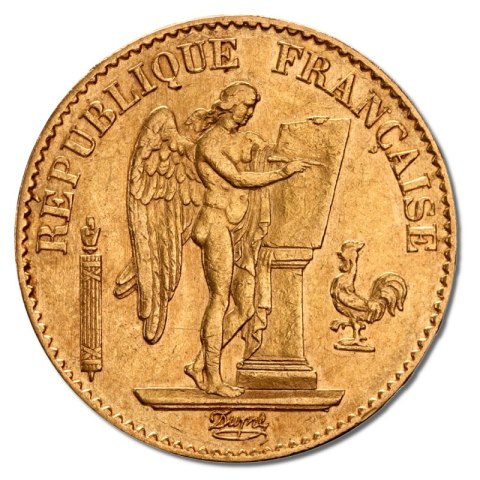
The 20 Francs France Third Republic Angel (1871-1898) gold coin — popularly called "Angel" in numismatic trade — is a classic 20-franc piece of the Latin Monetary Union (LMU) standard with a gross mass of 6.4516 g, a pure-gold mass of 5.80645 g, a 0.900 fineness (Crown-Gold-style alloy), a 21.0 mm diameter and a 20-French-franc face value as legal tender of the Third Republic. The obverse features the Genius of Liberty (Génie de la Liberté) — a winged male figure (numismatically called "Angel") writing the word "Constitution" on a tablet — designed by Augustin Dupré in 1791, adapted for the Third Republic issues. It is the only LMU 20F with a male (winged) figure on the obverse — a contrast to Vreneli (Helvetia woman), the Helvetia coin (Helvetia woman) and Leopold II (king) or Napoleon III (emperor). The coin is VAT-exempt in the EU as a legal-tender coin with a 0.900 fineness struck after 1800.
Technical specification
| Parameter |
Value |
| Manufacturer |
Monnaie de Paris (letter A) |
| Series |
20 francs or Génie de la Liberté ("Angel") — Third French Republic |
| Third Republic mintage years |
1871-1898 (earlier issues 1848-1849 for the II Republic) |
| Standard |
Latin Monetary Union (LMU from 23.12.1865) |
| Gross mass |
6.4516 g (gold + copper) |
| Pure gold mass |
5.80645 g |
| Fineness |
0.900 fineness (Crown-Gold-style alloy) |
| Alloy |
Au 90% + Cu 10% |
| Diameter |
21.0 mm |
| Thickness |
approx. 1.3 mm |
| Face value |
20 French francs (legal tender of the Third Republic) |
| Obverse |
Genius of Liberty ("Angel") — winged male figure writing "Constitution" — Augustin Dupré (1791) |
| Reverse |
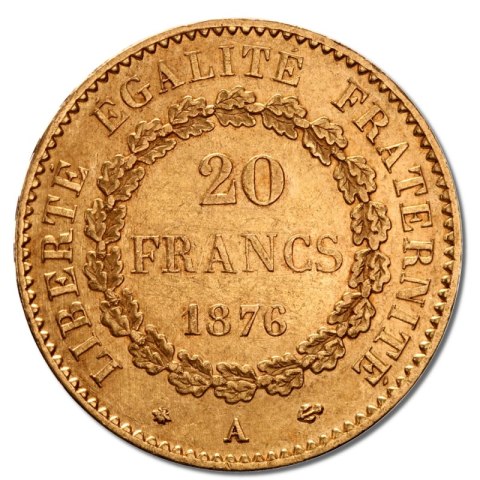
Gallic rooster on shield, LIBERTÉ ÉGALITÉ FRATERNITÉ, 20 FRANCS, year |
| LBMA status |
Not directly (historic coin, not a current bullion issue) |
| VAT in the EU |
Exempt (legal-tender coin, fineness 900 = minimum, struck after 1800, EU Directive 2006/112/EC Art. 344) |
| UK status |
NOT CGT-free (CGT exemption applies only to British legal tender) |
| USA status |
NOT IRA-eligible (IRS admits only American coins and selected bullion) |
| Packaging |
Protective capsule or blister |
Why the Angel deserves a place in your portfolio
- The only LMU 20F with a male figure on the obverse — unique collector motif: The Angel of the Third Republic is the only 20-franc coin in the LMU standard featuring a male figure (winged Genius of Liberty) on the obverse. All other LMU 20F issues depict monarchs (Napoleon III, Leopold II) or female personifications (Helvetia/Vreneli, Helvetia coin). This uniqueness provides additional value for collectors of historic gold coins — the Angel is "different" in the series and stands out thematically.
- Augustin Dupré's 1791 design — the oldest obverse concept among LMU 20F: The Genius of Liberty was designed by Augustin Dupré in 1791 (year II of the French Revolution) as a symbol of the new republic — the design was adapted for the Third Republic issues nearly 80 years later. No other LMU 20F has an obverse with such a long conceptual history. Dupré was the Monnaie de Paris chief engraver in 1791-1803 — he introduced revolutionary republican motifs to French coinage.
- Crown-Gold-style alloy 0.900 — historic LMU standard: The 900 fineness (Au 90% + Cu 10%) introduced by the LMU standard in 1865 (earlier the French 20F Napoleon III from 1853) has been unchanged — combining scratch resistance with high precious-metal content. The Angel retains the original 5.80645 g pure-gold content after over 120 years of circulation.
- Low premium 3-6% over spot — collector-investment compromise: The Angel has a market premium comparable to Napoleon III (3-6%) — only marginally higher than Vreneli (2-5%). This makes it accessible to individual investors as cheaper historic gold, while at the same time offering a unique collector motif (the only male figure in the LMU 20F series). Ideal for a hybrid portfolio — investment + collection.
- Third French Republic — historic context: The 1871-1898 issues span 27 years of the Third Republic — the period after the fall of the Second Empire (1870), the Franco-Prussian War, the Paris Commune (1871) and the development of France's republican political culture. The coin is a physical witness of the establishment of a lasting republic in France (after two failed attempts 1792-1804 and 1848-1852) and a symbol of the political maturity of the republican state concept.
History of the Third Republic and Angel symbolism
The Third French Republic was proclaimed on 4 September 1870 after the defeat of the Second Empire at the battle of Sedan and the capitulation of Napoleon III. The first months of the republic were marked by the war with Prussia (siege of Paris 1870-1871), the defeat of France (Treaty of Frankfurt, loss of Alsace and Lorraine) and the Paris Commune uprising (March-May 1871, bloodily suppressed by the republican government). Despite difficult beginnings, the Third Republic stabilised and lasted 70 years — until the fall of France in June 1940 after the German invasion.
The first 20-franc coins of the Third Republic were struck from 1871 — two parallel types: Ceres (head of a woman personifying the republic, design by Eugène Oudiné from 1849, continued from the Second Republic) and Angel/Genius of Liberty (continuation of the Augustin Dupré design from 1791, adapted for the Third Republic). Both issues had identical technical specifications (LMU standard) and were equal as legal tender. The Angel was struck from 1871 to 1898 at the Monnaie de Paris (letter A).
Augustin Dupré (1748-1833) — French sculptor and engraver, Monnaie de Paris chief engraver (graveur général) 1791-1803 — was one of the most important coin designers of revolutionary and Napoleonic France. He introduced the Genius of Liberty motif (Génie de la Liberté) — a winged male figure writing the Constitution — on the coins of the First Republic (1791-1804), replacing earlier monarchic motifs (Louis XVI). Dupré also designed medals for the French revolutionary army and Legion of Honour decorations.
The symbolism of the Genius of Liberty in the context of the Third Republic combines two revolutionary myths: the first French Revolution 1789-1799 (which established the first republic) and the revival of the republic in 1870 (after two failed attempts 1848-1852 and periods of Bourbon and Orléans monarchies and the empire). The winged figure (angel) writing the word "Constitution" symbolises divine inspiration of the republican ideals of liberty, equality and fraternity — although in a secular, not religious sense. "Angel" is a popular numismatic name, unrelated to Christian theology — an allegorical figure in the style of Graeco-Roman sculpture.
The Third Republic continued the LMU 20F standard (identical to Napoleon III) without technical changes — mass, fineness, diameter unchanged. Only the obverse motif (Genius of Liberty instead of the emperor) and the reverse motif (Gallic rooster instead of the imperial eagle) were changed, reflecting the change of regime from empire to republic. Full interchangeability with the 20-franc coins of Belgium (Leopold II), Switzerland (Helvetia coin/Vreneli) and Italy (Vittorio Emanuele II) was retained — the LMU remained functional throughout the Angel mintage period.
Obverse — Genius of Liberty ("Angel") by Augustin Dupré (1791, adapted 1871)
The obverse of the 20 Francs Angel coin features the Genius of Liberty (Génie de la Liberté) — a winged male figure standing, writing with a pen on a tablet placed on a column. On the tablet is the word "Constitution" — symbol of the supreme republican law. The figure is naked (classical Graeco-Roman sculpture stylistics) with drapery wrapped around the hips; wings spread behind the back refer to the tradition of antique sculpture (Nike, Roman genius).
Numismatically the figure is popularly called "Angel" (L'Ange) due to the wings — a colloquial term used in secondary trade by collectors and investors. The official name of the motif is "Génie de la Liberté" (Genius of Liberty) or "Génie ailé" (winged Genius) — an allegorical figure, not a religious figure. In French tradition the Genius is a male figure (contrast to Marianne — the female personification of the Republic, used on Ceres and Marianne coins of the 20th century).
Augustin Dupré (1748-1833) designed the Genius of Liberty in 1791 for the first coins of the First French Republic. The original issues 1791-1803 (First Republic and First Consulate) used this motif on 24-franc gold coins and 5-franc silver coins. After the fall of the First Republic the motif disappeared from coins during the empire of Napoleon I (1804-1815), the Bourbon Restoration (1815-1830), the July Monarchy of Louis Philippe (1830-1848), the Second Republic (1848-1852) and the Second Empire of Napoleon III (1852-1870). It returned only in 1871 for the Third Republic — continuation of republican symbolism after a 67-year break.
Around the Genius figure is the inscription REPUBLIQUE FRANÇAISE (French Republic) — identification of the issuer as a republican state, in contrast to the earlier EMPIRE FRANÇAIS (French Empire) on Napoleon III. Below the figure are Dupré's signatures (DUPRE) as the author of the design and the mint mark (letter A — Monnaie de Paris) and year of issue. All Angel issues of the Third Republic come from the Paris mint — no other French mint struck this coin in the period 1871-1898.
Reverse — Gallic rooster on a shield with the republican motto
The reverse of the 20 Francs Angel coin features the Gallic rooster (le coq gaulois) — symbol of France and the French Republic — standing on an ornate shield or on a column. Around the rooster is the republican motto LIBERTÉ ÉGALITÉ FRATERNITÉ (Liberty Equality Fraternity) — the official motto of the French Republic since 1848 (Second Republic) and finally established from 1880 (Third Republic law on the tricolour flag and motto). Below are the face value 20 FRANCS and the year of minting.
The Gallic rooster is a national symbol of France from the Middle Ages — it derives from a Latin pun: gallus means both "Gaul" (inhabitant of Gaul, ancient France) and "rooster". The rooster's symbolism refers to strength, vigilance and courage (the rooster wakes at dawn, defends its territory). The Third Republic adopted the rooster as an official state symbol (alongside Marianne — the female personification of the Republic) and placed it on coins (the reverse of the 20-franc Angel coin), postage stamps, flags and state insignia.
The motto LIBERTÉ ÉGALITÉ FRATERNITÉ (Liberty Equality Fraternity) has been the official motto of the French Republic since 1848 — derived from the slogan of the French Revolution of 1789 (originally "Liberté, Egalité, Fraternité ou la Mort" — Liberty, Equality, Fraternity or Death, used during the Terror 1793-1794). The Third Republic officially established the motto without "or Death" as the tripartite republican slogan. The motto is today used on all official documents of the French Republic and on state coats of arms.
The year of minting placed under the rooster serves as the distinguishing feature between issues in the 27-year Third Republic Angel series (1871-1898). The most common vintages in secondary trade are the years 1875-1895 (highest mintages). The rarest are early issues (1871-1874 — first years of the republic, low mintages due to the costs of war) and late issues (1896-1898 — the twilight of Angel issues before replacement by the Gallic rooster as the sole motif from 1899). These vintages may have numismatic value higher than the precious-metal value itself.
What to look out for when buying
Check the vintage of the Angel coin — in secondary trade, mixed years contains various vintages 1871-1898 (Third Republic). Specific collector vintages (1871-1874 — first years of the republic; 1896-1898 — last issues before the motif change in 1899) may be sold with a higher numismatic premium — typically +15-35% over mixed years. For an investment strategy (gold purchase as a store of value), mixed years are optimal due to the lowest unit cost.
Note the collector subtype — the Genius of Liberty was also struck earlier for the Second French Republic (1848-1849) — these issues are significantly rarer and more collectible than the Third Republic issues (1871-1898). Mixed years usually contains only Third Republic issues; Second Republic issues (1848-1849) are sold separately with a premium of +50-100% over the base spot.
The market premium on the Angel typically holds in the range of 3-6% over spot — comparable to Napoleon III (3-6%) and slightly higher than Vreneli (2-5%). This results from the lower mintage of the issue than Vreneli (the Angel was struck for 27 years at one mint, while Vreneli for 52 years) and the unique collector motif (the only male figure in the LMU 20F series). The premium is still low — the Angel remains one of the cheapest historic gold coins on the European market.
Check the condition of the coin and authenticity — the Angel in the 900/1000 alloy (harder than pure 999.9) retains typical circulation traces after 125-155 years: light wear, fine scratches, natural surface patina. Pay particular attention to the preservation of obverse details — the pen in the Genius's hand and the inscription "Constitution" on the tablet are fine elements prone to wear. For an investment strategy, VF and EF grades are acceptable. Each coin is delivered in a protective capsule or individual blister.
Why GoldInvest24
- Full cross-section of historic LMU 20-franc coins: in our catalogue you will find all the key LMU 20F issues — Vreneli (Switzerland), Napoleon III (France), Angel of the Third Republic (France), Helvetia (Switzerland) and Leopold II (Belgium) — which allows building a balanced historic-gold portfolio with the lowest market premium on the European market.
- Mixed years for optimal premium: Angel offer in mixed-years format (various vintages 1871-1898 of the Third Republic) with a 3-6% premium over spot. For collectors, specific vintages in AU/UNC grades and rare Second Republic issues (1848-1849) are also available in the higher price range.
- PL / DE / EN language versions: full technical descriptions and specifications in three languages for convenient service of the Polish, German and international markets — particularly valuable for historic coins with numismatic terminology in three languages.
- Current precious-metals quotes: spot data for comparing offer prices with current market valuation — check the current precious-metals prices before purchase to assess the effective premium on historic coins.
- Full precious-metal categories in one shop: access to gold investment coins, bars, silver, platinum and palladium — all from a single customer account, with full PL/DE/EN support.
Comparison of 5 coins — Vreneli, Napoleon III, Angel, Helvetia, Leopold II
| Feature |
Vreneli (CH) |
Napoleon III (FR) |
Angel (FR) |
Helvetia (CH) |
Leopold II (BE) |
| Mintage years |
1897-1949 |
1853-1870 |
1871-1898 |
1883-1896 |
1867-1882 |
| Mint |
Bern |
Monnaie de Paris |
Monnaie de Paris |
Bern |
Brussels Mint |
| Obverse |
Helvetia (Vreneli) |
Napoleon III |
Genius of Liberty |
Helvetia seated |
Leopold II |
| Designer |
Fritz Ulysse Landry |
Barre / Hugues |
Augustin Dupré |
Antoine Bovy |
Léopold Wiener |
| Pure gold |
5.80645 g |
5.80645 g |
5.80645 g |
5.80645 g |
5.80645 g |
| Fineness |
0.900 |
0.900 |
0.900 |
0.900 |
0.900 |
| Typical premium |
2-5% |
3-6% |
3-6% |
5-10% |
4-8% |
| Secondary liquidity |
Highest |
Very high |
High |
Medium |
High |
See the entire gold investment coins category available at GoldInvest24.
FAQ — common questions about the 20 Francs Angel Third Republic
What is the 20 Francs Angel Third Republic?
The 20 Francs France Third Republic Angel is a historic French gold coin of the Latin Monetary Union standard, struck at the Monnaie de Paris in 1871-1898 with a gross mass of 6.4516 g, a pure-gold mass of 5.80645 g, a 0.900 fineness and a 21.0 mm diameter. The obverse features the Genius of Liberty (Génie de la Liberté) — a winged male figure writing "Constitution" on a tablet, designed by Augustin Dupré in 1791. "Angel" is a popular numismatic name of the motif due to the wings — the only LMU 20F with a male figure on the obverse.
What is the technical specification of the Angel?
Gross mass 6.4516 g (gold + copper), pure-gold mass 5.80645 g, 0.900 fineness (Au 90% + Cu 10%, Crown-Gold-style alloy), 21.0 mm diameter, approx. 1.3 mm thickness, face value 20 French francs. Mint: Paris (letter A). Obverse: Genius of Liberty ("Angel") writing "Constitution" — Augustin Dupré (1791). Reverse: Gallic rooster on shield, motto LIBERTÉ ÉGALITÉ FRATERNITÉ, 20 FRANCS and year of minting.
What is the history of the Third Republic and the Angel?
The Third Republic was proclaimed on 4.9.1870 after the fall of the Second Empire (battle of Sedan). The first 20-franc coins of the Third Republic were struck from 1871 — two parallel types: Ceres (woman, Oudiné 1849) and Angel/Genius of Liberty (man, Dupré 1791). The Angel was struck 1871-1898 at the Monnaie de Paris (letter A). LMU standard unchanged — full interchangeability with the other 20-franc coins of the union. The Third Republic lasted 70 years until June 1940.
How does the Angel differ from Vreneli, Napoleon III, Helvetia and Leopold II?
Angel (France, 1871-1898) — the only LMU 20F with a male figure (winged Genius of Liberty), Third Republic, Augustin Dupré design from 1791. Vreneli (Switzerland, 1897-1949) — highest-mintage LMU 20F, Helvetia woman, premium 2-5%. Napoleon III (France, 1853-1870) — Second Empire, two emperor-portrait types. Helvetia (Switzerland, 1883-1896) — Vreneli predecessor, Helvetia seated woman (Bovy). Leopold II (Belgium, 1867-1882) — Belgium, King Leopold II (Wiener).
For whom is the Angel a practical choice?
For collectors of historic gold coins due to uniqueness (the only LMU 20F with a male figure) and the oldest obverse concept (Dupré design 1791), for individual investors seeking cheap historic gold with a low 3-6% premium, and for those building a hybrid portfolio (investment + collection) as a complement to Vreneli and Napoleon III in the LMU 20F portfolio.
What is the LBMA, VAT, CGT and IRA status of the Angel?
LBMA Good Delivery — NOT directly (the Angel is a historic coin, not a current bullion issue). VAT in the EU — EXEMPT (historic legal-tender coin, 0.900 fineness = minimum, struck after 1800, market price ≤180% of gold value — meets EU Directive 2006/112/EC Art. 344). CGT-free in the UK — NO (CGT-free status applies only to British legal tender). IRA-eligible in the USA — NO (the IRS admits only American coins and selected bullion).
How do I buy the 20 Francs Angel Third Republic at GoldInvest24?
Place an order in our shop with access to the gold investment coins category, the full range of historic LMU 20-franc coins (Vreneli, Napoleon III, Angel, Helvetia, Leopold II) and the offer of LBMA bullion mints. Check the current gold quotes to compare the premium against the current spot price. Descriptions in PL / DE / EN.
![[{[item.product.name]}]]([{[item.product.photo.url]}] 75w)