20 Swiss Francs Vreneli (1897-1949) — the most popular 20-franc coin of the Latin Monetary Union with the portrait of a Helvetic woman against the Alps
The 20 Swiss Francs Vreneli (1897-1949) gold coin is a classic 20-franc piece in the Latin Monetary Union (LMU) standard, with a gross mass of 6.4516 g, a pure-gold mass of 5.80645 g, a fineness of 900/1000 (Crown-Gold-style alloy), a 21.0 mm diameter and a face value of 20 Swiss francs (CHF) as legal tender of historic Switzerland. Vreneli — a popular diminutive of the name Verena — is the portrait of a woman representing Helvetia against alpine peaks, designed by Fritz Ulysse Landry and struck by the Bern Mint (letter B) for over 50 years (1897-1949). The coin is VAT-exempt in the EU as a legal-tender coin with a 900/1000 fineness struck after 1800 — the most popular LMU 20F on the secondary market with a typical premium of 2-5% over spot, making it the cheapest historic gold available to the individual investor.
Technical specification
| Parameter |
Value |
| Manufacturer |
Bern Mint (Switzerland, letter "B" on the coin) |
| Series |
20 Franken Schweizer Vreneli — successor to the Helvetia coin |
| Mintage years |
1897-1949 (mixed years on sale) |
| Standard |
Latin Monetary Union (LMU, established 23.12.1865 in Paris) |
| Gross mass |
6.4516 g (gold + copper) |
| Pure gold mass |
5.80645 g |
| Fineness |
0.900 fineness (Crown-Gold-style alloy) |
| Alloy |
Au 90% + Cu 10% |
| Diameter |
21.0 mm |
| Thickness |
approx. 1.3 mm |
| Face value |
20 Swiss francs (CHF, historic legal tender) |
| Obverse |
Helvetia — Vreneli (woman against the Alps) — Fritz Ulysse Landry, HELVETIA |
| Reverse |
Swiss shield with Helvetic cross and oak wreath, 20 FR |
| LBMA status |
Not directly (historic coin, not a current bullion issue) |
| VAT in the EU |
Exempt (legal-tender coin, fineness 900 = minimum, struck after 1800, EU Directive 2006/112/EC Art. 344) |
| UK status |
NOT CGT-free (CGT exemption applies only to British legal tender) |
| USA status |
NOT IRA-eligible (IRS admits only American coins and selected bullion) |
| Packaging |
Protective capsule or blister |
Why Vreneli deserves a place in your portfolio
- The most popular LMU 20F on the secondary market — highest liquidity: Vreneli is the most commonly encountered LMU 20F in European secondary trade — market depth ensures a very low spread on resale and reliable valuation by any gold dealer in the EU and Switzerland. The total mintage 1897-1949 exceeded 58 million pieces, making Vreneli the highest-mintage LMU 20F coin.
- Crown-Gold-style alloy 900/1000 — historic standard since 1865: The 900 fineness (Au 90% + Cu 10%) introduced by the Latin Monetary Union has been unchanged since 1865 — it combines scratch resistance (a harder alloy than pure 999.9 gold) with high precious-metal content. Vreneli retains the original 5.80645 g pure-gold content after over 100 years of circulation.
- Low market premium 2-5% over spot — the cheapest historic gold: LMU 20F coins have the lowest premium among historic gold coins — typically 2-5% over spot for mixed-years Vreneli. It is an acceptable trade-off: no collector value of a single vintage (mass-produced in 58 million pieces), but the cheapest historic gold available to the individual investor.
- LMU as the "Euro of the 19th century" — standard of the 4 Union states: The Latin Monetary Union 1865-1927 linked France, Belgium, Switzerland and Italy (later joined by Greece, Spain, Romania and several others) through a common mintage standard 20F = 6.4516 g gross, 0.900 fineness. Vreneli was fully interchangeable with 20F Napoleon III, Angel and Leopold II — one of the earliest currency unions in history.
- Helvetia and Alps motif — iconic Swiss symbol: The portrait of a woman representing Helvetia against the alpine range is one of the most recognisable Swiss numismatic images. "Vreneli" — a Swiss-German diminutive of the name Verena (common in German-speaking Switzerland) — has become synonymous with Swiss gold for European investors, and at the same time the embodiment of Swiss neutrality and monetary stability.
History of the Latin Monetary Union (1865-1927) — the "Euro of the 19th century"
The Latin Monetary Union (LMU) was established by the treaty signed on 23 December 1865 in Paris by France, Belgium, Switzerland and Italy. The union's aim was to unify the standards for striking silver and gold coins in a bimetallic monetary system with a silver:gold ratio of 15.5:1 (Au 1 g = Ag 15.5 g) — corresponding to the contemporary market exchange rate of precious metals. The 20F standard: 6.4516 g gross, 0.900 fineness, 21.0 mm diameter, 5.80645 g of pure gold — was identical for all member states and allowed full interchangeability of 20-franc coins between France, Belgium, Switzerland and Italy.
The LMU 20F standard was mathematically derived from the existing French 20-franc coin of Napoleon III (struck since 1853) — France, as the largest participating economy, dictated the parameters. The 5.80645 g pure gold results from the choice of parameters of the French germinal franc (1803, Napoleon I) — 1 franc = 0.290 g of pure gold, so 20 francs = 5.80645 g. The other member states adopted identical parameters for their 20-franc coins (Belgium, Switzerland, Italy), 20-drachma coins (Greece from 1868) and 20-peseta coins (Spain).
In the following years Greece (1868), Spain, Romania, Bulgaria, Serbia, San Marino, the Vatican and several smaller states joined the LMU — although the formal membership of the four founding states remained the core of the union. The LMU standard also covered silver coins (5 francs, 2 francs, 1 franc, 50 centimes, 20 centimes) of fixed weight and silver fineness, ensuring constant interchangeability of all denominations between member states. The bimetallic system 15.5:1 functioned properly as long as the market Au/Ag rate remained near this ratio.
The LMU crisis began in the 1870s with the discovery of large silver deposits in Nevada (Comstock Lode) and Australia, which increased silver supply and lowered the market Au/Ag ratio below 15.5:1. The result was the hoarding of gold coins (Gresham's law: "bad money drives out good") — citizens withdrew gold 20-franc coins from circulation, paying out the cheaper silver coins in settlements. In response, in 1878 the LMU suspended the striking of new 5-franc silver coins, effectively moving to gold monometallism, although the bimetallic standard was formally retained until the end of the union.
The Latin Monetary Union was formally dissolved in 1927 after the First World War, which destroyed the monetary stability of the member states. France, Belgium and Italy experienced sharp post-war inflation, Switzerland retained stability thanks to its neutrality, but the standard of common LMU interchangeability became impossible to maintain. Despite the formal dissolution, LMU 20F coins remained in residual circulation as a gold reserve for citizens — Switzerland struck Vreneli until 1949, and earlier issues from France, Belgium and Italy retained historic legal-tender status to this day.
Obverse — Helvetia (Vreneli) by Fritz Ulysse Landry (1897)
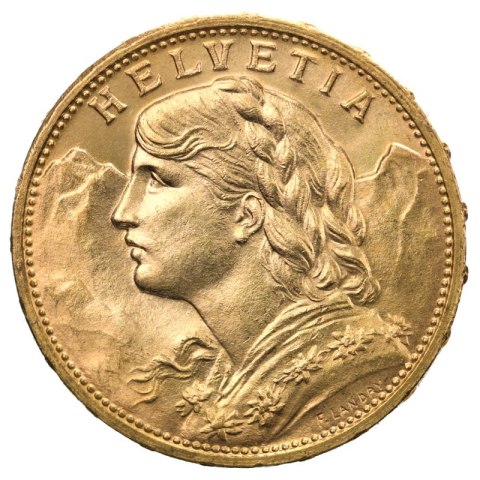
The obverse of the 20 Swiss Francs Vreneli coin features the portrait of a woman representing Helvetia — the personification of the Swiss Confederation — against the peaks of the alpine range. The figure is shown in left profile, with hair gathered into a braid or bun, with an edelweiss sprig (or other mountain plant) tucked into the hair. Above the portrait is the inscription HELVETIA, identifying the personification of Switzerland — the Latin equivalent of the country's name used in Swiss numismatics since the 19th century.
The obverse designer is Fritz Ulysse Landry (1842-1927) — a Swiss sculptor and engraver from Neuchâtel, the author of many Swiss Confederation coins and medals from the turn of the 19th and 20th centuries. Landry designed Vreneli in 1895 as part of a competition announced by the federal government of Switzerland to replace the earlier Helvetia coin (1883-1896, design by Antoine Bovy) with a more modern image. Landry's design won the competition and was introduced into production in 1897 — from that vintage the official Vreneli issue begins.
"Vreneli" — a popular Swiss-German diminutive of the name Verena (common in German-speaking Switzerland) — is not the official name of the coin, but a nickname given by citizens and collectors. Verena was a legendary figure common to Switzerland and southern Germany (a 3rd-century saint, patron of millers), and her diminutive "Vreneli" became synonymous with a typical Swiss woman. The official name of the coin is simply "20 Franken Schweizer Goldmünze" — the name "Vreneli" caught on in popular and numismatic usage due to recognisability and sentiment for the image.
The Vreneli image changed slightly during the 52-year production (1897-1949). The first issues (1897) showed Vreneli with looser hair and a more detailed alpine background; later vintages (from around 1900) had a portrait with hair gathered into a more compact bun and a simplified background. These changes are subtle and result from improvements in minting dies — all Vreneli vintages have an identical technical specification (mass, fineness, diameter) and are legal tender in an identical historic scope.
Reverse — Swiss shield with Helvetic cross and oak wreath
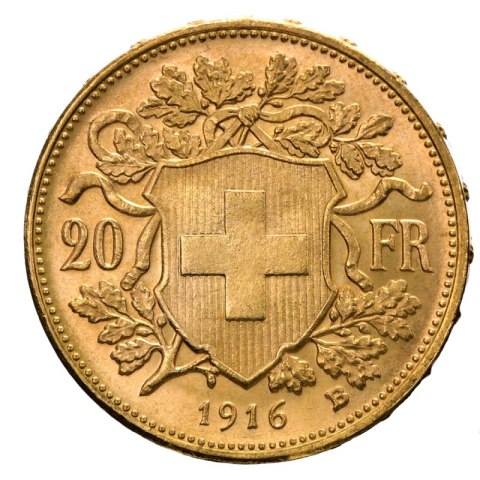
The reverse of the 20 Swiss Francs Vreneli coin features a Swiss shield with a white Helvetic cross (a Greek cross with equal arms) in the centre, surrounded by an oak or laurel-oak wreath. Around the shield is the inscription 20 FR — the face-value designation in Swiss francs — and the year of minting below the shield. The mint letter "B" (Bern, Bern Mint) is placed on the reverse next to the year.
The Helvetic cross (Schweizerkreuz) has been the national emblem of Switzerland since 1815 — a white Greek cross on a red background, with equal arms in a proportion of 7:6 to the side length. The cross derives from the medieval Swiss banner of the Holy Roman Empire and was used by the Swiss Confederation since the 14th century. On Vreneli coins the cross appears in a monochrome variant (marked by relief), without the red-and-white colouring — the colour is a flag feature, not a coin one.
The oak wreath surrounding the shield symbolises strength, durability and independence — a traditional European heraldic attribute associated with German and alpine oaks. The laurel wreath (in some Vreneli issues) symbolises victory and peace — the combination of oak and laurel expresses the balanced Swiss philosophy: military strength to defend independence combined with the pursuit of peace (neutrality). The Bern Mint has been striking coins for the Swiss Confederation since 1855 — Bern is the federal capital of Switzerland (de facto, although Switzerland has no formal capital).
The year of minting placed under the shield is the most important distinguishing feature between issues in the 52-year Vreneli series (1897-1949). The most commonly encountered vintages in secondary trade are the years 1910-1935 — with the highest mintages. The rarest are the early issues (1897-1900) and the post-war issues (1947-1949, low mintage resulting from Swiss neutrality in the Second World War) — these vintages may have numismatic value higher than the precious-metal value itself.
What to look out for when buying
Check the vintage of the Vreneli coin — the issue appears in a mixed-years format (various vintages 1897-1949) to preserve a low market premium (2-5% over spot). Specific collector vintages (e.g. 1897 first issue, 1947-1949 last issues, low-mintage vintages) may be sold with a higher numismatic premium — typically +10-30% over mixed years, depending on the preservation grade (EF, AU, UNC). For an investment strategy (gold purchase as a store of value), mixed years are optimal due to the lowest unit cost.
The market premium on Vreneli typically holds in the range of 2-5% over spot — the lowest premium among historic gold coins available on the European market. This results from the mass mintage of the series (over 58 million pieces struck in 52 years of production) — a single coin has no significant collector value, but the whole series has a deep secondary market and reliable valuation. The 2-5% premium is lower than on modern bullion (typically 4-7% for 1 oz Maple Leaf or Krugerrand) and significantly lower than fractional premiums (8-15% for 1/10 oz or 1/4 oz).
Check the mint of striking — all Vreneli are struck at the Bern Mint (letter "B" on the reverse next to the year). The absence of the letter "B" or another mint letter most likely indicates a counterfeit or modern restrike (Vreneli were not struck at any mint other than Bern). The Bern Mint — Eidgenössische Münzstätte — has struck federal Swiss coins continuously since 1855 and is the only official mint of the Confederation.
Check the condition of the coin and authenticity — Vreneli in the 900/1000 alloy is harder than pure 999.9 gold, but after 75-130 years of circulation retains typical circulation traces: light wear, fine scratches, natural surface patina. For an investment strategy, VF (Very Fine) and EF (Extremely Fine) grades are acceptable — sufficient to confirm authenticity and gold content. AU (About Uncirculated) and UNC (Uncirculated) grades are sought after by collectors and have a higher premium. Each coin is delivered in a protective capsule or individual blister to preserve the surface.
Why GoldInvest24
- Full cross-section of historic LMU 20-franc coins: in our catalogue you will find all the key LMU 20F issues — Vreneli (Switzerland), Napoleon III (France), Angel of the Third Republic (France), Helvetia (Switzerland) and Leopold II (Belgium) — which allows building a balanced historic-gold portfolio with the lowest market premium on the European market.
- Mixed years for optimal premium: Vreneli offer in mixed-years format (various vintages 1897-1949) with a 2-5% premium over spot — the lowest historic premium available to the individual investor. For vintage collectors, specific vintages in AU/UNC grades are also available in the higher price range.
- PL / DE / EN language versions: full technical descriptions and specifications in three languages for convenient service of the Polish, German and international markets — particularly valuable for historic coins with numismatic terminology in three languages.
- Current precious-metals quotes: spot data for comparing offer prices with current market valuation — check the current precious-metals prices before purchase to assess the effective premium on historic coins.
- Full precious-metal categories in one shop: access to gold investment coins, bars, silver, platinum and palladium — all from a single customer account, with full PL/DE/EN support.
Comparison of 5 coins — Vreneli, Napoleon III, Angel, Helvetia, Leopold II
| Feature |
Vreneli (CH) |
Napoleon III (FR) |
Angel (FR) |
Helvetia (CH) |
Leopold II (BE) |
| Mintage years |
1897-1949 |
1853-1870 |
1871-1898 |
1883-1896 |
1867-1882 |
| Mint |
Bern |
Monnaie de Paris |
Monnaie de Paris |
Bern |
Brussels Mint |
| Obverse |
Helvetia (Vreneli) |
Napoleon III |
Genius of Liberty |
Helvetia seated |
Leopold II |
| Designer |
Fritz Ulysse Landry |
Barre / Hugues |
Augustin Dupré |
Antoine Bovy |
Léopold Wiener |
| Pure gold |
5.80645 g |
5.80645 g |
5.80645 g |
5.80645 g |
5.80645 g |
| Fineness |
0.900 |
0.900 |
0.900 |
0.900 |
0.900 |
| Typical premium |
2-5% |
3-6% |
3-6% |
5-10% |
4-8% |
| Secondary liquidity |
Highest |
Very high |
High |
Medium |
High |
See the entire gold investment coins category available at GoldInvest24.
FAQ — common questions about the 20 Swiss Francs Vreneli
What is the 20 Swiss Francs Vreneli?
The 20 Swiss Francs Vreneli is a historic Swiss gold coin of the Latin Monetary Union standard, struck at the Bern Mint between 1897 and 1949 with a gross mass of 6.4516 g, a pure-gold mass of 5.80645 g, a 0.900 fineness and a 21.0 mm diameter. The obverse features Helvetia — a woman representing the Swiss Confederation — against the alpine peaks, designed by Fritz Ulysse Landry. "Vreneli" is a popular Swiss-German diminutive of the name Verena, used as a nickname for the coin in secondary trade and numismatics.
What is the technical specification of the Vreneli?
Gross mass 6.4516 g (gold + copper), pure-gold mass 5.80645 g, fineness 0.900 (Au 90% + Cu 10%, Crown-Gold-style alloy), 21.0 mm diameter, approx. 1.3 mm thickness, face value 20 Swiss francs (CHF). Mint: Bern (letter "B" on the reverse). Obverse: Helvetia/Vreneli against the Alps — Fritz Ulysse Landry. Reverse: Swiss shield with Helvetic cross and oak wreath, 20 FR and year of minting.
What is the history of the Latin Monetary Union and the Vreneli?
The Latin Monetary Union was established on 23.12.1865 in Paris by France, Belgium, Switzerland and Italy — common 20F standard: 6.4516 g gross, 0.900 fineness, 5.80645 g pure gold. Bimetallic ratio 15.5:1 (silver:gold). Vreneli introduced in 1897 as the successor to the Helvetia coin (1883-1896), designed by Fritz Ulysse Landry. Struck at the Bern Mint until 1949 — the total mintage of over 58 million pieces makes Vreneli the highest-mintage LMU 20F. The union was formally dissolved in 1927 after the First World War.
How does Vreneli differ from Napoleon III, Angel, Helvetia and Leopold II?
Vreneli (Switzerland, 1897-1949) — the highest-mintage LMU 20F, lowest premium 2-5%, Helvetia and Alps motif. Napoleon III (France, 1853-1870) — Second Empire issue, two types (bare head 1853-1860, laurel-wreathed 1861-1870). Angel (France, 1871-1898) — Third Republic, Genius of Liberty writing on a tablet (Augustin Dupré), the only LMU 20F with a male figure. Helvetia (Switzerland, 1883-1896) — direct predecessor of Vreneli (Antoine Bovy), lower mintages → higher collector value. Leopold II (Belgium, 1867-1882) — Belgium as LMU founding member, Léopold Wiener.
For whom is the Vreneli a practical choice?
For individual investors seeking the cheapest historic gold with deep secondary liquidity (lowest premium 2-5% among historic coins), for those building a portfolio of historic LMU 20F coins (Vreneli as the core due to liquidity), and for vintage collectors collecting the 52-year production 1897-1949. Vreneli is the most popular 20-franc coin on the European market — market depth ensures reliable valuation and a low spread on resale.
What is the LBMA, VAT, CGT and IRA status of the Vreneli?
LBMA Good Delivery — NOT directly (Vreneli is a historic coin, not a current bullion issue; the Bern Mint has had the status historically, but the current LBMA refers to ongoing production). VAT in the EU — EXEMPT (historic legal-tender coin, 0.900 fineness = minimum, struck after 1800, market price ≤180% of gold value — meets EU Directive 2006/112/EC Art. 344 and the Polish VAT Act Art. 122). CGT-free in the UK — NO (CGT-free status applies only to British legal tender). IRA-eligible in the USA — NO (the IRS admits only American coins and selected modern bullion).
How do I buy the 20 Swiss Francs Vreneli at GoldInvest24?
Place an order in our shop with access to the gold investment coins category, the full range of historic LMU 20-franc coins (Vreneli, Napoleon III, Angel, Helvetia, Leopold II) and the offer of LBMA bullion mints. Check the current gold quotes to compare the premium against the current spot price. Technical descriptions and specifications are available in PL / DE / EN language versions — particularly valuable for historic coins with numismatic terminology in three languages.
![[{[item.product.name]}]]([{[item.product.photo.url]}] 75w)