20 Marks German Emperor and King of Prussia Wilhelm I (1871-1888) Gold Coin — historic gold coin of the German Empire with the portrait of the first emperor of unified Germany
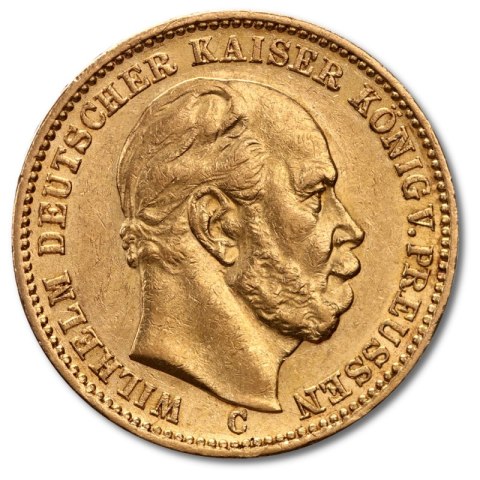
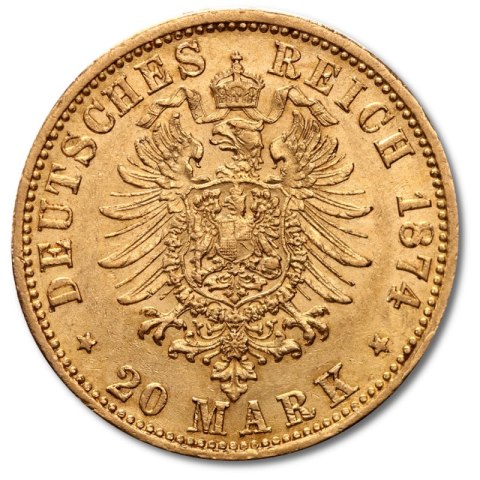
The 20 Marks German Emperor and King of Prussia Wilhelm I gold coin is a classic gold coin of the German Empire (Deutsches Kaiserreich), struck by eight German mints from 1871 to 1888 — featuring the portrait of Wilhelm I (1797-1888), the first emperor of unified Germany. Specification: gross mass 7.9650 g, pure-gold mass 7.1685 g, 0.900 fineness (German Empire Goldmark standard), 22.5 mm diameter and a face value of 20 German marks as legal tender of the German Empire (1871-1918). The obverse features the portrait of Wilhelm I with the inscription WILHELM DEUTSCHER KAISER KÖNIG VON PREUSSEN; the reverse — the Reichsadler (imperial German eagle) with crowns and the Hohenzollern coat of arms, DEUTSCHES REICH, 20 MARK, year. The designer of the design was Emil Weigand (signature W on the reverse). The coin is VAT-exempt in the EU as a historic legal-tender coin with a fineness ≥0.900 struck after 1800, with a typical market premium of 4-9% over spot — an average premium in the segment of historic German coins.
Technical specification
| Parameter |
Value |
| Manufacturer |
Eight German mints — Berlin (A), Hannover (B), Frankfurt (C), Munich (D), Dresden (E), Stuttgart (F), Karlsruhe (G), Hamburg (J) |
| Series |
20 Mark Deutsches Kaiserreich — Wilhelm I German Emperor |
| Mintage years |
1871-1888 (Wilhelm I's reign as emperor) |
| Standard |
Goldmark — introduced by the 1871 currency reform after German unification |
| Gross mass |
7.9650 g (gold + copper) |
| Pure gold mass |
7.1685 g |
| Fineness |
0.900 (German Empire Goldmark standard) |
| Alloy |
Au 90% + Cu 10% |
| Diameter |
22.5 mm |
| Thickness |
approx. 1.3 mm |
| Face value |
20 German marks (legal tender of the German Empire, 1 mark = 100 pfennig) |
| Obverse |
Portrait of Wilhelm I — WILHELM DEUTSCHER KAISER KÖNIG VON PREUSSEN, year |
| Reverse |
Reichsadler (imperial German eagle) with crowns and Hohenzollern coat of arms, DEUTSCHES REICH, 20 MARK, signature W (Emil Weigand) |
| Historic status |
Legal tender of the German Empire 1871-1918 (until the end of the First World War) |
| VAT in the EU |
Exempt (legal-tender coin, 0.900 fineness, struck after 1800, EU Directive 2006/112/EC Art. 344) |
| UK status |
NOT CGT-free (CGT exemption applies only to British legal tender) |
| USA status |
NOT IRA-eligible (historic coins are not on the IRS-approved list) |
| Packaging |
Individual protective capsule |
Why 20 Marks Wilhelm I deserves a place in your portfolio
- First classic gold coin of unified Germany — historic 1871 artefact: 20 Marks Wilhelm I is the first gold coin struck after German unification in 1871 (proclamation of the German Empire in the Hall of Mirrors at Versailles on 18 January 1871, after the victorious Franco-Prussian War). The coin is a physical artefact of the birth of the modern German state — Deutsches Kaiserreich (German Empire, 1871-1918) — the second most powerful European state of the 19th century after Great Britain.
- Goldmark standard 1871-1914 — foundation of the German gold standard: 20 Marks introduced by the currency reform of Chancellor Otto von Bismarck in 1871 — a unified German currency was created (mark replacing local thalers, guilders and crowns) based on gold. The Goldmark standard (1 mark = 0.358423 g pure gold; 20 marks = 7.1685 g) operated continuously until the outbreak of the First World War in 1914 — followed by hyperinflation 1918-1923, Rentenmark 1923, Reichsmark 1924, Deutsche Mark 1948, Euro 2002.
- Wilhelm I (1797-1888) — first emperor of unified Germany: Wilhelm I Hohenzollern, King of Prussia from 1861 and first emperor of the unified German Empire (from 18 January 1871 until his death on 9 March 1888), was the main monarch of the German unification period under Prussian hegemony. Together with Chancellor Otto von Bismarck he conducted three victorious unification wars (1864 — Denmark, 1866 — Austria, 1870/71 — France), which led to the establishment of the German Empire with Wilhelm I as its first emperor.
- Eight mints — rich collector diversity by letters: 20 Marks Wilhelm I was struck at eight German mints: Berlin (A), Hannover (B), Frankfurt (C), Munich (D), Dresden (E), Stuttgart (F), Karlsruhe (G) and Hamburg (J). The mint letter is on the reverse below the eagle. Each mint had its own tradition — Berlin (A) and Munich (D) were the largest and most popular; Hannover (B), Frankfurt (C) and Karlsruhe (G) — smaller but historically significant; issues from smaller mints may have a collector premium of 10-50% over the standard bullion price.
- Market premium 4-9% over spot — average in the segment of historic German coins: 20 Marks Wilhelm I has an average premium in the segment of historic German coins — higher than mass bullion coins (Krugerrand 4-7%) due to historic status and smaller production scale, but lower than rare collector years (e.g. the short reign of Friedrich III in 1888 has a premium of 50-200%). For an investor seeking historic German gold at an acceptable price, 20 Marks Wilhelm I offers the best balance of prestige and bullion among the three German emperors (Wilhelm I, Friedrich III, Wilhelm II).
History of the 20 Marks Wilhelm I (1871-1888) — birth of the German gold standard
The 20 marks gold coin was introduced by the currency reform of Chancellor Otto von Bismarck in 1871 — directly after the proclamation of the German Empire in the Hall of Mirrors at Versailles on 18 January 1871. German unification required the creation of a unified German currency (replacing the dozens of local currencies of the German states — Prussian thalers, southern German guilders, Hanoverian crowns, etc.). The 1871 reform introduced the German mark as the only currency of the Empire, based on the gold standard: 1 mark = 0.358423 g pure gold; main gold denominations — 5 marks, 10 marks, 20 marks (most popular); 1 mark = 100 pfennig as auxiliary unit.
The Goldmark standard 1871-1914 functioned for 43 years as the foundation of the German monetary system — the so-called Goldmark Era. All gold coins of the German Empire (5, 10, 20 marks) had a 0.900 fineness (Au 90% + Cu 10%) — identical to LMU 20-franc coins (Vreneli, Napoleon, Angel), but with different heraldic designs (Reichsadler instead of Helvetia or 13-star shield). The unified German coin was exchangeable with other gold-based currencies of the 19th century, but was formally not part of the LMU — Germany operated as a separate Reich gold standard.
20 Marks Wilhelm I was struck at eight German mints, reflecting the federal structure of the German Empire (Bundesstaat — 25 component states with legal and administrative autonomy). Each of the main German states had its own mint: Prussia (Berlin A, Frankfurt C — after the 1866 annexation, Hannover B — after the 1866 annexation), Bavaria (Munich D), Saxony (Dresden E), Württemberg (Stuttgart F), Baden (Karlsruhe G), Hamburg (Hamburg J — Free Hanseatic City). The mints struck identical coins in terms of specification (7.1685 g of gold), but with an individual mint letter on the reverse.
Wilhelm I died on 9 March 1888 at the age of 90 — after 27 years of reign as King of Prussia (1861-1888) and 17 years as German Emperor (1871-1888). He was succeeded by his son Friedrich III, but the "Year of the Three Emperors" (Dreikaiserjahr 1888) — Wilhelm I, Friedrich III, Wilhelm II — ended quickly. Friedrich III, the long-awaited liberal reformer, ruled only 99 days (9 March - 15 June 1888) before dying of laryngeal cancer; his son Wilhelm II (1859-1941) ascended the throne on 15 June 1888 and reigned until his abdication in November 1918 after losing the First World War.
After the First World War (1914-1918) and Germany's defeat, the Goldmark system 1871-1914 collapsed — a paper currency not convertible to gold was introduced, and the catastrophic hyperinflation 1918-1923 (record November 1923: 1 USD = 4.2 billion marks) destroyed the value of the German currency. The Rentenmark reform of 15 November 1923 stabilised the currency (1 Rentenmark = 1 trillion paper marks), and the Reichsmark introduced on 30 August 1924 maintained stability until the Second World War. Today 20 Marks Wilhelm I and Wilhelm II are popular investment and collector coins on the German market — symbol of the golden era of the German Empire before the First World War.
Obverse — portrait of Wilhelm I, the first emperor of unified Germany
The obverse of the 20 Marks Wilhelm I coin features the portrait of Emperor Wilhelm I (1797-1888) facing right — in the classic style of 19th-century German coins. Wilhelm I is depicted as an elderly man with beard and moustache in the Prussian style — with clear features of advanced age (the emperor was crowned at the age of 73 in 1871 and reigned until his death at the age of 90). Around the portrait is the inscription WILHELM DEUTSCHER KAISER KÖNIG VON PREUSSEN — "Wilhelm German Emperor King of Prussia" — the full official title of the monarch.
Wilhelm I Hohenzollern (1797-1888) was the son of Friedrich Wilhelm III (King of Prussia 1797-1840) and Luise of Mecklenburg. He began his military career in 1814 (Napoleonic Wars), later commanded the Prussian armed forces and was known as the "Cartridge Prince" for suppressing the 1848-1849 Spring of Nations in Berlin. In 1858 he became regent (after the mental illness of his brother Friedrich Wilhelm IV), and in 1861 — King of Prussia. Together with Otto von Bismarck (whom he appointed chancellor in 1862), he conducted three victorious unification wars: 1864 (with Denmark over Schleswig-Holstein), 1866 (with Austria over hegemony in Germany, "Brüderkrieg") and 1870/71 (with France of Napoleon III, "Franco-Prussian War").
After the victorious Franco-Prussian War, Wilhelm I was proclaimed German Emperor (Deutscher Kaiser) on 18 January 1871 in the Hall of Mirrors of the Palace of Versailles — symbolically in the palace of French kings, in the presence of all German princes. The title "Deutscher Kaiser" (German Emperor) was chosen as a compromise between Wilhelm I (who preferred "Kaiser von Deutschland" — "Emperor of Germany") and the independent German princes (who preferred "Deutscher Kaiser" — "German Emperor", emphasising that the emperor is first among equal princes, not their lord). Wilhelm I reluctantly accepted the imperial title, preferring to remain "only" King of Prussia, but yielded to Bismarck's pressure.
The inscription WILHELM DEUTSCHER KAISER KÖNIG VON PREUSSEN on the coin reflects the dual title of the monarch: as German Emperor (Deutscher Kaiser, from 1871) and as King of Prussia (König von Preussen, from 1861). The title emphasised the Prussian origin of imperial power — the German Empire was formally a federation of 25 German states, but actually dominated by Prussia (which comprised approximately 60% of the territory and population of the Empire). The Prussian Hohenzollern dynasty became the imperial dynasty of Germany — from Wilhelm I (1871-1888) through Friedrich III (1888) to Wilhelm II (1888-1918, abdication).
Reverse — Reichsadler (imperial German eagle) and Hohenzollern coat of arms
The reverse of the 20 Marks Wilhelm I coin features the Reichsadler — the imperial German eagle — with crowns over the heads and the coat of arms of the Hohenzollern dynasty on the breast. Around the eagle are the inscriptions DEUTSCHES REICH (above) and 20 MARK (denomination, below), and the year of mintage. The mint letter (A, B, C, D, E, F, G or J) is below the eagle. The signature W (Emil Weigand, designer of the design) is visible on the reverse — recognition mark of the original 1871 design.
The Reichsadler — imperial German eagle — has been the heraldic symbol of the German Empire since 1871, referring to the tradition of the Holy Roman Empire of the German Nation (962-1806) with the single-headed imperial eagle. The Reichsadler on coins of the German Empire 1871-1918 is single-headed (in contrast to the double-headed Habsburg eagle on Austrian ducats), with spread wings, the imperial crown over the head and the Hohenzollern coat of arms on the breast. The eagle's wings are asymmetrical — the right one spread more than the left — to emphasise strength and movement.
The coat of arms on the Reichsadler's breast contains the arms of the Hohenzollern dynasty — a white and black checkerboard (four silver and black fields alternately), crowned by the Prussian crown. The Hohenzollerns were a German noble dynasty originating from Swabia (Hohenzollern Castle in Baden-Württemberg), who ruled Brandenburg from the 15th century, and from 1701 — the Kingdom of Prussia (Friedrich I, 1701-1713). After German unification in 1871, the Hohenzollerns became the imperial dynasty of Germany — Wilhelm I, Friedrich III, Wilhelm II.
The designer of the Reichsadler design on the 20 marks coins was Emil Weigand (1837-1906) — German medallist and engraver, chief medallist of the Berlin Mint in the second half of the 19th century. The signature W on the reverse is his author's mark — it appears on all original 20-mark coins of Wilhelm I, Friedrich III and Wilhelm II (until 1915). Weigand also designed the reverses of the 5-mark and 10-mark coins of the German Empire and numerous state medals — he was one of the most important German medallists of the Bismarck and Wilhelm II era.
What to look out for when buying
Check authenticity and specification — 20 Marks Wilhelm I weighs 7.9650 g gross, contains 7.1685 g of pure gold at 0.900 fineness, 22.5 mm diameter. The specification is constant for all issues 1871-1888 from all eight mints. Counterfeits of German 20-mark coins are known on the market — particularly copies from the 1960s-1970s from the Middle East or modern Chinese replicas with lower fineness (sometimes 0.750-0.850). Purchase documents from a certified gold dealer and possibly PCGS or NGC grading for valuable years are important to secure authenticity.
Check the mint and year — the mint letter on the reverse below the eagle identifies the place of mintage: A (Berlin), B (Hannover, only 1872-1878 — mint closed), C (Frankfurt, only 1872-1879 — mint closed), D (Munich), E (Dresden, later Muldenhütten), F (Stuttgart), G (Karlsruhe), J (Hamburg). The Hannover (B) and Frankfurt (C) mints, closed in 1878-1879 after the reorganisation of the German mint system, have lower mintages and a higher collector value (premium 10-50% over the standard bullion price). The Berlin (A) and Munich (D) mints were the largest and most popular.
Check the variant — 20 marks Wilhelm I issues cover only 18 years (1871-1888), with the exception of the last year 1888 (short reign of Wilhelm I until 9 March, then Friedrich III and Wilhelm II — "Year of the Three Emperors"). The most popular are issues from 1872-1880 (highest mintages, good preservation), the rarest — the first year 1871 (only Berlin mint A) and the last years 1887-1888 (lower mintages before the emperor's death). The state of preservation (PCGS/NGC: VF, EF, AU, MS) affects the premium — for the bullion strategy VF-EF is acceptable, for the collector strategy MS-63 or higher is preferred.
The market premium on Wilhelm I 20-mark coins typically holds in the range of 4-9% over spot — average in the segment of historic German coins. Higher than mass bullion coins (Krugerrand 4-7%) due to historic status and smaller production scale, but lower than 20 marks Wilhelm II (typically 5-10% — larger mintage and better availability) or Friedrich III (50-200% — short reign 1888). For an investor focused on gold content, 20 Marks Wilhelm I offers the best balance of price and uniqueness among the three German emperors.
Why GoldInvest24
- Full offer of historic German and world gold coins: our catalogue features not only 20 Marks Wilhelm I, but also other historic German coins (10 marks, 5 marks of the German Empire, Weimar Republic coins, Reichsmark) and other great historic coins — the American Double Eagle, the Dutch 10 Guilders, the South African 2 Rand, the Mexican 50 Peso Centenario. A full cross-section allows building a balanced portfolio of German gold (19th-20th c.) and world gold.
- Eight German mints — full coverage of the federal structure of the Empire: 20 marks Wilhelm I issues from various German mints (Berlin A, Hannover B, Frankfurt C, Munich D, Dresden E, Stuttgart F, Karlsruhe G, Hamburg J) are available — with different mintages and collector values. The eight-mint structure of the Empire reflects the federal character of the state (25 component states with administrative autonomy).
- PL / DE / EN language versions: full technical descriptions and specifications in three languages for convenient service of the Polish, German and international markets — particularly valuable for German historic coins with German terminology (Goldmark, Deutsches Reich, Reichsadler, Hohenzollern) and mint indications.
- Current precious-metals quotes: spot data for comparing offer prices with current market valuation — check the current precious-metals prices before purchase to assess the effective premium on German 20-mark coins relative to the current gold price.
- Full precious-metal categories in one shop: access to gold investment coins, bars, silver, platinum and palladium — all from a single customer account, with full PL/DE/EN support and unified ordering policy across all product categories.
Comparison of 5 great historic world gold coins of package 107
| Feature |
20 USD Double Eagle Liberty |
2 Rand RSA Springbok |
20 Marks Wilhelm I |
10 Guilders Netherlands |
50 Peso Centenario |
| Country |
USA |
South Africa |
German Empire |
Netherlands |
Mexico |
| Mintage years |
1850-1907 |
1961-1983 |
1871-1888 |
1875-1933 |
1921-1947 (restrike 1949-1972) |
| Pure gold |
30.0926 g |
7.3224 g |
7.1685 g |
6.048 g |
37.5000 g |
| Gross mass |
33.4362 g |
7.9881 g |
7.9650 g |
6.720 g |
41.6666 g |
| Fineness |
0.900 |
0.9167 |
0.900 |
0.900 |
0.900 |
| Diameter |
34.0 mm |
22.07 mm |
22.5 mm |
22.5 mm |
37.0 mm |
| Obverse |
Liberty Head |
Jan van Riebeeck |
Wilhelm I |
Wilhelm III / Wilhelmina |
Angel of Independence |
| Reverse |
Bald Eagle |
Springbok |
Reichsadler |
Heraldic shield |
Águila Mexicana |
| Typical premium |
6-12% |
5-10% |
4-9% |
4-8% |
3-7% |
See the entire gold investment coins category available at GoldInvest24.
FAQ — common questions about the 20 Marks Wilhelm I German Empire
What is the 20 Marks Wilhelm I German Empire?
20 Marks Wilhelm I is a historic gold coin of the German Empire (Deutsches Kaiserreich) struck from 1871 to 1888 — featuring the portrait of the first emperor of unified Germany, Wilhelm I (1797-1888). Gross mass 7.9650 g, pure gold 7.1685 g, 0.900 fineness (Goldmark standard), 22.5 mm diameter. Struck at eight German mints: Berlin (A), Hannover (B), Frankfurt (C), Munich (D), Dresden (E), Stuttgart (F), Karlsruhe (G), Hamburg (J). Obverse: portrait of Wilhelm I, WILHELM DEUTSCHER KAISER KÖNIG VON PREUSSEN. Reverse: Reichsadler with Hohenzollern coat of arms, DEUTSCHES REICH, 20 MARK. Designer: Emil Weigand (signature W). Legal tender of the German Empire 1871-1918.
What is the technical specification of the 20 Marks Wilhelm I?
Gross mass 7.9650 g (gold + copper), pure-gold mass 7.1685 g, 0.900 fineness (Goldmark standard), alloy Au 90% + Cu 10%, 22.5 mm diameter, approx. 1.3 mm thickness. Manufacturer: eight German mints (Berlin A, Hannover B, Frankfurt C, Munich D, Dresden E, Stuttgart F, Karlsruhe G, Hamburg J). Obverse: portrait of Wilhelm I, WILHELM DEUTSCHER KAISER KÖNIG VON PREUSSEN, year. Reverse: Reichsadler with Hohenzollern coat of arms, DEUTSCHES REICH, 20 MARK, signature W (Emil Weigand). Legal tender of the German Empire 1871-1918.
What is the history of the 20 Marks Wilhelm I and the Goldmark?
Introduced by the currency reform of Chancellor Otto von Bismarck in 1871 — directly after the proclamation of the German Empire in the Hall of Mirrors at Versailles (18 January 1871, after the Franco-Prussian War). Goldmark — unified currency of the Empire instead of local thalers, guilders, crowns — operated 1871-1914 (until the First World War). Three emperors 1871-1918: Wilhelm I (1871-1888), Friedrich III (3 months 1888 — "Year of the Three Emperors"), Wilhelm II (1888-1918). After the First World War hyperinflation 1923 → Rentenmark 1923, Reichsmark 1924, Deutsche Mark 1948, Euro 2002.
How does 20 marks Wilhelm I differ from 20 marks Wilhelm II?
20 marks Wilhelm I (1871-1888) and 20 marks Wilhelm II (1888-1915) have an IDENTICAL technical specification: 7.9650 g gross, 7.1685 g pure gold, 0.900 fineness, 22.5 mm diameter, identical reverse (Reichsadler). Difference: portrait of the emperor on the obverse and mintage period. Wilhelm I — older, with beard, reigned 1871-1888 (17 years as emperor). Wilhelm II — younger, with moustache and helmet (on some issues), reigned 1888-1918 (30 years, until abdication). 20 marks Wilhelm II has a larger mintage (longer reign) and a lower collector premium than Wilhelm I.
For whom is 20 Marks Wilhelm I a practical choice?
For investors valuing historic German gold of the 19th century — 20 Marks Wilhelm I is a physical artefact of the birth of the modern German state (German Empire 1871-1918) and the German gold standard Goldmark. For numismatic collectors seeking classic designs by Emil Weigand. For building a diversified portfolio of historic world gold — 20 marks as the German representation alongside USA, Netherlands, RSA, Mexico. For those valuing the history of Bismarck, the Hohenzollerns and German unification.
What is the VAT, CGT and IRA status of the 20 Marks Wilhelm I?
VAT in the EU — EXEMPT (historic legal-tender coin, 0.900 fineness ≥ 0.900, struck after 1800, market price ≤180% of gold value — meets EU Directive 2006/112/EC Art. 344 and Polish VAT Act Art. 122). CGT-free in the UK — NO (CGT-free status applies only to British legal tender — Sovereign, Britannia, Lunar UK). IRA-eligible in the USA — NO (the IRS admits only American coins listed — American Gold Eagle, American Buffalo and selected modern bullion; historic coins, including 20 Marks, are NOT among the approved).
How do I buy 20 Marks Wilhelm I at GoldInvest24?
Place an order in our shop with access to the full gold investment coins category, the complete offer of great historic world gold coins (Double Eagle USA, 50 Peso Mexico, 20 Marks Germany, 10 Guilders Netherlands, 2 Rand RSA) and other historic German coins (10 marks, 5 marks). Check the current gold quotes to compare the premium against the current spot price. Descriptions and specifications are available in PL / DE / EN.
![[{[item.product.name]}]]([{[item.product.photo.url]}] 75w)