4 Ducats Quadruple Ducat Austria Restrike Gold Coin — Münze Österreich restrike with the 1915 date in the only official Dukatengold multiple
The 4 Ducats Quadruple Ducat Austria Restrike gold coin is a new strike (restrike, German Nachprägung) of Münze Österreich — the Austrian state mint in Vienna — struck since 1920 with the original 1915 date as the reference date. The coin retains the full historic specification of the Austro-Hungarian 4 ducat: gross mass 13.9636 g, pure-gold mass 13.7684 g (= 4 × 3.4421 g of a single ducat), fineness 986/1000 (23.75 carats, classic "Dukatengold"), diameter 39.5 mm, thickness approx. 1.1 mm. "Quadruple Ducat" (German Vierfachdukaten, Polish Czworak) is the only official multiple of the Dukatengold standard. Obverse features the portrait of Franz Joseph I (design by Anton Scharff, 1872), reverse — the Habsburg double-headed eagle. The restrike has legal-tender status of the Republic of Austria. Market premium typically 4-7% over spot — lower than on original circulation issues (5-10%) due to the absence of vintage collector value.
Technical specification
| Parameter |
Value |
| Manufacturer |
Münze Österreich (Vienna) — Austrian Mint, established 1194 |
| Series |
4 Ducats Quadruple Ducat Austria — Nachprägung (new strike / restrike with date 1915) |
| Mintage years |
1920 - present (date 1915 as a permanent inscription on the coin) |
| Standard |
Dukatengold — established 1612 by Matthias II of Habsburg |
| Gross mass |
13.9636 g (gold + small amount of copper) |
| Pure gold mass |
13.7684 g (= 4 × 3.4421 g of a single ducat) |
| Fineness |
0.986 fineness (23.75 carats, classic Dukatengold) |
| Diameter |
39.5 mm |
| Thickness |
approx. 1.1 mm |
| Face value |
4 ducats — legal tender of the Republic of Austria (restrike status) |
| Obverse |
Portrait of Franz Joseph I — Anton Scharff (1872), FRANC IOS I D G AVSTRIAE IMPERATOR |
| Reverse |
Imperial Habsburg double-headed eagle, HVNGAR BOHEM GAL LOD ILL REX AA, date 1915 |
| LBMA status |
Münze Österreich LBMA Good Delivery-accredited since 1962 |
| VAT in the EU |
Exempt (legal-tender coin, fineness 986, struck after 1800, EU Directive 2006/112/EC Art. 344) |
| UK status |
NOT CGT-free (CGT exemption applies only to British legal tender) |
| USA status |
NOT IRA-eligible (IRS admits only American coins and selected bullion) |
| Packaging |
Individual protective capsule |
Why 4 Ducats Quadruple Ducat Austria Restrike deserves a place in your portfolio
- Largest Dukatengold coin from current production — 13.7684 g pure gold in one coin: the Quadruple Ducat restrike offers the largest unit gold weight among today's currently produced Austrian historic coins of Münze Österreich. 13.7684 g pure gold (= 4 × 3.4421 g of a single ducat) in a single 986-fineness coin provides an excellent ratio of metal value to production cost, which translates into a competitive premium (4-7%) in the "half-ounce" class. That is twice the gold of 20 crowns (6.0975 g) and nearly four times that of a single ducat (3.4421 g).
- Münze Österreich new strike — guaranteed purity and authenticity: the restrike (Nachprägung) struck by the Austrian state mint since 1920 retains the full specification of the originals 1872-1915, but is produced on modern minting machinery with guaranteed weight and fineness. Münze Österreich has held LBMA Good Delivery accreditation since 1962 — the highest international refining standard. Each Quadruple Ducat restrike has identical specification — without tolerance variations typical of historic originals.
- Highest fineness of a classic historic coin — 986/1000 (Dukatengold): the Quadruple Ducat restrike has a fineness of 986/1000 (23.75 carats) — one of the highest finenesses among historic European gold coins. The Dukatengold standard introduced 1612 by Matthias II of Habsburg remained unchanged for over 300 years. The 986 fineness is clearly higher than the 900/1000 used in the Latin Monetary Union (Vreneli, Napoleon, Angel, 20 Austrian crowns) and 916.67/1000 of British sovereigns.
- Market premium 4-7% over spot — cost efficiency in the historic segment: restrike Quadruple Ducats have a lower premium than original circulation issues (5-10%) due to the absence of vintage collector value — all restrikes bear the 1915 date as a fixed inscription, regardless of the actual year of production. The 4-7% premium is lower than on single original ducats (4-8%) and comparable to mass bullion of 999.9 fineness (Maple Leaf, Krugerrand, typically 4-7%) — with significantly higher prestige of the classic Habsburg design.
- Habsburg symbolism in large format — double-headed eagle and Franz Joseph I: 39.5 mm diameter of the Quadruple Ducat allows exceptionally detailed rendering of the portrait of Franz Joseph I and the Habsburg double-headed eagle. Heraldic details (crowns, sceptres, arms of constituent states) and the imperial portrait are in much larger scale than for the single ducat (19.75 mm), making the Quadruple Ducat restrike one of the most visually impressive Austrian bullion coins available from current production.
History of 4 Ducats (Quadruple Ducat) and Münze Österreich restrike
4 Ducats (Quadruple Ducat — English, Vierfachdukaten — German, Czworak — Polish) is a historic multiple of the Dukatengold standard struck in Austria and the Austro-Hungarian monarchy in the years 1659-1915. The Dukatengold standard (fineness 986/1000) was established by Emperor Matthias II of Habsburg in 1612 — higher than most European gold coins, which made Austro-Hungarian ducats the preferred currency in 18th-19th century international trade. The Quadruple Ducat is at once the largest and the only official multiple of the Dukatengold standard — there are no official 2- or 3-ducat issues in the 986 standard.
The design in use to this day — for both 1872-1915 originals and restrikes — was designed in 1872 by Anton Scharff (1845-1903), chief medallist of the Vienna Mint. The design features the portrait of Franz Joseph I on the obverse (older head, with beard and moustache) and the imperial Habsburg double-headed eagle on the reverse. After the First World War and the fall of the Austro-Hungarian monarchy in 1918, the Republic of Austria decided to continue striking ducats (1 and 4) from 1920 — with the original 1915 date as the fixed reference date. The Quadruple Ducat restrike was introduced in response to West European market demand (mainly Germany, Switzerland, the UK) for classic ducat coins.
The Quadruple Ducat restrike retains the full specification of the originals: mass 13.9636 g gross, pure gold 13.7684 g, fineness 986/1000, diameter 39.5 mm, obverse with the portrait of Franz Joseph I, reverse with the Habsburg double-headed eagle, Latin inscriptions. The difference from the originals is limited to the date (1915 as a fixed inscription) and the production method (modern dies, more uniform relief, no signs of circulation). Münze Österreich has continued the striking of "1915" Quadruple Ducats uninterruptedly since 1920 — that is over 100 years of continuous restriking, a phenomenon unparalleled in world numismatics. The production scale is however significantly smaller than the 1-ducat restrike.
In 1989 Münze Österreich introduced the Vienna Philharmonic — a new flagship bullion series with fineness 999.9 — which became the main commercial product of the mint. Quadruple Ducat restrikes, however, remain in production as historic restrikes for investors valuing the classic Habsburg designs, the higher Austrian finenesses and a larger coin format. Münze Österreich is the only mint legally entitled to strike Austrian Quadruple Ducats with the 1915 date — any copies from other mints are counterfeits or illegal restrikes, regardless of declared fineness.
Münze Österreich has held LBMA Good Delivery accreditation since 1962 — the highest international refining standard for the production of investment gold. The LBMA accreditation guarantees that all Münze Österreich products (Philharmonics, ducats 1 and 4, crowns 20 and 100, bars) meet the highest standards of purity, weight accuracy and alloy quality. The mint is a subsidiary of Oesterreichische Nationalbank — which ensures state status and government guarantee for all Quadruple Ducat restrike issues.
Obverse — portrait of Franz Joseph I by Anton Scharff
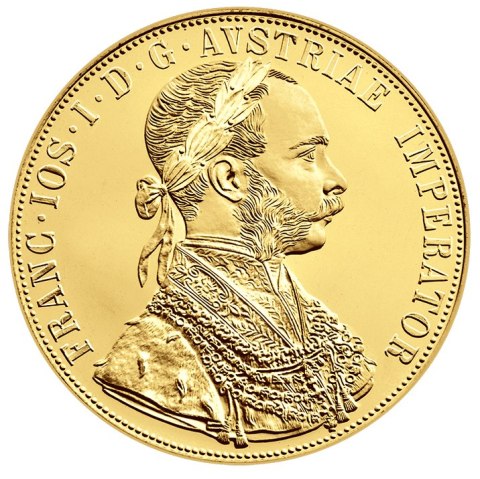
The obverse of the 4 Ducats Quadruple Ducat Austria Restrike coin features the portrait of Franz Joseph I (1830-1916, reign 1848-1916) — the longest-reigning Habsburg (68 years on the throne). The emperor is shown in right profile, with beard and moustache in the style known from official portraits of the late 19th century. Around the portrait is the Latin inscription FRANC IOS I D G AVSTRIAE IMPERATOR — "Franz Joseph I, by the Grace of God Emperor of Austria". The larger diameter of the Quadruple Ducat (39.5 mm vs 19.75 mm of the single ducat) allows exceptional detail accuracy of the portrait.
The designer of the 1872 design is Anton Scharff (1845-1903) — Viennese medallist and engraver, chief medallist of the Vienna Mint at the end of the 19th century. Scharff designed most Austro-Hungarian coins of the Franz Joseph I era: ducats (1872), 4 ducats (1872), Austro-Hungarian crowns (from 1892) and numerous commemorative medals. His style is characterised by high portrait quality — Scharff depicted the emperor with photographic accuracy. The Quadruple Ducat restrike retains the 1872 design (older head of Franz Joseph) without modifications — all restrike Quadruple Ducats of Münze Österreich 1920-present have an identical obverse.
The obverse inscription FRANC IOS I D G AVSTRIAE IMPERATOR (Franciscus Iosephus I Dei Gratia Austriae Imperator) is the standard formula used on Austrian and Austro-Hungarian coins since 1872. "FRANC IOS I" means Franz Joseph I, "D G" — "Dei Gratia" (by the Grace of God) — the traditional titulature of European monarchs. "AVSTRIAE IMPERATOR" — Emperor of Austria — is the central title on the obverse. The scale of the Quadruple Ducat allows clearer reading of the inscription without using a magnifier — the coin is preferred by investors and collectors valuing detail expressiveness.
The Quadruple Ducat restrike with the 1915 date has uniform production quality — modern dies and state-mint quality control guarantee identical relief on all pieces. This is a significant difference from 1872-1915 originals, where production variants and signs of circulation can introduce variability in quality and require assessment on the numismatic scale (MS, VF). The restrike is preferred by investors valuing product standardisation — each restrike Quadruple Ducat has identical technical parameters and appearance.
Reverse — imperial Habsburg double-headed eagle
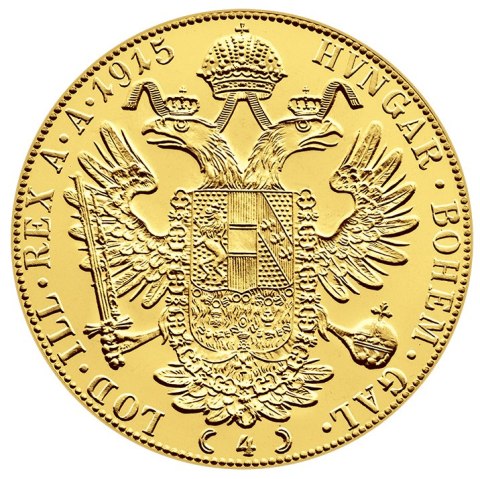
The reverse of the 4 Ducats Quadruple Ducat Austria Restrike coin features the imperial Habsburg double-headed eagle (Doppeladler) — symbol of the Austrian Empire since 1804 and of the Austro-Hungarian monarchy since 1867 (after the Ausgleich — the Austro-Hungarian Compromise). The eagle is depicted with two heads turned in opposite directions, crowns above each head, sceptres and a sword in the talons, and smaller coats of arms of the Habsburg states on the shield. The reverse also bears the date 1915 (fixed on all restrikes) and the inscription HVNGAR BOHEM GAL LOD ILL REX AA. The larger diameter of the Quadruple Ducat (39.5 mm) allows exceptionally detailed rendering of all the heraldic elements of the eagle.
The two heads of the eagle symbolise the two parts of the dualistic Austro-Hungarian monarchy — the Austrian Empire (eastern head, facing right from the viewer's perspective) and the Kingdom of Hungary (western head, facing left) — joined into a single state organism under one monarch (Franz Joseph I), but with separate administrations and parliaments. Each head has its own crown: the crown of the Austrian Empire (Hauskrone of Rudolf II from 1602) and the Crown of Saint Stephen (the Crown of the Kingdom of Hungary from the 10th century). The sceptres in the eagle's talons represent imperial (right) and royal (left) authority.
The inscription HVNGAR BOHEM GAL LOD ILL REX AA — the Latin abbreviation Hungariae Bohemiae Galiciae Lodomeriae Illyriae Rex, Archidux Austriae — means "King of Hungary, Bohemia, Galicia, Lodomeria, Illyria, Archduke of Austria". It is the abbreviated title of Franz Joseph I covering the main Habsburg states: Hungary, Bohemia, Galicia and Lodomeria (Austrian province of Poland), Illyria (Slovenia, Croatia, parts of Dalmatia). The abbreviations "REX" (king) and "AA" (Archidux Austriae — Archduke of Austria) close the titulature. The 1915 date is a fixed reference date on the restrike — distinguishes the restrike from 1872-1915 originals bearing various annual dates.
The double-headed eagle design from 1872 — by Anton Scharff — is the standard for all Austro-Hungarian Quadruple Ducats of issues 1872-1915 and Münze Österreich restrikes 1920-present. The central shield of the eagle contains the smaller arms of the constituent states of the monarchy — including the arms of Bohemia (two-tailed lion), the arms of Galicia, the arms of Illyria. The scale of the Quadruple Ducat (39.5 mm) allows recognition of all heraldic details without using a magnifier. The restrike retains all elements of the original design without modifications — the 1872 design is unchanged for over 150 years of continuous production (originals 1872-1915 + restrike 1920-present).
What to look out for when buying
Check the status of the coin — original or restrike (Nachprägung). The restrike (Nachprägung) Quadruple Ducat of Münze Österreich bears the 1915 date as a fixed inscription — regardless of the actual year of production (1920+). Original circulation issues (1872-1915) bear various annual dates and have higher collector value than restrikes, but also a higher market premium (typically 5-10% vs 4-7% on restrikes). For an investment strategy focused on gold content, the restrike Quadruple Ducat is optimal — identical bullion weight (13.7684 g), lower premium.
The market premium on Münze Österreich restrike Quadruple Ducats typically holds in the range of 4-7% over spot — lower than on original circulation issues (5-10%), comparable to mass bullion coins of 999.9 fineness (Maple Leaf, Krugerrand, typically 4-7%). For comparison, premium on single restrike ducats is 3-5% — lower, but applies to smaller weight (3.4421 g). The Quadruple Ducat restrike in the "half-ounce" class offers a competitive price for significant gold weight in the classic Habsburg design — an attractive alternative to 1/2 oz Maple Leaf or 1/2 oz Krugerrand with comparable weight.
Check authenticity and weight — the Münze Österreich restrike Quadruple Ducat weighs 13.9636 g gross with state-mint tolerance. The 986/1000 fineness is one of the highest among historic gold coins — the Quadruple Ducat is soft to the touch (small amount of copper in the alloy), which may cause light scratches on the surface during careless handling. Each coin is delivered in an individual protective capsule to preserve the surface and facilitate identification of authenticity (dimensions 13.9636 g / 39.5 mm / fineness 986). The restrike has uniform relief and quality — all pieces are in Mint State (BU — Brilliant Uncirculated).
Check the manufacturer — all authentic restrike Quadruple Ducats come exclusively from Münze Österreich (Vienna). The mint is a subsidiary of the Austrian National Bank and the only entity legally entitled to strike Austrian Quadruple Ducats with the 1915 date. Strikes from other mints (e.g. contemporary East European copies) are counterfeits or illegal restrikes, regardless of declared fineness. Standard mint markings (Münze Österreich mark) are subtle and require examination under a magnifier — therefore purchase documents from a certified dealer are important for later resale.
Why GoldInvest24
- Full offer of Austrian historic Münze Österreich coins: our catalogue features all key Austrian issues — 1 and 4 ducats (Quadruple Ducat), 20 crowns, both in original (1872-1915 originals) and restrike (1915-dated restrike) variants. A full cross-section allows building a balanced Habsburg gold portfolio adjusted to the investment and collector strategy.
- Manufacturer LBMA Good Delivery-accredited since 1962: Münze Österreich holds LBMA Good Delivery accreditation — the highest international refining standard — which guarantees compliance with international requirements on fineness, weight and purity for all products (Philharmonics, ducats, crowns). The LBMA accreditation is a condition of acceptance in interbank trading and a guarantee of authenticity.
- PL / DE / EN language versions: full technical descriptions and specifications in three languages for convenient service of the Polish, German and international markets — particularly valuable for Austrian historic coins with numismatic terminology in German (Dukatengold, Nachprägung, Vierfachdukaten, Doppeladler) and Latin (inscriptions on the coin).
- Current precious-metals quotes: spot data for comparing offer prices with current market valuation — check the current precious-metals prices before purchase to assess the effective premium on restrike Quadruple Ducats relative to the current gold price.
- Full precious-metal categories in one shop: access to gold investment coins, bars, silver, platinum and palladium — all from a single customer account, with full PL/DE/EN support and unified ordering policy across all product categories.
Comparison of 5 coins in pack 106 — Austrian Habsburg coins
| Feature |
1 Ducat BU (786) |
1 Ducat Original (81) |
4 Ducats Trade Strike (80) |
4 Ducats BU (787) |
20 Crowns (360) |
| Status |
Restrike (1920+) BU |
Original 1872-1915 |
Restrike (1920+) Trade strike |
Restrike (1920+) BU |
Restrike (1920+) |
| Pure gold |
3.4421 g |
3.4421 g |
13.7684 g |
13.7684 g |
6.0975 g |
| Gross mass |
3.4909 g |
3.4909 g |
13.9636 g |
13.9636 g |
6.7751 g |
| Fineness |
0.986 |
0.986 |
0.986 |
0.986 |
0.900 |
| Diameter |
19.75 mm |
19.75 mm |
39.5 mm |
39.5 mm |
21.0 mm |
| Obverse |
Franz Joseph I |
Franz Joseph I |
Franz Joseph I |
Franz Joseph I |
Franz Joseph I |
| Designer |
Anton Scharff |
Anton Scharff |
Anton Scharff |
Anton Scharff |
Anton Scharff |
| Typical premium |
3-5% |
4-8% |
4-7% |
6-10% |
3-6% |
See the entire gold investment coins category available at GoldInvest24.
FAQ — common questions about the 4 Ducats Quadruple Ducat Austria Restrike
What is the 4 Ducats Quadruple Ducat Austria Restrike?
The 4 Ducats Quadruple Ducat Austria Restrike is a new strike (restrike, German Nachprägung) struck by Münze Österreich since 1920 with the original 1915 date as the reference date. "Quadruple Ducat" (Vierfachdukaten in German, Czworak in Polish) is the only official multiple of the Dukatengold standard. Gross mass 13.9636 g, pure gold 13.7684 g (= 4 × 3.4421 g of a single ducat), 0.986 fineness, 39.5 mm diameter. Obverse: portrait of Franz Joseph I (Anton Scharff, 1872). Reverse: Habsburg double-headed eagle. Status: legal tender of the Republic of Austria.
What is the technical specification of the 4 Ducats Austria Restrike?
Gross mass 13.9636 g (gold + small copper), pure-gold mass 13.7684 g (= 4 × 3.4421 g of a single ducat), 0.986 fineness (classic Dukatengold, 23.75 carats), 39.5 mm diameter, approx. 1.1 mm thickness. Manufacturer: Münze Österreich (Vienna), LBMA Good Delivery accreditation since 1962. Obverse: portrait of Franz Joseph I (Anton Scharff, 1872), inscription FRANC IOS I D G AVSTRIAE IMPERATOR. Reverse: Habsburg double-headed eagle, inscription HVNGAR BOHEM GAL LOD ILL REX AA, 1915 date as a fixed inscription.
What is the history of the 4 Ducats (Quadruple Ducat) and Münze Österreich restrike?
4 Ducats (Quadruple Ducat / Vierfachdukaten / Czworak) — historic multiple of the Dukatengold standard struck in Austria 1659-1915. Standard stabilised in the 18th century, design unified in 1872 by Anton Scharff. Münze Österreich founded 1194 — the oldest operating European mint. After the First World War (1918) the Republic of Austria continues striking Quadruple Ducats from 1920 with the 1915 date as a fixed inscription — the longest continuous restrike in the history of numismatics. LBMA since 1962. The Quadruple Ducat is the only official Dukatengold multiple.
How does the restrike Quadruple Ducat differ from the original?
Restrike (Nachprägung) — new strike of Münze Österreich 1920-present with the 1915 date as a fixed inscription, regardless of actual year of production. Premium 4-7% over spot. Original (Originalprägung) — historic 1872-1915 original, various annual dates on the reverse, higher collector value. Premium 5-10% over spot. Technical specification identical (13.9636 g gross, 13.7684 g pure gold, 0.986 fineness, 39.5 mm diameter). For an investment strategy focused on gold content, the restrike is optimal (lower premium, identical weight).
For whom is the 4 Ducats Quadruple Ducat Austria Restrike a practical choice?
For investors valuing significant gold weight in a single coin (13.7684 g, half-ounce class) — Quadruple Ducat restrike offers four times the ducat at a competitive premium 4-7%. For those building a portfolio of Austrian Habsburg coins (Münze Österreich) as a core due to availability and low premium. For buyers seeking an alternative to 1/2 oz Maple Leaf or 1/2 oz Krugerrand with classic historic design and higher fineness (986 vs 916.67-999.9). All pieces in BU (Brilliant Uncirculated) condition.
What is the LBMA, VAT, CGT and IRA status of the 4 Ducats Quadruple Ducat Austria Restrike?
LBMA Good Delivery — YES, Münze Österreich LBMA-accredited since 1962 (the highest international refining standard). VAT in the EU — EXEMPT (legal-tender coin, 0.986 fineness ≥ 0.900, struck after 1800 — meets EU Directive 2006/112/EC Art. 344 and Polish VAT Act Art. 122). CGT-free in the UK — NO (CGT-free status applies only to British legal tender). IRA-eligible in the USA — NO (the IRS admits only American coins and selected modern bullion).
How do I buy the 4 Ducats Quadruple Ducat Austria Restrike at GoldInvest24?
Place an order in our shop with access to the full gold investment coins category, the complete offer of Austrian Habsburg coins (1 and 4 ducats original and restrike, 20 crowns) and products of other LBMA mints. Check the current gold quotes to compare the premium against the current spot price. Technical descriptions and specifications are available in PL / DE / EN language versions.
![[{[item.product.name]}]]([{[item.product.photo.url]}] 75w)