50 Peso Mexico Centenario Gold Coin — the largest historic gold coin of Latin America, commemorative issue of the centenary of Mexican independence 1810-1910
The 50 Peso Mexico "Centenario" gold coin is the largest and heaviest historic gold coin of Mexico — a commemorative issue of the centenary of Mexican independence (1810-1910), struck by the Casa de Moneda de México from 1921 to 1947 and as a restrike from 1949 to 1972 (with the 1947 date as a fixed inscription). Specification: gross mass 41.6666 g, pure-gold mass 37.5000 g (= 1.2057 troy oz, more than 1 ounce), 0.900 fineness, 37.0 mm diameter and a face value of 50 Mexican pesos. The obverse features the Angel of Independence (Ángel de la Independencia) — a replica of the gold angel crowning the Independence Monument in Mexico City (1910); the reverse — the Mexican eagle "Águila Mexicana" (eagle on a nopal cactus with a snake in its beak, motif from Aztec mythology and the Mexican coat of arms). The most liquid historic Latin American coin with a typical market premium of 3-7% over spot — one of the lowest in the segment of historic coins over 1 oz. VAT-exempt in the EU as a historic legal-tender coin with a fineness ≥0.900 struck after 1800.
Technical specification
| Parameter |
Value |
| Manufacturer |
Casa de Moneda de México (Mexico City) — oldest mint in the Americas since 1535 |
| Series |
50 Peso Centenario — commemorative issue of the centenary of Mexican independence 1810-1910 |
| Mintage years |
1921-1947 and restrike 1949-1972 (with date 1947 as fixed inscription) |
| Standard |
0.900 fineness, mass standardised for the international market (1.2057 troy oz) |
| Gross mass |
41.6666 g (gold + copper) |
| Pure gold mass |
37.5000 g (= 1.2057 troy oz, more than 1 ounce) |
| Fineness |
0.900 (Au 90% + Cu 10%) |
| Diameter |
37.0 mm |
| Thickness |
approx. 2.7 mm |
| Face value |
50 Mexican pesos (historic legal tender, 1 peso = 100 centavos) |
| Obverse |
Angel of Independence (Ángel de la Independencia) — replica of the gold angel of the Independence Monument in Mexico City (1910) |
| Reverse |
Águila Mexicana — Mexican eagle on a nopal cactus with a snake in its beak, ESTADOS UNIDOS MEXICANOS, 50 PESOS, year |
| Historic status |
Commemorative issue of the centenary of Mexican independence (1810-1910) |
| VAT in the EU |
Exempt (legal-tender coin, 0.900 fineness, struck after 1800, EU Directive 2006/112/EC Art. 344) |
| UK status |
NOT CGT-free (CGT exemption applies only to British legal tender) |
| USA status |
NOT IRA-eligible (historic coins are not on the IRS-approved list) |
| Packaging |
Individual protective capsule |
Why 50 Peso Mexico Centenario deserves a place in your portfolio
- Largest historic gold coin of Mexico — 37.5 g pure gold (more than 1 oz): 50 Peso Centenario contains 37.5 g of pure gold = 1.2057 troy oz — more than 1 ounce, less than 1.5 oz, in a unique format between classic bullion denominations. Larger than the American Double Eagle (30.0926 g) and Krugerrand (31.1035 g), smaller than the Mexican 100 peso (75 g) or Swiss 100 LMU francs. Optimal weight/dimension ratio for an investor seeking significant bullion weight in a single historic coin.
- Most liquid historic Latin American coin — premium 3-7% over spot: 50 Peso Centenario has the lowest premium in the segment of historic coins over 1 oz — typically 3-7% over spot. This results from the large production scale (1921-1947 + restrike 1949-1972 = over 50 years of continuous emission), the high gold weight (scale effect on percentage premium) and the strong Latin American market (Mexico, USA — large Mexican community). The most liquid historic Latin American coin on the global market, also known as the "Mexican gold ounce" among English-speaking investors.
- Casa de Moneda de México — oldest mint in the Americas since 1535: the Casa de Moneda de México (Mexican Mint) was established in 1535 in Mexico City by Viceroy Antonio de Mendoza on the orders of Charles I of Spain (Charles V Holy Roman Emperor) — it is the oldest mint in the Americas and one of the oldest operating mints in the world. The mint produced Spanish reales (1535-1821), Mexican pesos after independence (1821-present), 50 Peso Centenario from 1921 — almost 500 years of continuous numismatic history.
- "Centenario" — commemorative issue of the centenary of Mexican independence 1810-1910: the name "Centenario" (Spanish for "centenary") comes from the commemorative character of the coin — issued on the occasion of the 100th anniversary of Mexican independence (16 September 1810 — 16 September 1910), although actual issue began in 1921, 11 years after the anniversary. The Angel of Independence on the obverse is a replica of the gold angel crowning El Ángel de la Independencia — a monument erected in 1910 for the 100th anniversary of independence in Mexico City (Paseo de la Reforma). The coin is a physical artefact of the centenary of Mexican independence and a symbol of modern 20th-century Mexico.
- Águila Mexicana — eagle on a nopal cactus with snake in beak, motif from Aztec mythology: the reverse features the Águila Mexicana (Mexican Eagle) — an eagle on a nopal cactus holding a snake in its beak, a motif from Aztec mythology (founding legend of Tenochtitlán in 1325 — the god Huitzilopochtli showed the Aztecs the place where they would see an eagle on a cactus with a snake in its beak, as the place to found their capital). The motif appears on the flag, coat of arms and state seal of Mexico from 1821 (declaration of independence) — one of the most recognisable Latin American national symbols.
History of the 50 Peso Mexico Centenario (1921-1972) — commemorative issue of the independence centenary
The 50 peso "Centenario" gold coin was introduced in 1921 — as a commemorative issue of the centenary of Mexican independence, although in fact 11 years after the actual anniversary (16 September 1910). Mexican independence began on 16 September 1810 with the "Grito de Dolores" — the cry for independence by priest Miguel Hidalgo y Costilla in the town of Dolores (today Dolores Hidalgo, Guanajuato) — and ended on 27 September 1821 with the entry of the Three Guarantees Army of Augustín de Iturbide into Mexico City. The 100th anniversary of independence in 1910 was marked by the erection of the El Ángel de la Independencia monument in Mexico City (on Paseo de la Reforma) — a 36-metre column with a 6.7-metre gilded angel at the top.
The 11-year delay between the centenary (1910) and the striking of the 50 Peso Centenario (1921) results from the turbulent period of the Mexican Revolution (1910-1920) — a civil war that shook the country and delayed all state projects. After the overthrow of President Porfirio Díaz in 1911 came a 10-year period of political instability involving Francisco Madero, Pancho Villa, Emiliano Zapata, Venustiano Carranza and Álvaro Obregón. The Constitution of 1917 ended the main period of the revolution, but only in 1921 — the year of celebrations of the 100th anniversary of the consummation of independence (27 September 1821) — did the Mexican mint strike the first series of 50-peso Centenario coins.
The Casa de Moneda de México (Mexico City) — the oldest mint in the Americas, established in 1535 — produced 50 Peso Centenario continuously 1921-1947 (26 years of original issue), with various mintages depending on demand and Mexico's economic conditions. All coins of original production bear the actual year of issue (1921, 1922, 1923... up to 1947) as annual dates. In 1949 the mint introduced a restrike — production of new coins with the 1947 date as a fixed reference date (analogous to the Austrian ducats of Münze Österreich with the 1915 date). The restrike 1949-1972 created an additional large supply on the market — approximately 4 million pieces with the 1947 date struck during the restrike period.
In total, the production of the 50 Peso Centenario over 51 years (1921-1972) included: approximately 1 million pieces of original production 1921-1947 and approximately 4 million pieces of restrike 1949-1972 (with the 1947 date) — a total of approximately 5 million coins. The restrike 1949-1972 with the 1947 date is the most common version on the secondary market and is practically indistinguishable from the original 1947 issue (identical date, identical specification, identical mint dies). For an investment strategy focused on gold content, the original and the restrike are equivalent — the collector value difference concerns only the earlier dates of the originals (1921-1946), which are rarer and more collectible.
After 1972 the Casa de Moneda de México ended production of the 50 Peso Centenario, but the coin retained its status as historic legal tender of Mexico and the original designs (Angel of Independence, Águila Mexicana). Today 50 Peso Centenario is the most well-known and most liquid historic gold coin of Latin America — popular among Mexican, American (especially the Mexican community in the USA), Canadian and European investors. The Casa de Moneda continues to produce other Mexican coins (circulating peso, silver Libertad from 1982, gold Libertad from 1981) as the oldest operating mint in the Americas.
Obverse — Angel of Independence (Ángel de la Independencia)
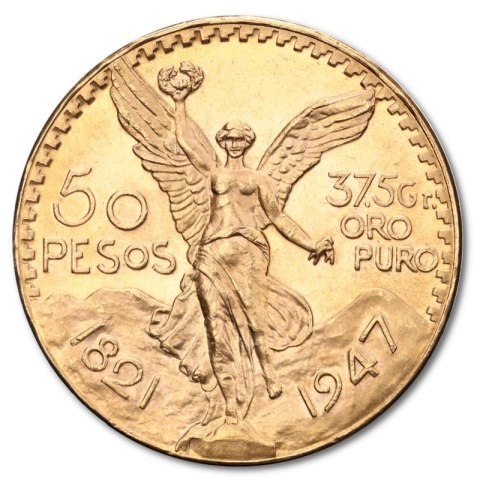
The obverse of the 50 Peso Mexico Centenario coin features the Angel of Independence (Ángel de la Independencia) — a replica of the gold angel crowning the Independence Monument in Mexico City. The angel stands on a globe with a laurel branch in its right hand (symbol of victory) and broken chains in its left hand (symbol of liberation from Spanish colonial rule). Around the angel is the inscription 50 PESOS and two dates: 1821 (the year of the consummation of Mexican independence — Tratado de Córdoba signed on 24 August 1821, entry of the Three Guarantees on 27 September 1821) and the year of the actual issue of the coin (1921, 1922... 1947 for originals; 1947 for all restrikes 1949-1972).
The El Ángel de la Independencia monument — from which the angel design on the coin comes — was erected in 1910 on Paseo de la Reforma in Mexico City for the 100th anniversary of Mexican independence. The monument consists of a 36-metre white marble column crowned by a 6.7-metre figure of an angel made of bronze covered with 24-carat gold. The angel — formally called Niké ("Victoria", Greek goddess of victory) — was designed by the Italian sculptor Enrique Alciati and Antonio Rivas Mercado, the chief architect of the monument. The monument became a symbol of Mexico City and a place of patriotic celebrations (Independence Day 16 September).
The angel on the 50 Peso Centenario coin is an exact replica of the monument angel — with a laurel branch (Laurel) in the right hand and broken chains (Cadenas Rotas) in the left. The symbols are classic: laurel — victory (victory over Spanish colonial rule), broken chains — liberation (from the colonial dependence of the Viceroyalty of New Spain 1521-1821, a total of 300 years of Spanish rule over Mexico). The figure of the angel stands on a globe, symbolising the global reach of the ideals of freedom (echo of the French Statue of Liberty 1886 — analogous female figure symbolising liberty).
The dates 1821-1947 (or the appropriate year for originals) on the obverse reflect symbolic anniversaries: 1821 — consummation of Mexican independence (formal separation from Spain), 1921-1947 — period of striking the Centenario originals, 1947 — fixed date of the restrike (1949-1972). The form "1821 - 1947" on restrikes is widely encountered on the secondary market — interpreted as "126th anniversary of independence" (1947-1821=126), although in fact the restrike with this date was still being produced in 1972 (151st anniversary). For the collector strategy, earlier dates of the originals (1921, 1925, 1930, 1943) are more valuable than the restrike with the 1947 date.
Reverse — Águila Mexicana (Mexican eagle on a nopal cactus with snake in its beak)
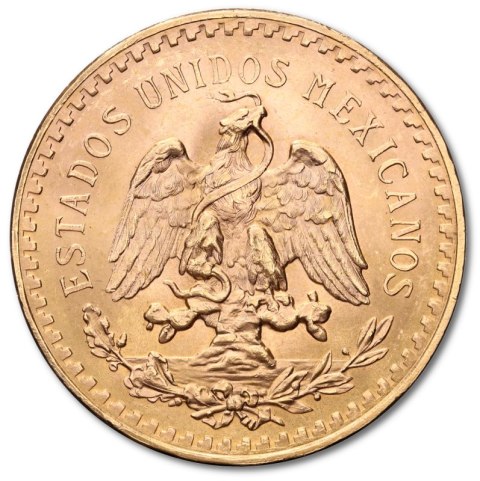
The reverse of the 50 Peso Mexico Centenario coin features the Águila Mexicana (Mexican Eagle) — an eagle on a nopal cactus holding a snake in its beak. Around the eagle is the inscription ESTADOS UNIDOS MEXICANOS (United Mexican States — the official name of Mexico from 1824). The Águila Mexicana is the central heraldic symbol of Mexico — it appears on the flag (central element), coat of arms and state seal, and on most Mexican coins (circulating peso, silver Libertad, gold Libertad, 50 Peso Centenario).
The Águila Mexicana has deep roots in Aztec (Mexica) mythology — according to the founding legend of Tenochtitlán of 1325, the god of sun and war Huitzilopochtli showed the wandering Aztecs the place where they would see an eagle perching on a nopal cactus and eating a snake, as the place to found the capital of their new state. The Aztecs saw this sign on an island in the middle of Lake Texcoco (where Mexico City is now), where they founded Tenochtitlán in 1325 — the capital of the Aztec empire, conquered by the Spanish conquistadors of Hernán Cortés in 1521 (today Mexico City).
After Mexican independence (1810-1821) and the establishment of the First Mexican Empire (Augustín I, 1821-1823), the new government adopted the Águila Mexicana as the state coat of arms — continuing the Aztec historic roots of Mexican national identity. The design was standardised in the 20th century — eagle facing right, on a nopal cactus (Opuntia), holding a snake in its beak and talons, against a background of laurel and oak branches. The snake in the beak symbolises the struggle of good against evil (eagle = good, snake = evil) — a theme from Christian heraldry overlaid on Aztec roots.
The inscription ESTADOS UNIDOS MEXICANOS — United Mexican States — is the official name of Mexico from 1824 (first constitution after the empire of Augustín I). The name reflects the federal structure of the state (32 federal states), modelled on the United States of America (Constitución de Estados Unidos Mexicanos 1824 was inspired by the American constitution of 1787). Mexico City (Ciudad de México, CDMX) is the federal capital and a separate entity (since 2016 as CDMX, previously Distrito Federal). The Casa de Moneda de México is located in Mexico City — in the historic centre of the city, near the Palacio Nacional.
What to look out for when buying
Check authenticity and specification — 50 Peso Centenario weighs 41.6666 g gross, contains 37.5000 g of pure gold (= 1.2057 troy oz) at 0.900 fineness, 37.0 mm diameter, approx. 2.7 mm thickness. The specification is constant for all issues 1921-1972 (originals and restrikes). Counterfeits of the 50 Peso Centenario are known on the market — particularly copies from the 1960s-1970s from the Middle East or modern Chinese replicas with lower fineness. Due to the high value of the coin (over 1 oz of gold), purchase documents from a certified gold dealer and possibly PCGS or NGC grading are important to secure authenticity.
Check the date and status — originals 1921-1946 (with various annual dates) vs originals 1947 vs restrike 1947 (1949-1972). The technical specification is identical in all three variants (41.6666 g gross, 37.5000 g pure gold, 0.900 fineness). The collector value differs: originals 1921-1946 — most valuable (original date, smaller mintages), collector premium 10-50% over the standard bullion price; originals 1947 — higher premium than restrike, but lower than earlier dates; restrike 1947 (1949-1972) — most common version on the secondary market, lowest premium (3-7%). For the bullion strategy the restrike is optimal, for the collector strategy — earlier dates of the originals.
Check the state of preservation — 50 Peso Centenario has a 51-year production period (1921-1972) with various states of preservation of coins in circulation. The most common state is AU-MS (About Uncirculated - Mint State) due to weak circulation in the Mexican economy (high-denomination coin, mainly hoarded). VF-EF condition is rarer. For the investment strategy any state of preservation is acceptable (value proportional to gold content), for the collector strategy MS-63 or higher is preferred (with PCGS/NGC grading).
The market premium on the 50 Peso Centenario typically holds in the range of 3-7% over spot — the lowest in the segment of historic coins over 1 oz. For comparison: American Double Eagle (0.9675 oz) — premium 6-12%; modern Krugerrand (1 oz) — premium 4-7%; Swiss 100 LMU francs (29.03 g) — premium 5-10%. 50 Peso Centenario has the best price-to-bullion-weight ratio in the segment of historic coins over 1 oz — mainly thanks to the large production scale (5 million coins) and the strong Latin American market (Mexico, USA — large Mexican community).
Why GoldInvest24
- Full offer of historic world coins — 50 Peso as Latin American representation: our catalogue features not only 50 Peso Centenario, but also other great historic coins — the American Double Eagle (USA), the German 20 Marks (German Empire), the Dutch 10 Guilders, the South African 2 Rand. 50 Peso is the Latin American representation in this collection — the largest and most liquid historic gold coin of Latin America. A full cross-section allows building a balanced portfolio of historic gold from 5 continents.
- Casa de Moneda de México — oldest mint in the Americas since 1535: the Mexican Mint is one of the oldest operating mints in the world — 490 years of continuous numismatic history. Established by Viceroy Antonio de Mendoza in 1535 on the orders of Charles I of Spain, the mint produced Spanish reales (1535-1821), Mexican pesos after independence (1821-present), 50 Peso Centenario from 1921, silver and gold Libertad from 1981/1982. The oldest mint in the Americas and one of the most important producers of Latin American gold.
- PL / DE / EN language versions: full technical descriptions and specifications in three languages for convenient service of the Polish, German and international markets — particularly valuable for Mexican historic coins with Spanish terminology (Centenario, Águila Mexicana, Casa de Moneda, Angel of Independence) preserved in descriptions in all three languages.
- Current precious-metals quotes: spot data for comparing offer prices with current market valuation — check the current precious-metals prices before purchase to assess the effective premium on 50 Peso Centenario relative to the current gold price.
- Full precious-metal categories in one shop: access to gold investment coins, bars, silver, platinum and palladium — all from a single customer account, with full PL/DE/EN support and unified ordering policy across all product categories.
Comparison of 5 great historic world gold coins of package 107
| Feature |
20 USD Double Eagle Liberty |
2 Rand RSA Springbok |
20 Marks Wilhelm I |
10 Guilders Netherlands |
50 Peso Centenario |
| Country |
USA |
South Africa |
German Empire |
Netherlands |
Mexico |
| Mintage years |
1850-1907 |
1961-1983 |
1871-1888 |
1875-1933 |
1921-1947 (restrike 1949-1972) |
| Pure gold |
30.0926 g |
7.3224 g |
7.1685 g |
6.048 g |
37.5000 g |
| Gross mass |
33.4362 g |
7.9881 g |
7.9650 g |
6.720 g |
41.6666 g |
| Fineness |
0.900 |
0.9167 |
0.900 |
0.900 |
0.900 |
| Diameter |
34.0 mm |
22.07 mm |
22.5 mm |
22.5 mm |
37.0 mm |
| Obverse |
Liberty Head |
Jan van Riebeeck |
Wilhelm I |
Wilhelm III / Wilhelmina |
Angel of Independence |
| Reverse |
Bald Eagle |
Springbok |
Reichsadler |
Heraldic shield |
Águila Mexicana |
| Typical premium |
6-12% |
5-10% |
4-9% |
4-8% |
3-7% |
See the entire gold investment coins category available at GoldInvest24.
FAQ — common questions about the 50 Peso Mexico Centenario
What is the 50 Peso Mexico Centenario?
50 Peso Mexico Centenario is the largest historic gold coin of Mexico — a commemorative issue of the centenary of Mexican independence (1810-1910), struck by the Casa de Moneda de México from 1921 to 1947 and as a restrike from 1949 to 1972 (with the 1947 date as a fixed inscription). Gross mass 41.6666 g, pure gold 37.5000 g (= 1.2057 troy oz, more than 1 ounce), 0.900 fineness, 37.0 mm diameter. Obverse: Angel of Independence (replica of the gold angel of the Independence Monument in Mexico City 1910). Reverse: Águila Mexicana (Mexican eagle on a nopal cactus with snake in beak), ESTADOS UNIDOS MEXICANOS, 50 PESOS. The most liquid historic Latin American coin, premium 3-7% over spot.
What is the technical specification of the 50 Peso Centenario?
Gross mass 41.6666 g (gold + copper), pure-gold mass 37.5000 g (= 1.2057 troy oz, more than 1 oz), 0.900 fineness (Au 90% + Cu 10%), 37.0 mm diameter, approx. 2.7 mm thickness. Manufacturer: Casa de Moneda de México (Mexico City, oldest mint in the Americas since 1535). Obverse: Angel of Independence (replica of the 1910 monument), 50 PESOS, dates 1821 and year of actual issue. Reverse: Águila Mexicana (eagle on a nopal cactus with snake), ESTADOS UNIDOS MEXICANOS. Legal tender of Mexico.
What is the history of the 50 Peso Centenario?
Introduced 1921 as a commemorative issue of the centenary of Mexican independence (1810-1821 war of independence, 1821 consummation). 11-year delay after the centenary (1910) — Mexican Revolution 1910-1920. Struck 1921-1947 at the Casa de Moneda de México (original issue, 1 million pieces). Restrike 1949-1972 with the 1947 date as a fixed inscription (4 million pieces, the most common version on the secondary market). A total of approximately 5 million coins. Angel of Independence on the obverse — replica of the gold angel of the El Ángel de la Independencia monument in Mexico City (1910).
How does the 1921-1947 original differ from the 1949-1972 restrike?
Technical specification IDENTICAL: 41.6666 g gross, 37.5000 g pure gold, 0.900 fineness, 37.0 mm diameter. Difference: date on the coin and production period. Originals 1921-1947 bear the actual year of issue (1921, 1922... 1947). The restrike 1949-1972 bears the 1947 DATE as a fixed inscription (regardless of the actual year of production in the 1949-1972 period). Collector value: originals 1921-1946 — most valuable (original dates, smaller mintages), collector premium 10-50%; originals 1947 — average premium; restrike 1947 (1949-1972) — lowest premium (3-7%), the most common version on the secondary market.
For whom is the 50 Peso Centenario a practical choice?
For investors seeking a historic gold coin over 1 oz at a low premium (3-7%) — the most liquid historic Latin American coin. For building a diversified portfolio of historic world gold — 50 Peso as the Latin American representation alongside USA, Germany, Netherlands, RSA. For those valuing a unique weight format (37.5 g = between 1 oz and 1.5 oz). For collectors of Aztec and Mexican numismatics (Águila Mexicana, Angel of Independence). For the Mexican community in the USA — the most recognisable historic Mexican gold coin.
What is the VAT, CGT and IRA status of the 50 Peso Centenario?
VAT in the EU — EXEMPT (historic legal-tender coin, 0.900 fineness ≥ 0.900, struck after 1800, market price ≤180% of gold value — meets EU Directive 2006/112/EC Art. 344 and Polish VAT Act Art. 122). CGT-free in the UK — NO (CGT-free status applies only to British legal tender — Sovereign, Britannia, Lunar UK). IRA-eligible in the USA — NO (the IRS admits only American coins listed — American Gold Eagle, American Buffalo and selected modern bullion; historic coins, including 50 Peso Centenario, are NOT among the approved).
How do I buy the 50 Peso Mexico Centenario at GoldInvest24?
Place an order in our shop with access to the full gold investment coins category, the complete offer of great historic world gold coins (Double Eagle USA, 50 Peso Mexico, 20 Marks Germany, 10 Guilders Netherlands, 2 Rand RSA) and other Mexican coins (50, 20, 10, 5, 2.5, 2 Peso). Check the current gold quotes to compare the premium against the current spot price. Descriptions and specifications are available in PL / DE / EN.