Sovereign King George V 1911-1932 — the last British Sovereign circulation mintage spanning the First World War
The Sovereign King George V 1911-1932 gold coin is a historic Royal Mint Full Sovereign with a gross mass of 7.98805 g, a gold mass of 7.32238 g, a fineness of 916.7/1000 (Crown Gold 22 carat), a 22.05 mm diameter and a 1 GBP face value as legal tender of the United Kingdom. George V (1865-1936) reigned for 26 years (1910-1936), but circulation Sovereigns with his portrait were struck in the UK only until 1917 (halted by the Bank of England due to the First World War), and in colonial mints — India, South Africa, Australia, Canada — until 1932. The coin is VAT-exempt in the EU as a legal-tender coin 916.7 struck after 1800, holds LBMA accreditation and CGT-free status for UK tax residents.
Technical specification
| Parameter |
Value |
| Manufacturer |
Royal Mint (United Kingdom, LBMA Good Delivery since 1750) |
| Type |
Full Sovereign — George V portrait |
| Strike period |
1911-1932 (UK to 1917, colonial to 1932) |
| Gross mass |
7.98805 g |
| Gold mass |
7.32238 g |
| Fineness |
916.7/1000 (Crown Gold, 22 carat) |
| Alloy |
Au 91.67% + Cu 8.33% |
| Diameter |
22.05 mm |
| Thickness |
approx. 1.52 mm |
| Face value |
1 GBP (legal tender United Kingdom) |
| Obverse |
George V — Bertram Mackennal (1911) |
| Reverse |
St. George slaying the dragon — Pistrucci (1817) |
| LBMA status |
Yes (Royal Mint Good Delivery since 1750) |
| VAT in the EU |
Exempt (legal-tender coin, fineness 916.7 >= 900, struck after 1800) |
| UK status |
CGT-free (British legal tender Sovereign) |
| USA status |
NOT IRA-eligible |
| Packaging |
Protective capsule |
Why this Sovereign earns a place in your stack
- Last British Sovereign circulation mintage (UK to 1917): George V Sovereigns were the last British Sovereigns struck for monetary circulation — the Bank of England halted note-to-Sovereign exchange in 1917 due to the First World War, ending the centuries-old tradition of gold pound circulation in the United Kingdom.
- First World War era (1914-1918): George V Sovereigns mark the most turbulent decade of the 20th century — outbreak of the First World War (1914), Russian Revolution (1917), end of the war (1918) and interwar period until 1932 (the date of the last colonial mintage — South Africa Pretoria SA).
- Colonial mintages until 1932 (India, South Africa, Australia, Canada): after the UK halt in 1917, George V Sovereigns continued to be struck at colonial mints — Bombay (I — India 1918), Pretoria (SA — South Africa 1923-1932), Sydney/Melbourne/Perth (S/M/P — Australia to 1931), Ottawa (C — Canada to 1919). The colonial variant SA Pretoria 1932 is the last vintage of classic British Sovereigns.
- CGT-free for UK tax residents: all British Sovereigns hold Capital Gains Tax exempt status for UK tax residents — George V as 1 GBP legal tender qualifies fully for this tax preference.
- VAT-exempt in the EU as a legal-tender coin: fineness 916.7 above 900, strike after 1800 (1911+) and United Kingdom legal-tender status meet all VAT exemption criteria under Polish VAT Act Art. 122 and EU Directive 2006/112/EC Art. 344.
History of George V and the Sovereigns 1911-1932 — from coronation to the end of gold circulation
George V (1865-1936) — second son of Edward VII (the eldest son Albert Edward died of influenza in 1892 before ascending the throne) — ascended the throne on 6 May 1910 after his father's death. The coronation took place on 22 June 1911 at Westminster Abbey, and the first Sovereigns with the George V portrait were also struck in 1911. George V reigned for 26 years (1910-1936), but Sovereigns for UK circulation were struck only until 1917.
The outbreak of the First World War in August 1914 revolutionised British monetary policy — the Bank of England halted note-to-Sovereign exchange and began issuing paper notes (Treasury Notes 10 shillings and 1 pound) to avoid gold outflow abroad. In 1917 the Royal Mint formally ended Sovereign mintage for British monetary circulation, although subsequent issues were struck at colonial mints until 1932.
George V Sovereigns continued to be struck at colonial mints of the British Empire: Bombay/India (mintmark I, only 1918), Sydney/Australia (S, to 1926), Melbourne/Australia (M, to 1931), Perth/Australia (P, to 1931), Ottawa/Canada (C, to 1919) and Pretoria/South Africa (SA, 1923-1932). Pretoria SA 1932 is the last vintage of classic British George V Sovereigns — subsequent issues appeared only after the Second World War (Elizabeth II Sovereigns from 1957).
George V died on 20 January 1936 at Sandringham House at age 70, ending a 26-year reign. The throne was taken over by his eldest son Edward VIII, who abdicated on 11 December 1936 (after 326 days of reign) — Edward VIII Sovereigns never entered circulation. Subsequently, the throne was taken over by George V's younger son — George VI (1936-1952), father of Elizabeth II.
Royal Mint holds LBMA Good Delivery accreditation since 1750 — the oldest active LBMA status among mints and refineries producing gold bullion. The mint operates from the Llantrisant site (Wales) since 1968 after relocation from London's Tower Hill.
Obverse — George V by Bertram Mackennal (1911)
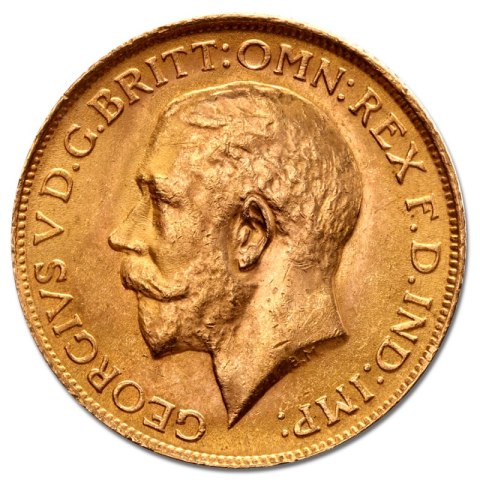
The obverse of the Sovereign George V 1911-1932 features the king's portrait by Bertram Mackennal from 1911 — George V facing left (in line with the convention of changing direction with each monarch — Edward VII faced right). The portrait reflects the 46-year-old king with characteristic pointed beard, distinguished facial expression and Field Marshal uniform — George V was an active military officer and wore the uniform as everyday dress.
Around the portrait are the Latin inscriptions GEORGIVS V D G BRITT OMN REX F D IND IMP (George V by the Grace of God, King of all the Britains, Defender of the Faith, Emperor of India) — the full monarch title valid since the Indian proclamation of 1876. The Emperor of India status (Indiae Imperator) was valid for all monarchs until 1947 (Indian independence under George VI).
Bertram Mackennal (1863-1931) — Australian sculptor born in Melbourne — was the first Australian to receive the noble title of Sir for artistic merit (1921). He designed George V portraits for all coins of the British Empire from 1911 (Sovereign, Half Sovereign, Two Pounds, Five Pounds, silver and copper coins). After Mackennal's death in 1931, the portrait remained in use on the last colonial mintages until 1932.
Reverse — St. George slaying the dragon (Pistrucci 1817)
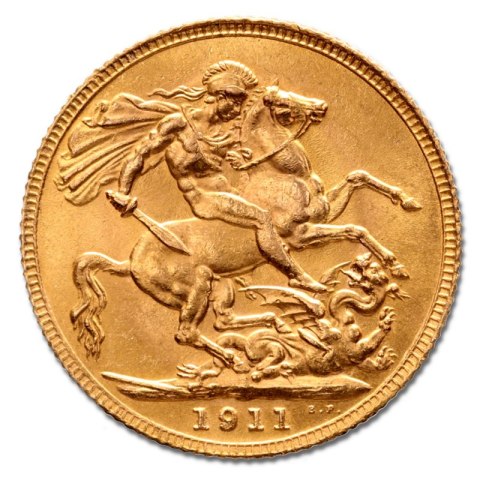
The reverse of the Sovereign George V 1911-1932 shows the classic motif of St. George slaying the dragon in the 1817 Benedetto Pistrucci design — the saint nude on horseback in classical sculpture style, lance raised to deliver the fatal strike on the dragon lying under the horse's hooves. Royal Mint continued exclusive use of the Pistrucci reverse — the George V Sovereign no longer knew the Shield variant (abandoned after 1887).
The motif symbolises the triumph of good over evil and references Christian mythology and the aesthetics of classical Greek and Roman sculpture. In a historical context — particularly for George V Sovereigns from the years of the First World War — the motif of the triumph of good over evil gained additional meaning when the United Kingdom waged war against the German Empire.
Benedetto Pistrucci (1783-1855) — chief engraver of the Royal Mint from 1828 to 1855 — also designed the famous Waterloo Medal commemorating the victory over Napoleon. The 1817 St. George motif remains to this day the Sovereign reverse across all vintages from Victoria Young Head to Charles III 2026 — over 200 years of design continuity.
What to check when buying
Inspect the preservation condition of the Sovereign George V — Crown Gold 22 carat (916.7) is harder than .9999 and less prone to scratching, but specimens from 95-115 years of history (1911-1932+) often show circulation marks. Preservation condition (VF, EF, AU, UNC) significantly affects collector premium — specimens in higher conditions with legible George V pointed beard (Mackennal) achieve higher prices.
The premium on the Sovereign George V is typically 8-15% in the European retail segment — lower than on Victoria Young Head (8-18%) and Edward VII (10-18%) due to greater supply (22 strike years 1911-1932 including colonies). Rarer colonial variants are: Bombay I 1918 (one-year Indian strike), Pretoria SA 1923-1932 (long period of the last Sovereigns), Sydney/Melbourne/Perth — some 1929-1931 vintages achieve clearly higher premiums.
CGT-free status applies to all British Sovereigns — George V as legal tender of the United Kingdom (1 GBP face value) qualifies for the CGT exemption for UK tax residents, regardless of strike vintage and colonial mint. This status distinguishes Sovereigns from neutral bullion coins (Krugerrand, Maple Leaf), which are not CGT-free in the UK.
Check the strike mint — George V Sovereigns were struck at the main Royal Mint in London (no mintmark, until 1917) and at colonial mints: Sydney (S, to 1926), Melbourne (M, to 1931), Perth (P, to 1931), Bombay (I, only 1918), Ottawa (C, to 1919) and Pretoria (SA, 1923-1932). The mintmark is usually placed below the St. George motif on the reverse. Pretoria SA 1932 is the symbolic last vintage of classic British George V Sovereigns.
Why GoldInvest24
- Manufacturers with LBMA accreditation: in the catalogue you will find coins and bars from mints accredited by the London Bullion Market Association — Royal Mint holds LBMA Good Delivery status since 1750, the oldest active status.
- Full Sovereigns size range: Half Sovereign, Full Sovereign, Double Sovereign and Quintuple Sovereign in one shop — allowing the build of a portfolio diversified by unit value.
- Language versions PL / DE / EN: full technical descriptions and specifications in three languages for convenient handling of the Polish, German and international markets.
- Current precious-metals quotes: spot data for comparing offer prices with current market valuation — check current metals prices before purchase.
- Full metals categories in one shop: access to gold bullion coins, bars, silver, platinum and palladium — all from one customer account.
Comparison of 5 Sovereign types — from Edward VII to Charles III
| Feature |
Edward VII |
George V |
Elizabeth II Mix Years |
Elizabeth II 2022 |
Double Sovereign Charles III 2026 |
| Strike period |
1902-1910 |
1911-1932 |
1957-2021 |
2022 |
2026 |
| Strike years |
9 |
22 |
65 |
1 |
1 |
| Portraitist |
G. W. De Saulles |
Bertram Mackennal |
5 portraits 1957-2022 |
Jody Clark (2015) |
Martin Jennings (2022) |
| Gold mass |
7.32238 g |
7.32238 g |
7.32238 g |
7.32238 g |
14.6347 g |
| Fineness |
916.7 |
916.7 |
916.7 |
916.7 |
916.7 |
| Face value |
1 GBP |
1 GBP |
1 GBP |
1 GBP |
2 GBP |
| Typical premium |
10-18% |
8-15% |
5-9% |
8-15% |
5-10% |
| Portfolio function |
Edwardiana |
WWI era |
Bullion CGT-free |
Memorial Year |
Premium Double |
See the full category of gold bullion coins available at GoldInvest24.
FAQ — common questions about the Sovereign George V 1911-1932
What is the Sovereign King George V 1911-1932?
The Sovereign King George V 1911-1932 is a historic Royal Mint Full Sovereign with 7.32238 g of gold, fineness 916.7 (Crown Gold 22 carat), 22.05 mm diameter and 1 GBP face value. George V (1865-1936) reigned for 26 years (1910-1936), but circulation Sovereigns were struck in the UK only until 1917 (halted due to the First World War), and in colonial mints — India, South Africa, Australia, Canada — until 1932. Obverse: portrait by Bertram Mackennal. Reverse: St. George slaying the dragon (Pistrucci 1817).
What is the technical specification of the Sovereign George V?
Gross mass 7.98805 g, gold mass 7.32238 g, fineness 916.7/1000 (Crown Gold 22 carat, alloy Au 91.67% + Cu 8.33%), diameter 22.05 mm, thickness approx. 1.52 mm, face value 1 GBP. Obverse: George V portrait by Bertram Mackennal with characteristic pointed beard, facing left. Reverse: St. George slaying the dragon in the classic Pistrucci 1817 design.
Why did the UK halt Sovereign mintage in 1917?
The Bank of England halted note-to-Sovereign exchange in 1917 due to the First World War (1914-1918) — the goal was to avoid gold outflow abroad and to finance the war effort. Treasury Notes 10 shillings and 1 pound replaced the circulation of gold coins. Royal Mint formally ended Sovereign mintage for UK circulation in 1917, although subsequent issues were struck at colonial mints (India 1918, South Africa 1923-1932, Australia to 1931, Canada to 1919).
How does George V differ from Edward VII, Elizabeth II and Charles III?
George V (1911-1932) — 22 strike years, Mackennal portrait, second son of Edward VII (first died 1892), the last British Sovereign circulation mintage. Edward VII (1902-1910) — 9 years, De Saulles portrait, father of George V. Elizabeth II Mix Years (1957-2021) — 65 years, 5 portraits, granddaughter of George V (after George VI). Charles III (2024+) — newest monarch, Martin Jennings portrait. All have identical Full Sovereign specifications.
For whom is the Sovereign George V a practical choice?
For collectors of 20th-century monarch portraits (Edward VII, George V, Elizabeth II, Charles III), for those valuing the history of Britain in the First World War period (1914-1918) and interwar period (1918-1939), and for UK tax residents using the CGT-free status. The George V collector premium (8-15%) is lower than on Victoria (10-20%) and Edward VII (10-18%) due to greater supply (22 strike years including colonies).
What is the LBMA, VAT, CGT and IRA status of the Sovereign George V?
LBMA Good Delivery — YES (Royal Mint holds the status since 1750, the oldest active). VAT in the EU — EXEMPT (legal-tender coin, fineness 916.7 above 900, struck after 1800 — meets the Polish VAT Act Art. 122 and EU Directive 2006/112/EC Art. 344 criteria). CGT-free in the United Kingdom — YES (British legal tender Sovereign). IRA-eligible in the USA — NO.
How do I buy the Sovereign George V at GoldInvest24?
Place an order in our shop with access to the gold bullion coins category, the full range of Royal Mint Sovereigns (Victoria Young Head, Jubilee, Old Head, Edward VII, George V, Elizabeth II, Charles III) and the offer of LBMA mints. Check the current gold quotes to compare the premium against the current spot price. Technical descriptions and specifications are available in PL / DE / EN language versions.
![[{[item.product.name]}]]([{[item.product.photo.url]}] 75w)