Sovereign Victoria „Young Head" 1838-1887 — the longest-serving queen portrait in British Sovereign history
The Sovereign Victoria „Young Head" 1838-1887 gold coin is a classic Royal Mint Full Sovereign with a gross mass of 7.98805 g, a gold mass of 7.32238 g, a fineness of 916.7/1000 (Crown Gold 22 carat), a 22.05 mm diameter and a 1 GBP face value as legal tender of the United Kingdom. The „Young Head" portrait by William Wyon remained in use for 49 years (1838-1887) — the longest-serving monarch likeness in Sovereign history. The coin is VAT-exempt in the EU as a legal-tender coin with fineness above 900/1000 struck after 1800, holds Royal Mint LBMA accreditation and CGT-free status for UK tax residents.
Technical specification
| Parameter |
Value |
| Manufacturer |
Royal Mint (United Kingdom, LBMA Good Delivery since 1750) |
| Type |
Full Sovereign — „Young Head" portrait |
| Strike period |
1838-1887 (49 years) |
| Gross mass |
7.98805 g |
| Gold mass |
7.32238 g |
| Fineness |
916.7/1000 (Crown Gold, 22 carat) |
| Alloy |
Au 91.67% + Cu 8.33% (classic Crown Gold since 1817) |
| Diameter |
22.05 mm |
| Thickness |
approx. 1.52 mm |
| Face value |
1 GBP (legal tender United Kingdom) |
| Obverse |
Queen Victoria „Young Head" — William Wyon (1838) |
| Reverse |
St. George slaying the dragon — Pistrucci OR Shield Sovereign (depending on vintage) |
| LBMA status |
Yes (Royal Mint Good Delivery since 1750) |
| VAT in the EU |
Exempt (legal-tender coin, fineness 916.7 >= 900, struck after 1800) |
| UK status |
CGT-free (British legal tender Sovereign) |
| USA status |
NOT IRA-eligible (IRA covers only American coins) |
| Packaging |
Protective capsule |
Why this Sovereign earns a place in your stack
- The longest-serving Victoria portrait (49 years 1838-1887): the Sovereign Victoria „Young Head" with the William Wyon portrait ran from Victoria's first regnal year (1838) until the 50-year anniversary of her reign (Golden Jubilee 1887) — that is 49 uninterrupted strike years, the longest single-person likeness on the obverse in British Sovereign history.
- Early industrialisation era of the United Kingdom: Victoria Young Head Sovereigns were struck during the peak of the Industrial Revolution, the expansion of the British Empire and the 1851 Great Exhibition — the historical context raises collector value of specimens in EF (Extremely Fine) condition and above.
- Crown Gold 916.7 — standard since 1817: 22-carat fineness (Au 91.67% + Cu 8.33%) introduced in 1817 alongside the modern Sovereign form remains unchanged to this day — combining scratch resistance (harder alloy than pure .9999 gold) with high precious-metal content.
- CGT-free for UK tax residents: all British Sovereigns hold Capital Gains Tax exempt status for UK tax residents — capital gains from resale are not subject to capital gains tax, a unique privilege of British legal-tender coins.
- VAT-exempt in the EU as a legal-tender coin: Polish VAT Act (Art. 122) and EU Directive 2006/112/EC (Art. 344) exempt from VAT coins with fineness no less than 900/1000, struck after 1800, holding legal-tender status — the Sovereign 916.7 meets all three criteria.
Sovereign history — from Henry VII (1489) to the modern form of 1817
The first Sovereign was struck in 1489 under Henry VII as an exclusive coin weighing approx. 15.55 g (comparable to today's Double Sovereign), serving as a manifestation of royal power and Tudor prestige. The Sovereign of that era carried large, detailed portraits of monarchs on the throne and royal arms — it was used in diplomatic transactions and as royal-treasury reserve.
The modern form of the Sovereign was introduced in 1817 after the Napoleonic Wars, when the United Kingdom stabilised the minting standard and returned to the gold parity. The 1817 vintage set today's parameters: gross mass 7.98805 g, fineness 916.7/1000 (Crown Gold 22 carat), diameter 22.05 mm, face value 1 British pound. These parameters have applied without interruption since 1817 — the Sovereign is one of the longest-running standard bullion coins in the world.
In 1817 the Royal Mint hired Benedetto Pistrucci — an Italian sculptor and engraver — who designed the classic Sovereign reverse showing St. George slaying the dragon. The motif was drawn from Christian mythology and symbolises the triumph of good over evil; Pistrucci placed the saint nude on horseback in classical style, referencing Greek and Roman sculpture. Pistrucci served as chief engraver of the Royal Mint from 1828 to 1855 and is also the author of the Waterloo Medal commemorating the victory over Napoleon.
Victoria ascended the throne in June 1837 after the death of her uncle William IV, and the first Sovereigns with her „Young Head" portrait by William Wyon appeared in 1838. William Wyon (1795-1851) — chief engraver of the Royal Mint from 1828 — designed the portrait of the young queen (then 19 years old) with a laurel crown in classical Roman style. The portrait remained in use for the following 49 years, despite Victoria visibly aging — the Royal Mint did not change the likeness until the Golden Jubilee of 1887.
Royal Mint holds LBMA Good Delivery accreditation since 1750 — the oldest active LBMA status among all refineries and mints producing gold bullion. The mint operates at the Llantrisant site (Wales, United Kingdom) since 1968 after relocation from London's Tower Hill; it currently produces Sovereigns in cooperation with the LBMA under strict quality and alloy-purity audit.
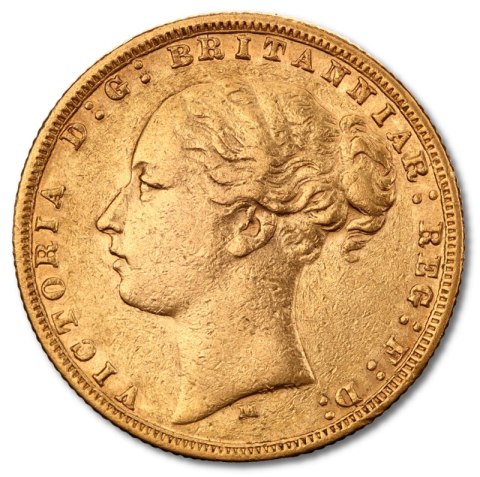
Obverse — Queen Victoria „Young Head" by William Wyon (1838)
The obverse of the Sovereign Victoria 1838-1887 features Queen Victoria's „Young Head" portrait in the version executed by William Wyon in 1838 — the portrait was in use from the queen's first regnal year (1837/1838) until the 50-year anniversary of her reign (Golden Jubilee 1887), giving 49 uninterrupted strike years. Victoria is shown at a young age (19-20) with a laurel crown in Roman style, hair simply pinned up and slightly facing left.
Around the portrait are the inscriptions VICTORIA DEI GRATIA (Victoria by the Grace of God) and BRITANNIAR REGINA FID DEF (Queen of the Britons, Defender of the Faith) — Latin monarch titles still used today by the Royal Mint for official portraits. The strike year is placed on the reverse or in the exergue below the portrait, depending on vintage and mint variant.
William Wyon (1795-1851) — chief engraver of the Royal Mint from 1828 — also designed the popular King Edward VII medal and many institutional medals of 19th-century Britain. The „Young Head" Victoria portrait is regarded as one of his best sculptural works; despite the monarch aging, the Royal Mint retained this likeness until 1887, when the 50-year jubilee justified introducing the new „Jubilee Head" portrait by Boehm.
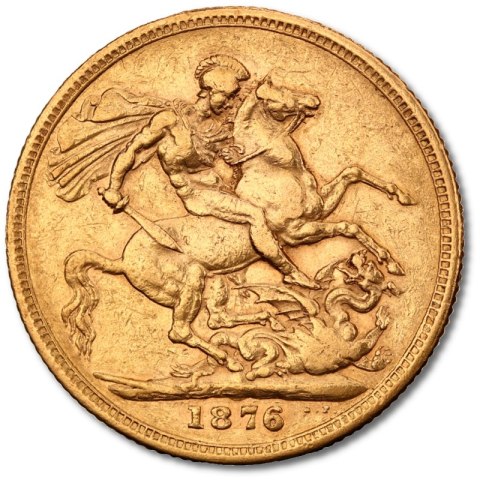
Reverse — St. George slaying the dragon (Pistrucci 1817) or Shield Sovereign
The reverse of the Sovereign Victoria 1838-1887 comes in two principal variants. The classic variant shows St. George slaying the dragon in the 1817 Benedetto Pistrucci design — the saint nude on horseback in classical sculpture style, lance raised to deliver the fatal strike on the dragon lying under the horse's hooves. The motif symbolises the triumph of good over evil and references Christian mythology together with ancient Greek and Roman sculpture.
The second variant — the so-called Shield Sovereign — shows an ornate royal shield with the arms of England, Scotland and Ireland in the reverse field, surrounded by a laurel crown. The Shield Sovereign was struck in many Victoria Young Head vintages (including 1838-1874 for some mints) before the classic Pistrucci motif became dominant. Both variants have identical technical specifications (mass, fineness, diameter) and are legal tender to the same extent.
Benedetto Pistrucci (1783-1855) — Italian sculptor born in Rome — served as chief engraver of the Royal Mint from 1828 to 1855. He is also the author of the famous Waterloo Medal commemorating the victory over Napoleon in 1815, a medal executed on a scale larger than any earlier work of this type (the project took 30 years). The 1817 St. George motif remains to this day the Sovereign reverse across all vintages from Victoria to Charles III.
What to check when buying
Inspect the preservation condition of the Sovereign Victoria 1838-1887 — Crown Gold 22 carat (916.7) is harder than pure .9999 gold and less prone to scratching, but specimens from nearly 200 years of history often show circulation marks (edge wear, micro-scratches, surface oxidation). Preservation condition affects collector premium — specimens in EF (Extremely Fine), AU (About Uncirculated) and higher achieve higher prices than specimens in VF (Very Fine) or below.
The premium on the Sovereign Victoria Young Head is higher than on Elizabeth II Mix Years Sovereigns (the most common in circulation) — typically 8-18% in the European retail segment, of which part is a collector premium for the historical vintage. Rarer variants (Shield Sovereign from early colonial mints — Sydney 1855, Melbourne 1872, Perth 1899) achieve significantly higher premiums up to 50-100% over spot, sometimes more for colonial mints in UNC condition.
CGT-free status applies to all British Sovereigns — Victoria Young Head is legal tender of the United Kingdom (1 GBP face value) and qualifies for the Capital Gains Tax exemption for UK tax residents, regardless of strike vintage. This status distinguishes Sovereigns from neutral bullion coins (Krugerrand, Maple Leaf), which are not CGT-free in the UK despite LBMA accreditation and high fineness.
Check whether the offered specimen comes from the main Royal Mint in London or from a colonial mint (Sydney, Melbourne, Perth, Bombay, Ottawa, Pretoria) — colonial mints used mintmarks (S, M, P, I, C, SA) which can be hard to identify without magnification. Reverse variant (Pistrucci St. George vs Shield) and mintmark are the two most important elements for identifying the collector value of a Victoria Young Head vintage.
Why GoldInvest24
- Manufacturers with LBMA accreditation: in the catalogue you will find coins and bars from mints accredited by the London Bullion Market Association — Royal Mint holds LBMA Good Delivery status since 1750, the oldest active status among mints and refineries producing gold bullion.
- Full Sovereigns size range: Half Sovereign, Full Sovereign, Double Sovereign and Quintuple Sovereign in one shop — allowing the build of a portfolio diversified by unit value without using different suppliers for different fractionals.
- Language versions PL / DE / EN: full technical descriptions and specifications in three languages for convenient handling of the Polish, German and international markets.
- Current precious-metals quotes: spot data for comparing offer prices with current market valuation — check current metals prices before purchase.
- Full metals categories in one shop: access to gold bullion coins, bars, silver, platinum and palladium — all from one customer account.
Comparison of 5 Sovereign types — from Victoria to Charles III
| Feature |
Victoria Young Head |
Victoria Jubilee |
Edward VII |
George V |
Elizabeth II Mix Years |
| Strike period |
1838-1887 |
1887-1893 |
1902-1910 |
1911-1932 |
1957-2021 |
| Strike years |
49 |
6 |
9 |
22 |
65 |
| Portraitist |
William Wyon |
Joseph E. Boehm |
G. W. De Saulles |
Bertram Mackennal |
5 portraits 1957-2022 |
| Gold mass |
7.32238 g |
7.32238 g |
7.32238 g |
7.32238 g |
7.32238 g |
| Fineness |
916.7 |
916.7 |
916.7 |
916.7 |
916.7 |
| Reverse |
Pistrucci OR Shield |
Pistrucci |
Pistrucci |
Pistrucci |
Pistrucci |
| Typical premium |
8-18% |
10-20% |
10-18% |
8-15% |
5-9% |
| Portfolio function |
Historic Victoria |
Short mintage |
Edwardiana |
WWI era |
Bullion CGT-free |
See the full category of gold bullion coins available at GoldInvest24.
FAQ — common questions about the Sovereign Victoria 1838-1887
What is the Sovereign Victoria „Young Head" 1838-1887?
The Sovereign Victoria „Young Head" 1838-1887 is a historic Royal Mint Full Sovereign with a gold mass of 7.32238 g, a fineness of 916.7 (Crown Gold 22 carat), a 22.05 mm diameter and a 1 GBP face value. The 1838 „Young Head" portrait by William Wyon ran for 49 years — the longest-serving monarch likeness in Sovereign history. The reverse comes in two variants: Pistrucci's St. George (1817) or Shield Sovereign, depending on the vintage and mint.
What is the technical specification of the Sovereign Victoria Young Head?
Gross mass 7.98805 g, gold mass 7.32238 g, fineness 916.7/1000 (Crown Gold 22 carat, alloy Au 91.67% + Cu 8.33%), diameter 22.05 mm, thickness approx. 1.52 mm, face value 1 GBP. Obverse: Victoria „Young Head" portrait by William Wyon with a laurel crown in Roman style. Reverse: St. George slaying the dragon (Pistrucci 1817) or Shield Sovereign with the arms of England, Scotland and Ireland.
Who designed the „Young Head" portrait and the St. George reverse?
Victoria's „Young Head" portrait was designed by William Wyon (1795-1851) — chief engraver of the Royal Mint from 1828, also author of the King Edward VII medal. The classic St. George slaying the dragon reverse was designed by Benedetto Pistrucci (1783-1855) — Italian sculptor, chief engraver of the Royal Mint 1828-1855, also author of the Waterloo Medal. Pistrucci's 1817 motif remains to this day the Sovereign reverse from Victoria to Charles III.
How does Victoria Young Head differ from Victoria Jubilee, Old Head and Elizabeth II?
Victoria Young Head (1838-1887) — 49 strike years, portrait of the 19-year-old queen. Victoria Jubilee (1887-1893) — short 6-year mintage for the 50-year jubilee, Boehm portrait (unpopular). Victoria Old Head / Veiled Head (1893-1901) — last Victoria type, Brock portrait with veil. Elizabeth II Mix Years (1957-2021) — 65 strike years, 5 portraits (Gillick, Machin, Maklouf, Rank-Broadley, Clark). All have identical Full Sovereign specifications.
For whom is the Sovereign Victoria 1838-1887 a practical choice?
For collectors of Victoria coins building a set of the three main portraits (Young Head, Jubilee, Old Head), for those valuing the history of 19th-century Britain and the industrialisation era, and for UK tax residents using the CGT-free status to optimise capital-gains taxation. The collector premium (8-18%) is higher than on Elizabeth II Mix Years Sovereigns (5-9%) — Victoria Young Head combines the bullion function with a historical premium.
What is the LBMA, VAT, CGT and IRA status of the Sovereign Victoria?
LBMA Good Delivery — YES (Royal Mint holds the status since 1750, the oldest active). VAT in the EU — EXEMPT (legal-tender coin, fineness 916.7 above 900, struck after 1800 — meets Polish VAT Act Art. 122 and EU Directive 2006/112/EC Art. 344). CGT-free in the United Kingdom — YES (British legal tender Sovereign, CGT exempt status for UK tax residents). IRA-eligible in the USA — NO (the IRS admits exclusively American coins to retirement accounts).
How do I buy the Sovereign Victoria 1838-1887 at GoldInvest24?
Place an order in our shop with access to the gold bullion coins category, the full range of Royal Mint Sovereigns (Victoria, Edward VII, George V, Elizabeth II, Charles III) and the offer of LBMA mints. Check the current gold quotes to compare the premium against the current spot price. Technical descriptions and specifications are available in PL / DE / EN language versions.
![[{[item.product.name]}]]([{[item.product.photo.url]}] 75w)