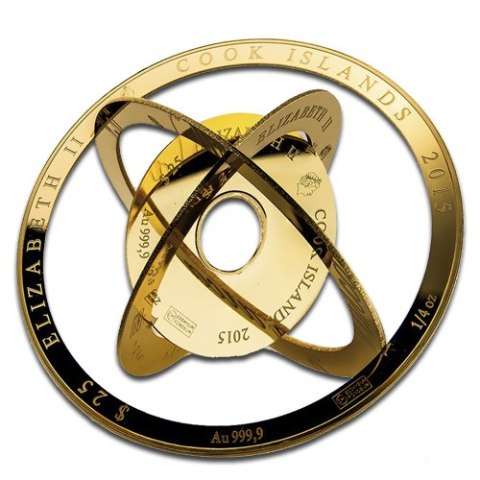
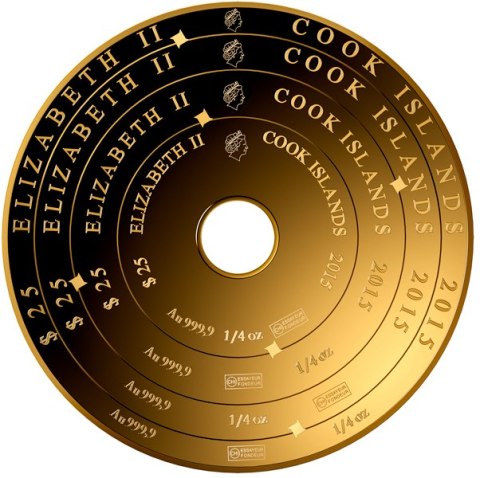
1 oz Cook Islands Armillary Sphere Gold Coin Valcambi — a bullion ounce with the motif of the armillary sphere, the astronomical instrument of Greek, Arab, and Renaissance astronomers
The 1 oz Cook Islands Armillary Sphere Valcambi gold coin is a bullion coin with a mass of 31.1035 g (1 troy oz), a fineness of 999.9/1000 (fine gold), a 32.69 mm diameter, a thickness of approximately 2.4 mm, and a 250 Cook Islands dollar face value as legal tender. The obverse features the portrait of the British monarch (Charles III since 2024, previously Elizabeth II) — Cook Islands as a self-governing realm in free association with New Zealand since 1965 uses the portrait of the British monarch on its legal-tender coins. The reverse features the Armillary Sphere — an astronomical instrument consisting of metal rings representing the celestial spheres, used from antiquity (2nd century BC, Eratosthenes, Hipparchus) through the 17th century (replaced by Galileo's telescope in 1609). The design author is Coin Invest Trust (CIT) Liechtenstein, struck by Valcambi (Switzerland, LBMA Good Delivery since 1968 — one of the 5 major Swiss gold refineries). The coin is VAT-exempt in the EU, with a typical market premium of 4-6% over spot.
Technical specification
| Parameter |
Value |
| Manufacturer |
Valcambi (Switzerland, LBMA Good Delivery since 1968) |
| Designer |
Coin Invest Trust (CIT) Liechtenstein — specialist in unusual numismatic motifs |
| Legal-tender issuer |
Cook Islands (self-governing realm in free association with New Zealand since 1965) |
| Series |
Armillary Sphere — Cook Islands × Valcambi |
| Format |
1 oz (one troy ounce) |
| Gross mass |
31.1035 g (1 troy oz) |
| Fine gold mass |
31.1035 g (fine gold, fineness 999.9) |
| Fineness |
999.9/1000 (.9999, fine gold) |
| Diameter |
32.69 mm (Valcambi 1 oz standard) |
| Thickness |
approx. 2.4 mm |
| Face value |
250 Cook Islands dollars (legal tender Cook Islands) |
| Obverse |
Portrait of the British monarch (Charles III since 2024, previously Elizabeth II — V Commonwealth Portrait Rank-Broadley) |
| Reverse |
Armillary Sphere — celestial rings from the astronomical model |
| Inscription |
COOK ISLANDS · 1 OZ FINE GOLD 999.9 · 250 DOLLARS |
| LBMA status |
Yes (Valcambi Good Delivery since 1968) |
| VAT in the EU |
Exempt (legal-tender coin, fineness 999.9 well above 900, struck after 1800 — Directive 2006/112/EC Art. 344) |
| UK status |
NOT CGT-free (Cook Islands legal tender, not British) |
| USA status |
NOT IRA-eligible (IRS does not approve Cook Islands coins) |
| Packaging |
Individual capsule |
Why 1 oz Armillary Sphere Valcambi deserves a place in your portfolio
- An unusual bullion motif — armillary sphere from Greek and Arab ancient astronomy: The Armillary Sphere is an astronomical instrument used from the 2nd century BC (Eratosthenes, Hipparchus in Alexandria) through the 17th century (replaced by Galileo's telescope in 1609) to visualize the movement of celestial bodies in Ptolemy's geocentric and Copernicus's heliocentric models. A rarer motif than mainstream bullion (Maple, Eagle, Krugerrand) — attractive for collectors appreciating the symbolism of the history of science and astronomy.
- Valcambi — one of the 5 major Swiss gold refineries LBMA since 1968: Valcambi (founded 1961, based in Balerna, Canton Ticino) is one of the five major Swiss LBMA Good Delivery gold refineries (alongside PAMP, Argor-Heraeus, Metalor, and Heraeus Holding). LBMA status since 1968 — 57 years of continuous accreditation guarantees alloy quality and weight accuracy exceeding the requirements of the UK Royal Mint and Royal Canadian Mint for their own bullion.
- Coin Invest Trust (CIT) Liechtenstein — specialist in unusual numismatic motifs: The design author is CIT Liechtenstein — a company specializing in unusual numismatic motifs for the mints of Cook Islands, Niue, Tuvalu, and Republic of Chad. CIT designed the series Tiffany Art (Art Nouveau, Renaissance), Mauquoy Art Coins (pre-Columbian, oriental), and Armillary Sphere — all using rarely seen themes in bullion from the history of art and science.
- Fineness 999.9 and 31.1035 g of fine gold — full 1 oz without excess: The coin contains 31.1035 g of fine gold at fineness 999.9 (four nines). Unlike Crown Gold alloy coins (916.7) or 22-karat (American Eagle 0.9167 with gross excess 33.93 g), the Armillary Sphere at pure fineness 999.9 has a gross mass = fine gold mass = 31.1035 g, simplifying the spot value calculation and the EU VAT exemption.
- Premium 4-6% over spot — a reasonable ratio for thematic-motif bullion: 1 oz Armillary Sphere Valcambi has a market premium of typically 4-6% over spot — lower than thematic semi-collector coins (10-25%), comparable with 1 oz Emu Perth Mint (4-7%), but higher than 1 oz Maple Leaf (3-5%). This positions the Armillary Sphere in the bullion-style segment with thematic premium, offering iconographic portfolio diversification.
History of the armillary sphere — from ancient Greece to the Renaissance
The armillary sphere (armillaris from Latin armilla — bracelet) is an astronomical instrument consisting of metal rings representing the main circles of the celestial sphere — the celestial equator, the ecliptic, the meridians, the parallels, the colures (two great circles connecting the celestial poles with the equinoxes and solstices), and the Earth's sphere at the center (in the geocentric model) or the solar sphere (in the heliocentric model). The first applications of the armillary sphere date to the 2nd century BC in Alexandria — Eratosthenes (276-194 BC, director of the Library of Alexandria, author of the first measurement of the Earth's circumference) used the armillary sphere to determine the obliquity of the ecliptic. Hipparchus of Nicaea (190-120 BC, creator of the first star catalog) refined the construction of the armillary sphere to observe the precession of the equinoxes.
Arab astronomers of the 9th-12th centuries (Al-Battani, Al-Zarqali, As-Sufi) refined the construction of the armillary sphere — adding more rings and increasing its accuracy. Al-Battani (858-929, born in Harran) used the armillary sphere to observe the Sun and Moon, determined a more accurate value for the obliquity of the ecliptic (23°35' vs. modern 23°26') and the tropical year (365 days 5h 46m 24s vs. modern 365 days 5h 48m 45s — an error of only 2 minutes). As-Sufi (903-986, author of the Book of Fixed Stars) used the armillary sphere to catalog stars and named many constellations whose Arabic names survive to this day (Algol, Aldebaran, Vega, Betelgeuse, Rigel).
Medieval Europe received knowledge of the armillary sphere from Byzantium and the Islamic world — through translations of Arabic astronomical texts made in Toledo (Spain) and Sicily in the 12th-13th centuries. The armillary sphere became the main astronomical instrument of European universities (Bologna, Paris, Oxford, Padua) — used both for observations (determining the positions of stars, planets, Sun, and Moon) and for teaching astronomy (visualization of Ptolemy's geocentric model). Nicolaus Copernicus (1473-1543, author of De revolutionibus orbium coelestium 1543) used the armillary sphere during his work in Frombork — the armillary sphere was essential for the visualization of the interrelationships of celestial bodies in the heliocentric model that Copernicus proposed instead of Ptolemy's.
The Renaissance was the heyday of armillary sphere construction — in Nuremberg, Augsburg, Florence, Padua, and Prague precise instruments were made by outstanding constructors (Regiomontanus, Tycho Brahe, Galileo Galilei). Tycho Brahe (1546-1601, Danish astronomer from Uraniborg) built the largest armillary spheres of his era (up to 3.5 m in diameter) — using them for observations that Johannes Kepler (1571-1630) later transformed into the laws of planetary motion (1609, 1619). Galileo Galilei (1564-1642) used the armillary sphere to teach astronomy at the University of Padua (1592-1610) — before his invention of the telescope in 1609, which gradually displaced the armillary sphere as an observational instrument.
After the invention of the telescope (1609, Galileo), the armillary sphere gradually lost its significance as an observational instrument — it was replaced by refractor telescopes (Galileo, Kepler) and reflector telescopes (Newton 1668). However, the armillary sphere retained symbolic and didactic significance — as a visualization of the structure of the celestial sphere in astronomy teaching. The symbolism of the armillary sphere has been preserved in modern heraldry — the armillary sphere is the central element of the flag and coat of arms of Portugal (since 1495, the reign of Manuel I — symbol of the Portuguese Age of Discoveries), and appears in many European university emblems (Coimbra, Padua).
Obverse — portrait of the British monarch (Charles III since 2024)
The obverse of the 1 oz Armillary Sphere Cook Islands Valcambi features the portrait of the British monarch — since 2024 Charles III, previously (until 2023) Elizabeth II. Cook Islands as a self-governing realm in free association with New Zealand since 1965 uses the portrait of the British monarch on its legal-tender coins — a tradition dating back to the establishment of parliamentary autonomy of the Cook Islands within the Commonwealth realm. New Zealand, with which the Cook Islands are associated, has used the portrait of the British monarch on its coins since the 19th century — and this practice is also continued by the Cook Islands as a realm in free association.
The Elizabeth II portrait used on Cook Islands × Valcambi coins until 2023 — typically the V Commonwealth Portrait by Ian Rank-Broadley (1998, used in the UK and Commonwealth countries until 2015). Earlier the IV Commonwealth Portrait (Raphael Maklouf, 1985-1998) and the III (Arnold Machin, 1968-1984). Each portrait change required approval by the Cook Islands Mint Authority and selection in accordance with the Commonwealth realm protocol. Charles III on Cook Islands coins since 2024 — typically the portrait by Jody Clark or Martin Jennings, depending on the specific Cook Islands × Valcambi design.
Cook Islands — an archipelago of 15 islands in the central Pacific, northeast of New Zealand (Wellington), with a population of approximately 17,000 inhabitants (mainly Polynesian Cook Islands Māori). Political status: self-governing realm in free association with New Zealand since 1965 — meaning that the Cook Islands have their own parliament, government, and courts, but share the head of state (British monarch) and citizenship (Cook Islanders are also citizens of New Zealand). Despite the small population, the Cook Islands have great significance in the world numismatic market — they issue numerous collector coins in cooperation with European mints (Valcambi, B.H. Mayer, Mayer Mint).
Around the monarch's portrait is the inscription COOK ISLANDS · 250 DOLLARS · ELIZABETH II / CHARLES III · year of minting — face value 250 Cook Islands dollars as legal tender (the Cook Islands dollar is pegged 1:1 to the New Zealand dollar, NZD). Although the Cook Islands dollar has a nominal value of 250 NZD, the actual bullion value of the coin exceeds this amount many times over — which is typical for collector coins (legal tender is a formality enabling the EU VAT exemption).
Reverse — Armillary Sphere design by Coin Invest Trust (CIT) Liechtenstein
The reverse of the 1 oz Armillary Sphere Cook Islands Valcambi features the armillary sphere — an astronomical instrument consisting of metal rings representing the celestial spheres. The construction of the armillary sphere on the coin shows 6-8 metal rings with an axial ring passing through the celestial poles, the equatorial ring (celestial equator), the ecliptic ring (the Sun's path on the celestial sphere, inclined at 23.5° to the equator), meridian and celestial parallel rings, and the colure ring (passing through the poles and the equinox points). At the center of the sphere is a small ball representing the Earth (in the geocentric model) or the Sun (in the heliocentric model).
The design author is Coin Invest Trust (CIT) Liechtenstein — a company founded in 1970 in Liechtenstein, specializing in unusual numismatic motifs for the mints of Cook Islands, Niue, Tuvalu, Republic of Chad, and Palau. CIT designed the collector series Tiffany Art (Art Nouveau, Renaissance, Romanesque, Byzantine), Mauquoy Art Coins (pre-Columbian, oriental, African), Mongolian Wildlife, and Armillary Sphere — all using rarely seen themes in bullion from the history of art and science. CIT's philosophy — combining thematic collector value with bullion content — gives the coins a dual value: spot gold plus thematic collector premium.
The symbolism of the armillary sphere on the coin refers to the astronomical history of Polynesia — Cook Islands as Polynesian islands in the central Pacific have a tradition of oceanic navigation based on observing stars and constellations. The Polynesians, who settled the Pacific between 1500 BC (Tonga, Samoa) and 1300 AD (New Zealand, Hawaii, Easter Island), used the stars of the Pleiades (Matariki in the Māori language) as a maritime compass and seasonal calendar. The armillary sphere on the Cook Islands coin is a tribute to the Polynesian tradition of stellar navigation — combining the European astronomical instrument with the Polynesian practice of astronavigation.
Around the armillary sphere is the inscription COOK ISLANDS · 1 OZ FINE GOLD 999.9 · 250 DOLLARS on the rim of the coin. The fineness 999.9 (four nines) enables precise rendering of the details of the armillary sphere rings — thin metal frames, spherical geometry, and angular relationships of the rings — in a way harder to achieve on coins from harder alloys. The purer gold requires more careful handling of the coin, but allows for the engraving finesse that is the hallmark of Valcambi and CIT Liechtenstein.
What to look out for when buying
Check the vintage of the Cook Islands Armillary Sphere coin — different vintages may have minor differences in the construction of the armillary sphere (number of rings, angle of inclination, presence of a central Earth/Sun ball), as well as in the monarch's portrait (Charles III since 2024, previously Elizabeth II). When buying, it is important to check the specific vintage and portrait — some vintages are rarer and may have a higher secondary premium on the collector market.
The market premium on 1 oz Cook Islands Armillary Sphere Valcambi typically holds in the range of 4-6% over spot — lower than thematic semi-collector coins (10-25%), comparable with 1 oz Emu Perth Mint (4-7%), but higher than 1 oz Maple Leaf (3-5%). The premium reflects bullion-style 1 oz with premium mintage (typically 5,000-15,000 pieces per vintage vs. mass 500,000+ Maple Leaf or Krugerrand). When assessing the premium, it is worth comparing to the current CHF spot (Valcambi in Switzerland) and converting to PLN/EUR.
CGT status in the United Kingdom — Cook Islands Armillary Sphere is NOT CGT-free in the UK, as the CGT-free status applies exclusively to British legal-tender coins (Royal Mint Britannia, Sovereign, Tudor Beasts, Queens Beasts). Cook Islands Armillary Sphere as Cook Islands legal tender (250 NZD CI), despite the LBMA accreditation of Valcambi since 1968, does not benefit from the CGT-free status. For EU residents (Poland, Germany) this aspect is irrelevant — VAT exempt applies.
Check the condition of the coin — Cook Islands Armillary Sphere at the fineness 999.9 is pure gold, soft and prone to surface scratching. Each Valcambi coin is delivered in an individual capsule protecting the surface. When buying second-hand, it is worth checking the integrity of the capsule and the absence of scratches and abrasions on the coin's fields — especially on the armillary sphere, where the engraving of the rings is very detailed and even a small scratch can damage the image.
Why GoldInvest24
- Manufacturers with LBMA accreditation: in our catalogue you will find coins and bars from mints accredited by the London Bullion Market Association — Valcambi holds LBMA Good Delivery status since 1968, as one of the 5 major Swiss gold refineries (alongside PAMP, Argor-Heraeus, Metalor, and Heraeus Holding).
- Full range of Cook Islands × Valcambi: Armillary Sphere series, Tiffany Art, Mauquoy Art Coins, and other unusual CIT Liechtenstein motifs — facilitates building a thematically diverse collector portfolio with bullion content.
- PL / DE / EN language versions: full technical descriptions and specifications in three languages for convenient service of the Polish, German, and international markets.
- Current precious-metals quotes: spot data for comparing offer prices with the current market valuation — check the current precious-metals prices before purchase.
- Full precious-metal categories in one shop: access to gold bullion coins, bars, silver, platinum and palladium — all from a single customer account.
Comparison of 5 coins — Emu, Armillary Sphere, Bitcoin, Maple Leaf and Britannia
| Feature |
1 oz Emu Perth 2026 |
1 oz Armillary Sphere Valcambi |
1 oz Gold Bitcoin |
1 oz Maple Leaf |
1 oz Britannia |
| Manufacturer |
Perth Mint |
Valcambi (CIT) |
Pacific Islands |
Royal Canadian Mint |
Royal Mint |
| Legal-tender issuer |
Australia |
Cook Islands |
Niue/Tuvalu |
Canada |
United Kingdom |
| Fine gold mass |
31.1035 g |
31.1035 g |
31.1035 g |
31.1035 g |
31.1035 g |
| Fineness |
999.9 |
999.9 |
999.9 |
999.9 |
999.9 |
| Diameter |
32.1 mm |
32.69 mm |
32.7 mm |
30.0 mm |
32.69 mm |
| Face value |
100 AUD |
250 NZD CI |
100 NZD/AUD |
50 CAD |
100 GBP |
| Reverse motif |
Emu (annual) |
Armillary Sphere |
Bitcoin logo |
Maple leaf (fixed) |
Britannia (fixed) |
| CGT-free UK |
NO |
NO |
NO |
NO |
YES |
| Typical premium |
4-7% |
4-6% |
10-20% |
3-5% |
4-7% |
| Portfolio function |
Unusual bullion |
Thematic bullion |
Crypto-bullion collector |
Mainstream bullion |
CGT-free UK bullion |
See the entire gold bullion coins category available at GoldInvest24.
FAQ — common questions about the 1 oz Cook Islands Armillary Sphere Valcambi
What is the 1 oz Cook Islands Armillary Sphere Valcambi?
The 1 oz Cook Islands Armillary Sphere Valcambi is a bullion coin with a mass of 31.1035 g (1 troy oz), a fineness of 999.9/1000, a 32.69 mm diameter, and a 250 Cook Islands dollars face value as legal tender. The reverse features the armillary sphere — an astronomical instrument used from the 2nd century BC (Eratosthenes, Hipparchus) through the 17th century (replaced by Galileo's telescope in 1609). The obverse features the portrait of the British monarch (Charles III since 2024, previously Elizabeth II). Designer Coin Invest Trust (CIT) Liechtenstein, mint Valcambi (Switzerland, LBMA since 1968).
What is the technical specification of the 1 oz Armillary Sphere Valcambi?
Mass 31.1035 g (1 troy oz), fineness 999.9/1000 (fine gold), diameter 32.69 mm (Valcambi 1 oz standard), thickness approx. 2.4 mm, face value 250 Cook Islands dollars. Obverse: portrait of the British monarch (Charles III since 2024). Reverse: armillary sphere with 6-8 celestial rings. Inscription: COOK ISLANDS · 1 OZ FINE GOLD 999.9 · 250 DOLLARS. Designer CIT Liechtenstein, mint Valcambi.
What is the history of the armillary sphere as an astronomical instrument?
The armillary sphere was used from the 2nd century BC in Alexandria (Eratosthenes, Hipparchus). Arab astronomers of the 9th-12th centuries (Al-Battani, Al-Zarqali, As-Sufi) refined the construction. In the Renaissance, Nicolaus Copernicus (1473-1543) used the armillary sphere to visualize the heliocentric model, Tycho Brahe (1546-1601) built the largest armillary spheres (3.5 m diameter), Galileo (1564-1642) taught with the armillary sphere at the University of Padua. After the invention of the telescope (1609, Galileo), the armillary sphere was gradually displaced from observation, retaining symbolic significance (flag of Portugal).
Who are the Cook Islands and why do they have legal tender with the British monarch?
Cook Islands — an archipelago of 15 islands in the central Pacific, population approx. 17,000 (Polynesian Cook Islands Māori). Political status: self-governing realm in free association with New Zealand since 1965 — own parliament, government, courts, but share the head of state (British monarch) with the UK and New Zealand. Cook Islands legal tender (250 NZD CI) features the portrait of the monarch — Commonwealth realm tradition. Despite the small population, the Cook Islands have great significance in the world numismatic market (collector coins with European mints).
What is Valcambi and how does it differ from Perth Mint, RCM, and Royal Mint?
Valcambi (Switzerland, since 1961, LBMA since 1968) — one of the 5 major Swiss gold refineries (alongside PAMP, Argor-Heraeus, Metalor, Heraeus Holding). Strikes under license from various issuer mints (Cook Islands, Niue, Tuvalu). Perth Mint (Australia, LBMA since 1899) — Australian Kangaroo/Emu bullion with Charles III. RCM (Canada, LBMA since 1908) — Maple Leaf. Royal Mint (UK, LBMA since 1750) — Britannia, Sovereign. Valcambi is a specialized refinery plus mint partner, not a stand-alone state mint.
What is the LBMA, VAT, CGT, and IRA status of the 1 oz Armillary Sphere?
LBMA Good Delivery — YES (Valcambi holds the status since 1968). VAT in the EU — EXEMPT (legal-tender coin, fineness 999.9 well above the 900 minimum, struck after 1800 — Directive 2006/112/EC Art. 344). CGT-free in the UK — NO (Cook Islands legal tender, not British). IRA-eligible in the USA — NO (IRS does not approve Cook Islands coins for retirement accounts).
How to buy 1 oz Cook Islands Armillary Sphere Valcambi at GoldInvest24?
Place an order in our shop with access to the gold bullion coins category, the Cook Islands × Valcambi offer (Armillary Sphere, Tiffany Art, other CIT Liechtenstein motifs), and LBMA mints. Check the current gold quotes to compare the premium with the current spot price. Technical descriptions and specifications available in PL / DE / EN.
![[{[item.product.name]}]]([{[item.product.photo.url]}] 75w)