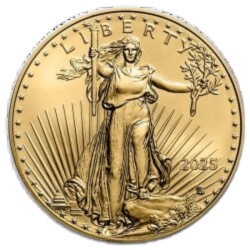
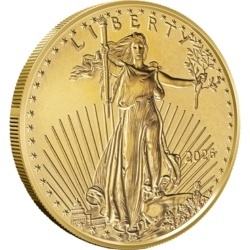
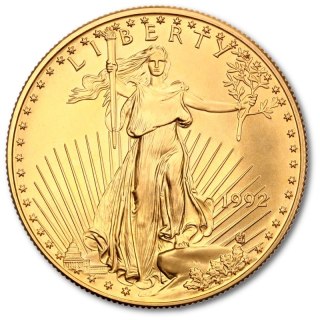
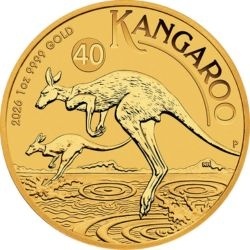
1 oz Krugerrand 2025 — South African bullion gold coin from Rand Refinery in Crown Gold 22 karat, 58th production vintage
Krugerrand 1 oz with 2025 vintage is the flagship bullion coin of Rand Refinery / South African Mint with 916.7/1000 fineness (Crown Gold 22 karat) and 31.103 g net gold. Diameter 32.77 mm, thickness 2.84 mm, gross weight 33.931 g (containing 8.33% copper).
The 2025 vintage is the 58th year of continuous production of the oldest modern bullion coin in the world (since 1967). Obverse Paul Kruger by Otto Schultz (1892), reverse springbok by Coert Steynberg (1947). The coin price is linked to current LBMA precious metals prices.
Technical specifications 1 oz Krugerrand 2025
| Parameter |
Value |
| Gold weight (Au) |
31.103 g (1.000 troy oz) |
| Gross weight |
33.931 g (with copper) |
| Fineness |
916.7/1000 (.9167, 22 karat Crown Gold) |
| Diameter |
32.77 mm |
| Thickness |
2.84 mm |
| Face value |
none ("1 oz Fine Gold" marking) |
| Manufacturer |
Rand Refinery / South African Mint (Pretoria, since 1923) |
| Obverse |
Paul Kruger — Otto Schultz (1892) |
| Reverse |
Springbok (Antidorcas marsupialis) — Coert Steynberg (1947) |
| Accreditation |
LBMA Good Delivery since 1965 |
| Historical production |
Over 50 million 1 oz coins (1967-2025) |
| Packaging |
Individual capsule |
| VAT |
Exempt (EU Directive 98/80/EC, 50+ years on the list) |
Why 1 oz Krugerrand 2025?
- 31.103 g of pure gold in Crown Gold alloy (8.33% copper) — higher physical hardness than .9999 coins
- Rand Refinery / South African Mint — LBMA accreditation since 1965, 58 years of continuous production (since 1967)
- Oldest modern bullion coin in the world — first in the 1 oz bullion segment available for retail
- Obverse Paul Kruger by Otto Schultz (1892) — design from the Transvaal Republic era
- Reverse springbok by Coert Steynberg (1947) — iconic South African zoological motif unchanged since 1967
History of Krugerrand — from 1967 debut to 2025 vintage
The Krugerrand was introduced on July 3, 1967 by the South African Mint and Rand Refinery as the first bullion coin in history dedicated exclusively to the retail investor segment (earlier gold coins were mainly collector or circulation coins). South Africa — at that time the producer of ~70% of world gold — was looking for a way to monetize the mined metal in a format understandable to Western buyers.
The first issue in 1967 amounted to only 40 thousand coins, but popularity grew geometrically. In the peak year 1980, the South African Mint produced ~6 million Krugerrand 1 oz — the only vintage in bullion history in which production exceeded 5 million units for a single denomination. In total, by 2025, over 50 million Krugerrand 1 oz have been produced — more than all Maple Leafs, Philharmonics and Britannias combined in the 1 oz segment.
The Krugerrand has retained 916.7/1000 fineness (Crown Gold 22 karat) since its debut day in 1967. The South African Mint's decision was deliberate: the British Crown Gold tradition, established by Henry VIII in 1526, provides the coin with significantly higher physical hardness thanks to 8.33% copper (since Roman times, copper has been an alloy increasing abrasion resistance). This makes Krugerrand the physically most resistant classic bullion coin — the coin does not require a capsule to retain resale value.
In the period 1986-1994, Krugerrand was subject to international sanctions related to apartheid in South Africa — many Western countries (USA, EEC countries) restricted or banned imports. After the end of apartheid and democratic elections in 1994, sanctions were lifted, and Krugerrand returned to world markets. Krugerrand is today available in all major jurisdictions and holds LBMA Good Delivery status granted to Rand Refinery already in 1965 (before the coin's debut).
The 2025 vintage retains all features of the 1967 original — obverse design, reverse, fineness, diameter and thickness are identical. The only visible change is the strike year. This design stability distinguishes Krugerrand from all other bullion classics (Maple Leaf — Bullion DNA 2013, Charles III portrait 2024; Philharmonics — micro-"W" 2024; Britannia — 4-tier system 2021).
Obverse — Paul Kruger by Otto Schultz (1892)
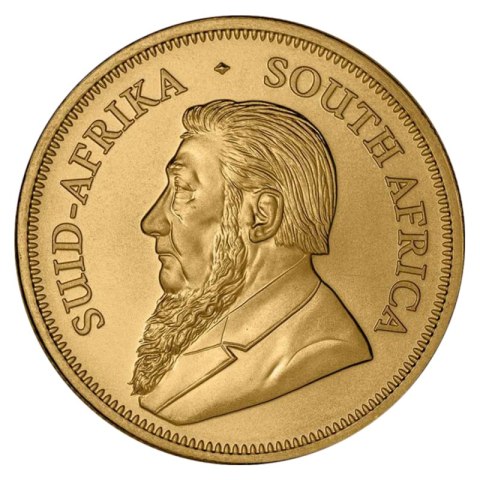
On the obverse of the Krugerrand coin is the portrait of Paul Kruger (full name: Stephanus Johannes Paulus Kruger, 1825-1904) — President of the Transvaal South African Republic from 1883-1900. Paul Kruger led the Republic during the Boer War (1899-1902) against the British Empire — he is one of the most important historical figures of the Republic of South Africa.
The Kruger portrait used on the coin comes from 1892 — the author of the graphic is Otto Schultz, a German engraver working at the time for the Transvaal mint in Pretoria. Schultz created the portrait in left profile, with Kruger's characteristic long beard. The same design was used on the Transvaal "Kruger Pounds" from 1892-1900 — the first issues of gold coins with the denomination of 1 pound in the Transvaal.
Around the portrait are placed the inscription "SUID-AFRIKA · SOUTH AFRICA" (in Afrikaans and English) and the strike year ("2025"). The mint symbol "R" (for "Rand") in the field next to the portrait identifies the South African Mint in Pretoria as the manufacturer. Krugerrand uses a historical author's portrait — without updating to a contemporary monarch or president — a practice unique among bullion classics.
Reverse — springbok by Coert Steynberg (1947)
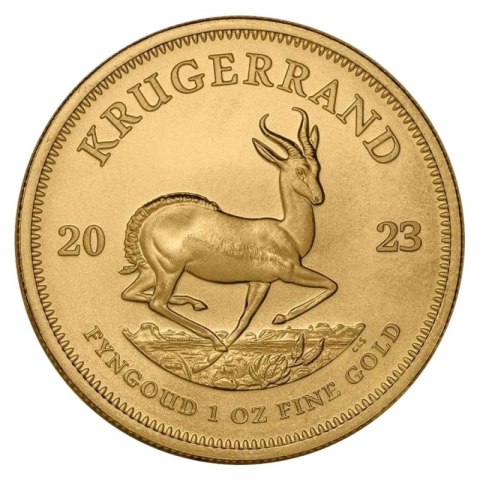
The reverse of the coin depicts a springbok (Antidorcas marsupialis) in full gallop — an antelope endemic to the Republic of South Africa and Namibia, a national symbol of South Africa. The 1947 design is by Coert Steynberg (1905-1982) — one of the most prominent South African sculptors of the 20th century, who created numerous national monuments and state medals.
Steynberg designed the springbok as a classic zoological figure — in the "pronk" position (characteristic jump of the antelope with all four legs in the air), with the head turned slightly to the side. The design is a precise anatomical study — from the fur texture to horn details. Coert Steynberg previously designed the springbok for the silver five-shilling coin of the Republic of South Africa (1947-1964) — the South African Mint transferred this design to Krugerrand in 1967 without any modifications.
Around the springbok is the inscription "KRUGERRAND" and "1 OZ FINE GOLD" (instead of a currency denomination — Krugerrand has no official denomination, it is legal tender in South Africa with a value linked to the current gold price). Krugerrand is the only classic bullion coin without a currency denomination — clearly signaling to the buyer that it is a bullion product, not a circulation one.
What to look for when buying 1 oz Krugerrand 2025?
First: Crown Gold 22 karat (8.33% copper) means higher physical resistance than .9999 coins. Krugerrand is one of the few bullion coins that can be safely stored outside a capsule without significant risk of micro-damage. The 916.7/1000 fineness meets the minimum 995/1000 required for VAT exemption based on the list of specific historical coins (Krugerrand has been on the list for over 50 years — EU Directive 98/80/EC).
Second: authenticity verification. Krugerrand does not have advanced optical security features (like Britannia, Maple Leaf or Philharmonics) — authenticity is verified through (a) weight measurement (33.931 g gross), (b) diameter (32.77 mm) and thickness (2.84 mm) measurement, (c) acoustic resonance test (Krugerrand has a characteristic "bell" sound on light tap), (d) densitometric test for confirming 916.7 fineness.
Third: 58 years of continuous production means a large base of available vintages. Krugerrand 1 oz from various years has identical bullion value (always 31.103 g Au). Sanctioned vintages (1986-1994) may be physically rarer in the retail market, but do not carry a standard collector premium. The 2025 vintage (current) has a standard market premium without additional markup.
Fourth: The color of Krugerrand is distinctly orange-golden (rather than yellow-golden like Maple Leaf or Philharmonics) — the result of 8.33% copper in the alloy. The color difference is noticeable to the naked eye. Krugerrand also has a specific weight in hand — the gross weight 33.931 g is about 2.8 g higher than .9999 1 oz coins (31.103 g).
Why GoldInvest24?
- Manufacturers with LBMA Good Delivery accreditation — Rand Refinery (since 1965), Royal Canadian Mint, Münze Österreich, Royal Mint, PAMP Suisse
- Full range of formats — from 1 g to 1 kg in bars and coins from 1/50 oz to 1 oz in multiple series (including Krugerrand 1/10, 1/4, 1/2 oz)
- Product descriptions in three language versions (PL/DE/EN) with concrete technical specifications and historical data
- Access to current precious metals prices on LBMA updated in real time
- Portfolio supplementation with categories gold investment coins, gold bullion bars, silver investment coins and silver bullion bars
Comparison of 5 coins and bars from the 1 oz package
| Feature |
Krugerrand |
Maple Leaf |
Philharmonic |
Britannia |
PAMP Fortuna |
| Manufacturer |
Rand Refinery |
Royal Canadian Mint |
Münze Österreich |
Royal Mint |
PAMP Suisse |
| Fineness |
916.7 (22 kt Crown Gold) |
999.9 |
999.9 |
999.9 |
999.9 |
| Diameter |
32.77 mm |
30.0 mm |
37.0 mm |
32.69 mm |
24×41 mm |
| Accreditation |
LBMA since 1965 |
LBMA since 1980 |
LBMA since 2008 |
LBMA since 1750, CGT-free UK |
LBMA since 1986 |
| Physical hardness |
High (Crown Gold) |
Lower (.9999) |
Lower (.9999) |
Lower (.9999) |
Lower (.9999) |
Frequently asked questions (FAQ)
What characterizes 1 oz Krugerrand 2025?
It is a South African bullion coin from Rand Refinery / South African Mint with 916.7/1000 fineness (Crown Gold 22 karat) and 31.103 g net gold, diameter 32.77 mm and gross weight 33.931 g. The 2025 vintage is the 58th year of production of the oldest modern bullion coin (since 1967). Obverse Paul Kruger (Schultz 1892), reverse springbok (Steynberg 1947).
What are the fineness and weight of the Krugerrand 1 oz coin?
The fineness is 916.7/1000 (Crown Gold 22 karat), net gold weight 31.103 g (1.000 troy oz), gross weight 33.931 g. The difference of 2.828 g is the 8.33% copper addition in the alloy. Diameter 32.77 mm, thickness 2.84 mm. Krugerrand has retained identical specification since its 1967 debut.
Who designed Krugerrand obverse and reverse?
Obverse (Paul Kruger portrait) was designed by Otto Schultz in 1892 — the design comes from the Transvaal Kruger pounds. Reverse (springbok in "pronk" jump) was created by Coert Steynberg in 1947 — the design originally appeared on the silver five-shilling coin of South Africa (1947-1964), transferred to Krugerrand in 1967 without modifications.
Krugerrand 1 oz vs Maple Leaf 1 oz — which to choose?
Krugerrand has 916.7 fineness (Crown Gold 22 karat, higher physical resistance), Maple Leaf has 999.9 fineness (.9999). Both contain 31.103 g of net gold. Krugerrand is the only classic bullion coin without a currency denomination, Maple Leaf has 50 CAD legal tender. Krugerrand has 58 years of tradition, Maple Leaf 47 years.
Who is Krugerrand 1 oz a good choice for?
Krugerrand 1 oz is a classic bullion portfolio position for those who value high physical resistance (Crown Gold) and low market premium relative to .9999 classics. Oldest bullion coin in the world — it serves as a base for a long-term portfolio and in a regular purchase strategy (DCA) thanks to the low premium.
Is Krugerrand VAT-exempt in the EU?
YES — Krugerrand is on the list of specific coins exempt from VAT in the EU as investment gold (EU Council Directive 98/80/EC). Although the 916.7 fineness is below the minimum 995/1000 required for fineness, Krugerrand qualifies through historical status — at least 50 years on the list of classic bullion coins.
How to buy Krugerrand 1 oz at GoldInvest24?
Krugerrand 1 oz 2025 is in the gold investment coins category of GoldInvest24, the price is linked to current LBMA precious metals prices. Each coin is verified by weight (33.931 g) and dimensions (32.77 × 2.84 mm) before shipping in an individual capsule.
The price of 1 oz Krugerrand 2025 is updated in real time and linked to LBMA precious metals prices.
![[{[item.product.name]}]]([{[item.product.photo.url]}] 75w)