1/10 oz Vienna Philharmonic 2025
A tenth of a troy ounce of 999.9 gold struck by Munze Oesterreich, the Austrian Mint. The mint publishes the fine gold content as 3.11 g, the diameter as 16.00 mm and the face value as 10 euro.
This size was introduced in 1991, four years after the one ounce coin. Before the euro changeover it carried a face value of 200 schillings.
Specifications
| Property |
Value |
| Metal |
Gold |
| Fineness |
999.9 |
| Fine gold |
3.11 g (1/10 troy ounce) |
| Diameter |
16.00 mm |
| Face value |
10 euro |
| Year |
2025 |
| Country |
Austria |
| Mint |
Munze Oesterreich |
| First issued |
1991 |
| Designer |
Thomas Pesendorfer |
The Austrian Mint does not publish a thickness for this coin. Secondary sources quote 1.2 mm; as that is not mint-confirmed it is not stated above as fact.
Obverse and reverse
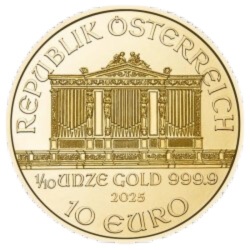
The obverse shows the great pipe organ of the Golden Hall of the Vienna Musikverein, with REPUBLIK OESTERREICH, the weight, the fineness, the year and the face value.
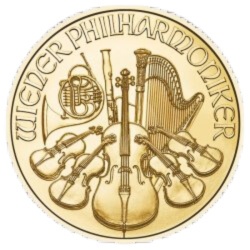
The reverse shows a group of orchestral instruments — a Vienna horn, a bassoon, a harp and four violins arranged around a cello — under the inscription WIENER PHILHARMONIKER. Both sides were designed by Thomas Pesendorfer, chief engraver of the Austrian Mint, in 1989, and neither has changed since.
Some dealer listings describe these two sides the other way round. The Austrian Mint treats the organ side as the obverse.
A euro coin, but not a sterling one
The Philharmonic is legal tender in the euro area, which satisfies one of HMRC’s tests for investment gold. It is not sterling legal tender, so it does not carry the UK capital gains tax exemption that a Britannia or a Sovereign does.
VAT and UK capital gains tax
HMRC treats a coin minted after 1800 as investment gold if it is at least 900 thousandths fine, is or has been legal tender in its country of origin, and normally sells at no more than 180 per cent of the open market value of its gold (VAT Notice 701/21A). The Philharmonic is 999.9 fine, Austrian legal tender and sold on the gold price, so it meets all three tests.
Capital gains tax is a separate matter. The UK exemption follows sterling legal tender, so it covers Sovereigns and Britannias but not an Austrian coin. This is a statement of the published rule, not tax advice — your own position depends on your circumstances.
Questions buyers ask
Which side is the obverse? The organ. The Austrian Mint treats the organ of the Musikverein as the obverse and the instruments as the reverse.
How much gold does it contain? The Austrian Mint states 3.11 g of fine gold, a tenth of a troy ounce, at 999.9 fineness.
Has the design ever changed? No. Thomas Pesendorfer designed both sides in 1989 and they have been used ever since.
Is it exempt from UK capital gains tax? No. That exemption follows sterling legal tender.
Authenticity checked at GoldInvest24 before dispatch. Other sizes are on the Vienna Philharmonic gold coins page. Live quotes on the precious metals prices page.
![[{[item.product.name]}]]([{[item.product.photo.url]}] 75w)