![[{[item.product.name]}]]([{[item.product.photo.url]}] 75w)
1 oz Vienna Philharmonic Gold Coin | 2026
The Symbol: 102101
1 oz Vienna Philharmonic 2026 — Musikverein Great Hall organ (Pesendorfer 1989), Münze Österreich, LBMA Good Delivery. GoldInvest24.
Availability: In stock 262 PCs.
Price: 16244.33
For free delivery are missing -,--
Sum 0,00 £
Price includes discounts
The Symbol: 102101
1 oz Vienna Philharmonic 2026 — Musikverein Great Hall organ (Pesendorfer 1989), Münze Österreich, LBMA Good Delivery. GoldInvest24.
Availability: In stock 262 PCs.
Price: 16244.33
The thirty-seventh annual issue of the Vienna Philharmonic in 1 oz format continues a series that has appeared regularly in World Gold Council rankings since 1989 as one of the world's best-selling bullion coins. The coin contains 31.103 g of fine gold, 999.9/1000 fineness and remains the only European bullion coin with a euro-denominated face value — 100 EUR, legal tender in Austria.
The 1 oz price is linked to the current gold price at the London Gold Fix (LBMA), with a market markup typically between 3 and 5% over spot. The margin is lower than for fractional sizes (1/10, 1/25 oz), making the 1 oz the most cost-efficient choice for buyers building a precious metals position in substantial units.
Münze Österreich, based in Vienna (Heinrichsgasse 4), is the state mint of the Republic of Austria, operating continuously since 1194 — making it one of the oldest mints in Europe. It is owned by the Austrian National Bank (OeNB) and holds LBMA (London Bullion Market Association) Good Delivery and LPPM accreditations. The Vienna Philharmonic in gold has been struck since 1989 — the motif design was created by Thomas Pesendorfer, the mint's Chief Engraver since 1985.
Historically, the 1 oz Vienna Philharmonic was at times the world's best-selling bullion coin — according to the World Gold Council, it reached this position in 1992, 1995, 1996 and 2000. Until 2001 it had a face value of 2,000 schillings; from January 2002 — with the introduction of the euro in Austria — the face value was changed to 100 EUR. It remains today the only bullion series with a face value in one of the world's major non-dollar currencies — which for many collectors offers a meaningful advantage over Krugerrand (ZAR) or Maple Leaf (CAD).
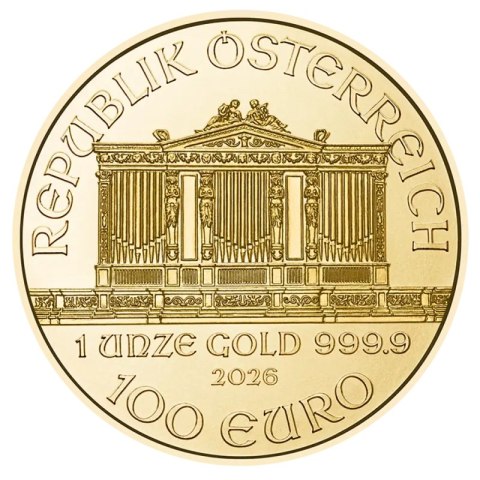
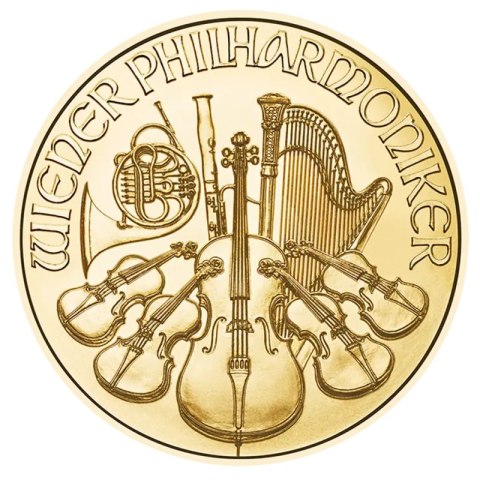
The obverse depicts the great organ of the Goldener Saal at the Musikverein — the heart of Viennese musical culture. The reverse presents eight instruments: violin, bassoon, harp, French horn, two cellos and two horns. The choice of theme is a direct tribute to the Wiener Philharmoniker — the orchestra that has set global standards in classical music since 1842. It is one of few bullion series whose motif reveals neither nation nor ruler but cultural heritage — which builds global recognition independent of the buyer's political orientation.
When Münze Österreich launched the Vienna Philharmonic in 1989, the European bullion market was dominated by the Krugerrand — the South African coin whose production through the 1980s was constrained by UN sanctions. Austria deliberately designed the series as a European alternative: 999.9 instead of the Krugerrand's 916.7, a cultural rather than national motif, a face value in local currency. This move was intended to fill the vacuum after the Krugerrand — and it succeeded completely.
By 1992, three years after debut, the Philharmonic became the world's best-selling bullion coin. Several factors drove the success: the first bullion coin in the EU (before 1995 competition within the Community was minimal), low margin (typically 3-5% over spot), a culturally universal motif, and — most importantly — full support from Münze Österreich on buyback. The mint guaranteed repurchase at a price near spot, creating an effective two-way market without sole reliance on dealers.
After 37 years the Philharmonic remains the only bullion series with a euro-denominated face value — making it the natural choice for buyers from the eurozone, for whom currency risk on resale is eliminated. Annual sales volumes consistently run in the hundreds of thousands of ounces, and the 2026 vintage continues the tradition: the same dimensions, the same 999.9 fineness, the same Pesendorfer design from 1989. The constancy of the design (in contrast to the annually changing reverses of Maple Leaf or American Eagle) is deliberate — Münze Österreich treats visual consistency as a value, not a constraint.
| Parameter | Value |
|---|---|
| Product type | Bullion coin |
| Manufacturer | Münze Österreich AG |
| Location | Vienna, Austria |
| Precious metal | Gold Au |
| Fineness | 999.9/1000 (.9999) |
| Fine gold weight | 31.103 g (1 troy oz) |
| Diameter | 37 mm |
| Thickness | 2 mm |
| Form | Minted coin |
| Face value | 100 EUR (legal tender in Austria) |
| Year | 2026 (37th annual issue) |
| First minted | 1989 |
| Designer | Thomas Pesendorfer |
| Packaging | Münze Österreich protective capsule |
| Accreditation | LBMA Good Delivery |
| VAT | Exempt under Council Directive 2006/112/EC |
| Coin | Fineness | Characteristic |
|---|---|---|
| Vienna Philharmonic 1 oz | 999.9 | Only bullion with euro face value, cultural motif, low margin |
| Krugerrand 1 oz | 916.7 | Silver alloy — higher hardness, oldest bullion (1967) |
| Maple Leaf 1 oz | 999.9 | Highest security technologies (micro-laser markings) |
| Britannia 1 oz | 999.9 | CGT-free in UK, reverse changes each year |
Is the 1 oz Vienna Philharmonic 2026 a good choice for a first-time gold buyer?
Yes — low markup (3-5% over spot), high global liquidity and euro face value make it a safe choice. For smaller budgets, consider also the 1/2 oz or 1/4 oz formats.
Why do Philharmonics have a euro face value while the Krugerrand does not?
The Philharmonics are issued by the Republic of Austria — a eurozone member state. The face value of 100 EUR is legal tender, although in practice no one pays with them (the metal value is 25-30× higher). The Krugerrand comes from South Africa and has no face value — its worth is determined solely by gold content.
How does the 2026 issue differ from previous years?
Only in the year of minting. The motif design, fineness, weight and dimensions have remained unchanged since 1989. Design constancy is a deliberate choice by Münze Österreich — it builds recognition and makes authenticity easier to verify.
Can I sell the coin back to GoldInvest24?
Yes. Buyback is at prices linked to the LBMA Gold Fix. The 1 oz Vienna Philharmonic is one of the most liquid coins — buyback usually at a price close to spot with minimal spread.
What VAT applies to this coin?
Bullion gold of at least 995/1000 fineness is exempt from VAT throughout the EU (Council Directive 2006/112/EC). The price does not include VAT.
Where can I check the current gold price?
The current spot price is available at GoldInvest24 — sections Gold price and Precious metals prices. Quotes update in line with the LBMA Gold Fix.
Choose the 1 oz Vienna Philharmonic 2026 at GoldInvest24, check the current gold price and compare with the Gold Coins category and Precious metals prices.