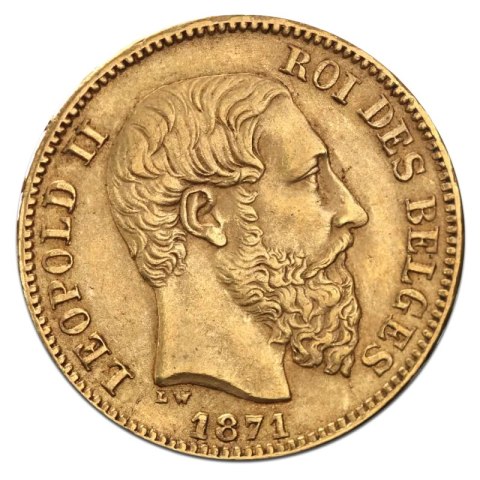
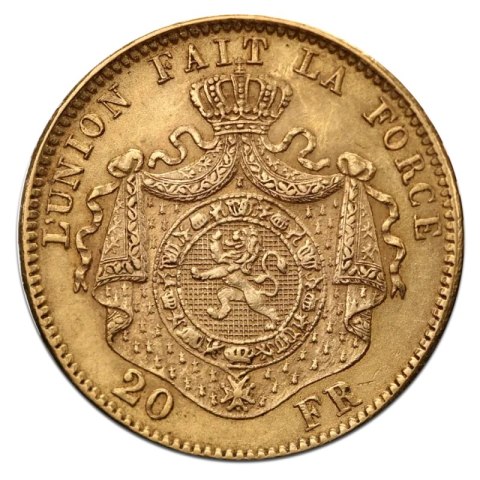
20 Francs Belgium Leopold II (1867-1882) — the Belgian LMU 20F with the portrait of the king of the LMU founding state
The 20 Francs Belgium Leopold II (1867-1882) gold coin is a historic Belgian 20-franc piece of the Latin Monetary Union (LMU) standard with a gross mass of 6.4516 g, a pure-gold mass of 5.80645 g, a 0.900 fineness (Crown-Gold-style alloy), a 21.0 mm diameter and a 20-Belgian-franc face value. The obverse features the portrait of King Leopold II — the second ruler of independent Belgium (1865-1909) — with the inscription LÉOPOLD II ROI DES BELGES (Leopold II King of the Belgians). Struck at the Brussels Mint (Monnaie de Bruxelles) for 16 years (1867, 1869-1882). Belgium as an LMU founding state (treaty of 23.12.1865 together with France, Switzerland and Italy) adopted the 20F standard without modification. Typically 4-8% over spot — the median among LMU 20F, higher than Vreneli and Napoleon III but lower than Helvetia. VAT-exempt in the EU as a historic legal-tender coin.
Technical specification
| Parameter |
Value |
| Manufacturer |
Brussels Mint (Monnaie de Bruxelles, Belgium) |
| Series |
20 francs Léopold II — Kingdom of Belgium |
| Mintage years |
1867, 1869-1882 (16 issues, mixed years on sale) |
| Standard |
Latin Monetary Union (LMU from 23.12.1865 — Belgium as founding member) |
| Gross mass |
6.4516 g (gold + copper) |
| Pure gold mass |
5.80645 g |
| Fineness |
0.900 fineness (Crown-Gold-style alloy) |
| Alloy |
Au 90% + Cu 10% |
| Diameter |
21.0 mm |
| Thickness |
approx. 1.3 mm |
| Face value |
20 Belgian francs (historic legal tender) |
| Obverse |
Leopold II — king's portrait — Léopold Wiener, LÉOPOLD II ROI DES BELGES |
| Reverse |
Belgian heraldic shield with Belgian lion, crown, 20 FR, year |
| LBMA status |
Not directly (historic coin, not a current bullion issue) |
| VAT in the EU |
Exempt (legal-tender coin, fineness 900 = minimum, struck after 1800, EU Directive 2006/112/EC Art. 344) |
| UK status |
NOT CGT-free (CGT exemption applies only to British legal tender) |
| USA status |
NOT IRA-eligible (IRS admits only American coins and selected bullion) |
| Packaging |
Protective capsule or blister |
Why Leopold II deserves a place in your portfolio
- Belgium as an LMU founding state — historic rank of the coin: Belgium was one of the four LMU founding states by the treaty of 23 December 1865 (alongside France, Switzerland and Italy). The Belgian 20-franc Leopold II adopted the LMU standard without modification — mass, fineness, diameter identical to the French 20F Napoleon III. Full interchangeability with the other 20-franc coins of the union was retained throughout the Leopold II mintage period.
- Portrait of the king of an LMU founding state — unique collector position: Leopold II of Belgium (reigned 1865-1909) is the only monarch of an LMU founding state whose portrait appears on a 20-franc coin during the active Union. Napoleon III (France) was struck until 1870 when the Second Empire fell; Helvetia and Vreneli (Switzerland) do not show monarchs (Switzerland is a republic). Leopold II in the period 1867-1882 is the only example of a monarch's portrait on an LMU 20F.
- Crown-Gold-style alloy 0.900 — LMU standard: The 900 fineness (Au 90% + Cu 10%) is identical to all LMU 20F coins. The alloy is harder than pure 999.9 gold, preserving the coins in good condition after 145-160 years of circulation. The Belgian Brussels Mint struck Leopold II in identical specifications to the Monnaie de Paris (Napoleon III, Angel) and the Bern Mint (Helvetia) — full LMU interoperability.
- Median markup 4-8% over spot — collector-bullion compromise: Leopold II has a market margin over spot higher than Vreneli (2-5%) and Napoleon III/Angel (3-6%), but lower than Helvetia (5-10%). Median markup over spot of LMU 20F for Leopold II — neither the cheapest nor the most expensive option. Results from moderate mintage (several million pieces over 16 years) and the Belgian regional market smaller than the French or Swiss.
- Belgium as a young state (from 1830) — historic context: Leopold II (1835-1909) was the second king of independent Belgium, a state established only in 1830 after the revolution separating Belgium from the Netherlands. The Leopold II issues 1867-1882 document the early phase of Belgian statehood — a period of industrialisation, colonial expansion (Congo Free State from 1885) and consolidation of independent Belgium in Europe.
History of Belgium in the LMU and Leopold II's reign
Belgium emerged as an independent state in 1830 after the Belgian Revolution separating the country from the United Kingdom of the Netherlands (established in 1815 after the Napoleonic Wars). The first king was Leopold I of Saxe-Coburg (reigned 1831-1865), elected by the National Congress of Belgium from among German Protestant princes. Leopold I established the Belgian constitutional monarchy by signing the 1831 constitution — one of the most liberal in 19th-century Europe.
Leopold II of Belgium (1835-1909) ascended the throne on 17 December 1865 after the death of his father Leopold I. The first 20-franc coins of Leopold II appeared in 1867 — with a two-year delay relative to the accession, due to the need to redesign the royal portrait (Leopold II was already 30 years old at the time of coronation, so the portrait had to differ from his father's image from the 1830s). In total, Leopold II was struck for 16 years (1867, 1869-1882) — the break in 1868 resulted from a mint reorganisation.
Belgium joined the Latin Monetary Union as a founding state by the treaty of 23 December 1865 — only a few weeks before Leopold II's accession to the throne. The LMU 20F standard (6.4516 g gross, 0.900 fineness, 5.80645 g pure gold) was accepted for the Belgian 20-franc coin without modification — Belgium accepted the French pattern mathematically derived from the germinal franc. The Belgian franc was interchangeable with the French, Swiss and Italian at a 1:1 ratio — both in silver and in gold.
Léopold Wiener (1823-1891) — Belgian sculptor and engraver of Jewish-German origin — was the chief medallist of the Brussels Mint in the second half of the 19th century. Wiener designed the Leopold II portrait for the 20-franc coin in 1867 — the portrait remained in use throughout Leopold II's reign until 1882 (replaced thereafter by the “Pigeon” motif — peace dove — in the years 1882-1909). Léopold Wiener was also the author of numerous Belgian, Dutch and French medals and commemorative coins of the Kingdom of Belgium.
In 1882 Belgium withdrew the Leopold II portrait from the 20-franc coin and introduced the “Pigeon” motif — a peace dove instead of the king's portrait. The reason was Leopold II's collector strategy — the king did not want his portrait to continue being mass-struck as the period of colonial expansion in the Congo (from 1885) and the political controversies associated with it approached. The 20-franc Pigeon issues (1882-1909) are stylistically different from Leopold II and sold as a separate collector type.
Obverse — Leopold II by Léopold Wiener (1867)
The obverse of the 20 Francs Belgium Leopold II coin features the portrait of King Leopold II in left profile (or right in some issues), with hair styled in the Victorian period style and the characteristic sideburns (favourites) typical of 19th-century fashion. Around the portrait is the inscription LÉOPOLD II ROI DES BELGES (Leopold II King of the Belgians) — the French title of the monarch, official in the Belgian constitutional monarchy.
Léopold Wiener (1823-1891) — Belgian sculptor and engraver born in Hoorn (Netherlands) — was the son of the German engraver Jacob Wiener, who settled in Belgium after 1830. Léopold studied in Brussels and Paris, where he was a student of well-known French sculptors of the Second Empire period. At the Brussels Mint Wiener served as chief medallist in the years 1865-1890 — he designed hundreds of Belgian, Dutch and French medals and coins.
The Leopold II portrait by Wiener is stylistically close to the Napoleon III portrait by Barre — both artists derived from the French sculptural tradition of the second half of the 19th century. The contrast to the Swiss Helvetia (Bovy, classicist woman) and Vreneli (Landry, young woman with braided hair) is clear — Leopold II is a portrait of an adult, bearded man in Victorian style, emphasising the majesty of the monarch. The inscription DES BELGES (of the Belgians, in the genitive) — not DE BELGIQUE (of Belgium) — reflects the Belgian constitutional tradition: the king is king of the nation (of the Belgians), not sovereign of a territory.
Leopold II was known in 19th-century Europe for his tall stature (he measured approx. 1.90 m, significantly above the era's average), long beard greying in later years, and active foreign policy (creation of the Congo Free State in 1885 as his private colony). On the 20-franc coins from the years 1867-1882 Leopold II is still depicted without grey hair — he was then 32-47 years old. The absence of an older Leopold II portrait on 20-franc coins results from the withdrawal of this motif in 1882 in favour of the Pigeon — when the king was already 47 years old and his image could have been updated.
Reverse — Belgian heraldic shield with the Belgian lion
The reverse of the 20 Francs Belgium Leopold II coin features the heraldic shield of the Kingdom of Belgium — a black shield with a golden Belgian lion (lion rampant facing left or right) with a crown above the shield. Around the shield is the inscription L'UNION FAIT LA FORCE (Unity makes strength) — the national motto of Belgium since 1830, chosen by the National Congress after the Belgian Revolution as an expression of Walloon-Flemish unity in the new state. Below the shield are the face value 20 FR and the year of minting.
The Belgian lion (Léo Belgique) has been the national emblem of Belgium since the Middle Ages — it derives from the coats of arms of the Duchy of Brabant (the main component of medieval Belgium) and the County of Flanders. The lion rampant (standing on its hind legs) symbolises strength, courage and sovereignty — a traditional motif of European heraldry associated with medieval monarchies. The crown above the shield is the Belgian royal crown — designed in 1831 for Leopold I, used by all subsequent Belgian kings.
The motto L'UNION FAIT LA FORCE (Unity makes strength) has been the national motto of Belgium since 1830 — it expresses the idea of federal unity between the Walloons (French-speaking southern Belgium) and the Flemings (Dutch-speaking northern Belgium), the two main language communities of the newly formed state. The motto appears on state coats of arms, coins (the reverse of the 20-franc Leopold II coin), postage stamps and Belgian official documents. In the three official languages of Belgium the motto reads: L'UNION FAIT LA FORCE (French), EENDRACHT MAAKT MACHT (Dutch), EINIGKEIT MACHT STARK (German).
The year of minting placed under the shield serves as the distinguishing feature between issues in the 16-year Leopold II series (1867, 1869-1882). The most common vintages are the years 1874-1880 (highest mintages). The rarest are early issues (1867 — first production year, low mintage; 1868 no issue) and late issues (1881-1882 — twilight of the Leopold II series before the introduction of the Pigeon in 1882). These issues may have numismatic value higher than the precious-metal value — typically +20-40% over mixed years.
What to look out for when buying
Check the vintage of the Leopold II coin — in secondary trade, mixed years contains various vintages 1867, 1869-1882. Specific collector vintages (1867 — first production year; 1881-1882 — last issues before the Pigeon) may be sold with a numismatic margin of +20-40% over mixed years. For a buying strategy, mixed years are optimal — lower unit cost while maintaining full gold content (5.80645 g identical in all vintages).
Note the collector subtype — after 1882 Belgium struck 20-franc coins with the “Pigeon” motif instead of the Leopold II portrait — the 1882-1909 issues are sold as a separate collector type. Mixed years usually contains only the Leopold II portrait issues (1867-1882); Pigeon issues (1882-1909) are sold separately. When buying, check the type — Leopold II portrait vs peace dove on the obverse.
The market markup on Leopold II typically holds in the range of 4-8% over spot — the median among LMU 20F: higher than Vreneli (2-5%) and Napoleon III/Angel (3-6%), but lower than Helvetia (5-10%). Results from moderate mintage (several million pieces in 16 years of production) and a smaller regional market than the French or Swiss. Belgium is less numerous on the European secondary market than France or Switzerland, which raises the margin over spot — but still significantly lower than on modern bullion or fractions.
Check the condition of the coin and authenticity — Leopold II in the 900/1000 alloy retains typical circulation traces after 145-160 years: light wear, fine scratches, natural surface patina. Pay particular attention to the preservation of obverse details — Leopold II's beard and sideburns are fine elements prone to wear, similarly to the Belgian lion on the reverse (fine heraldic details). For a buying strategy, VF and EF grades are acceptable. Each coin is delivered in a protective capsule or individual blister.
Why GoldInvest24
- Full cross-section of historic LMU 20-franc coins: in our catalogue you will find all the key LMU 20F issues — Vreneli (Switzerland), Napoleon III (France), Angel of the Third Republic (France), Helvetia (Switzerland) and Leopold II (Belgium) — which allows building a balanced historic-gold portfolio with representation of all LMU founding states.
- Mixed years for optimal markup over spot: Leopold II offer in mixed-years format (various vintages 1867, 1869-1882) with a 4-8% margin over spot — the median among LMU 20F. For vintage collectors, specific vintages in AU/UNC grades and separate Pigeon issues (1882-1909) are also available in the higher price range.
- PL / DE / EN language versions: full technical descriptions in three languages for convenient service of the Polish, German and international markets — particularly valuable for historic Belgian coins with numismatic terminology in three languages (French, Dutch, German as official languages in Belgium).
- Current precious-metals quotes: spot data for comparing offer prices with current market valuation — check the current precious-metals prices before purchase.
- Full precious-metal categories in one shop: access to gold bullion coins, bars, silver, platinum and palladium — all from a single customer account, with full PL/DE/EN support.
Comparison of 5 coins — Vreneli, Napoleon III, Angel, Helvetia, Leopold II
| Feature |
Vreneli (CH) |
Napoleon III (FR) |
Angel (FR) |
Helvetia (CH) |
Leopold II (BE) |
| Mintage years |
1897-1949 |
1853-1870 |
1871-1898 |
1883-1896 |
1867-1882 |
| Mint |
Bern |
Monnaie de Paris |
Monnaie de Paris |
Bern |
Brussels Mint |
| Obverse |
Helvetia (Vreneli) |
Napoleon III |
Genius of Liberty |
Helvetia seated |
Leopold II |
| Designer |
Fritz Ulysse Landry |
Barre / Hugues |
Augustin Dupré |
Antoine Bovy |
Léopold Wiener |
| Pure gold |
5.80645 g |
5.80645 g |
5.80645 g |
5.80645 g |
5.80645 g |
| Fineness |
0.900 |
0.900 |
0.900 |
0.900 |
0.900 |
| Typical markup |
2-5% |
3-6% |
3-6% |
5-10% |
4-8% |
| Secondary liquidity |
Highest |
Very high |
High |
Medium |
High |
See the entire gold bullion coins category available at GoldInvest24.
FAQ — common questions about the 20 Francs Belgium Leopold II
What is the 20 Francs Belgium Leopold II?
The 20 Francs Belgium Leopold II is a historic Belgian gold coin of the Latin Monetary Union standard, struck at the Brussels Mint in the years 1867, 1869-1882 with a gross mass of 6.4516 g, a pure-gold mass of 5.80645 g, a 0.900 fineness and a 21.0 mm diameter. The obverse features the portrait of King Leopold II with the inscription LÉOPOLD II ROI DES BELGES, designed by Léopold Wiener. The reverse presents the Belgian heraldic shield with the Belgian lion and crown.
What is the technical specification of Leopold II?
Gross mass 6.4516 g (gold + copper), pure-gold mass 5.80645 g, 0.900 fineness (Au 90% + Cu 10%, Crown-Gold-style alloy), 21.0 mm diameter, approx. 1.3 mm thickness, face value 20 Belgian francs. Mint: Brussels (Monnaie de Bruxelles). Obverse: Leopold II portrait — Léopold Wiener, LÉOPOLD II ROI DES BELGES. Reverse: Belgian heraldic shield with Belgian lion and crown, motto L'UNION FAIT LA FORCE, 20 FR and year of minting.
What is the history of Belgium in the LMU and Leopold II's reign?
Belgium emerged as an independent state in 1830 (Belgian Revolution separating from the Netherlands). Leopold I (1831-1865), Leopold II (1865-1909) — second king of Belgium. Belgium as LMU founding state on 23.12.1865. The first 20-franc coins of Leopold II in 1867 (two-year delay after accession). Mintage 1867, 1869-1882 — 16 issues. Replaced in 1882 by the “Pigeon” motif (peace dove instead of king's portrait).
How does Leopold II differ from Vreneli, Napoleon III, Angel and Helvetia?
Leopold II (Belgium, 1867-1882) — Belgium as LMU founding state, King Leopold II (Léopold Wiener), margin over spot 4-8%. Vreneli (Switzerland, 1897-1949) — highest-mintage LMU 20F, Helvetia woman, markup over spot 2-5%. Napoleon III (France, 1853-1870) — Second Empire, LMU prototype. Angel (France, 1871-1898) — Third Republic, Genius of Liberty (Dupré). Helvetia (Switzerland, 1883-1896) — Vreneli predecessor (Bovy).
For whom is Leopold II a practical choice?
For collectors of historic gold coins due to the king's portrait of an LMU founding state (unique position), for building a complete portfolio of historic LMU 20F coins with representation of all founding states (France: Napoleon III, Angel; Switzerland: Helvetia, Vreneli; Belgium: Leopold II), and for buyers accepting a median margin of 4-8% (median among LMU 20F).
What is the LBMA, VAT, CGT and IRA status of Leopold II?
LBMA Good Delivery — NOT directly (Leopold II is a historic coin, not a current bullion issue). VAT in the EU — EXEMPT (historic legal-tender coin, 0.900 fineness = minimum, struck after 1800, market price ≤180% of gold value — meets EU Directive 2006/112/EC Art. 344). CGT-free in the UK — NO (CGT-free status applies only to British legal tender). IRA-eligible in the USA — NO.
How do I buy the 20 Francs Belgium Leopold II at GoldInvest24?
Place an order in our shop with access to the gold bullion coins category, the full range of historic LMU 20-franc coins (Vreneli, Napoleon III, Angel, Helvetia, Leopold II) and the offer of LBMA bullion mints. Check the current gold quotes to compare the markup against the current spot price. Descriptions in PL / DE / EN.
![[{[item.product.name]}]]([{[item.product.photo.url]}] 75w)