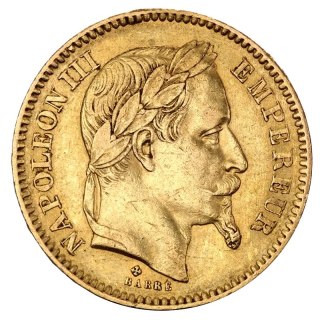
20 Francs Napoleon III Bonaparte (1853-1870) — the prototype of the Latin Monetary Union standard with the portrait of the Second Empire emperor
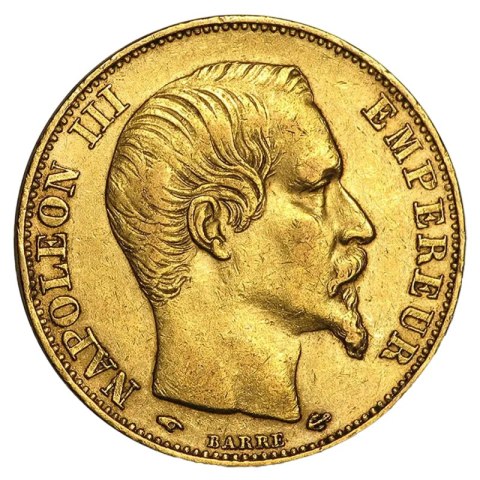
The 20 Francs Napoleon III Bonaparte (1853-1870) gold coin is a historic French 20-franc piece that became the prototype of the Latin Monetary Union (LMU) standard — with a gross mass of 6.4516 g, a pure-gold mass of 5.80645 g, a 0.900 fineness (Crown-Gold-style alloy), a 21.0 mm diameter and a 20-French-franc face value as legal tender of the Second Empire. Struck at the Monnaie de Paris (mint A — Paris) as well as at Strasbourg (BB) and Bordeaux (K) over 17 years (1853-1870), with two main emperor-portrait types: bare head (1853-1860, design by Albert-Désiré Barre) and laurel-wreathed head (1861-1870, design by Jean-Baptiste Hugues). The coin is VAT-exempt in the EU as a historic legal-tender coin with a 0.900 fineness struck after 1800, with a typical market markup of 3-6% over spot — the second most popular LMU 20F after Vreneli on the secondary market.
Technical specification
| Parameter |
Value |
| Manufacturer |
Monnaie de Paris (letter A), Strasbourg (BB), Bordeaux (K) |
| Series |
20 francs or Napoléon III — Second French Empire |
| Mintage years |
1853-1870 (17 years, two types: bare head and laurel-wreathed) |
| Standard |
Prototype of the LMU 20F (parameters adopted in the 23.12.1865 treaty) |
| Gross mass |
6.4516 g (gold + copper) |
| Pure gold mass |
5.80645 g |
| Fineness |
0.900 fineness (Crown-Gold-style alloy) |
| Alloy |
Au 90% + Cu 10% |
| Diameter |
21.0 mm |
| Thickness |
approx. 1.3 mm |
| Face value |
20 French francs (legal tender of the Second Empire) |
| Obverse |
Napoleon III — emperor's profile, NAPOLEON III EMPEREUR (Barre 1853-1860 / Hugues 1861-1870) |
| Reverse |
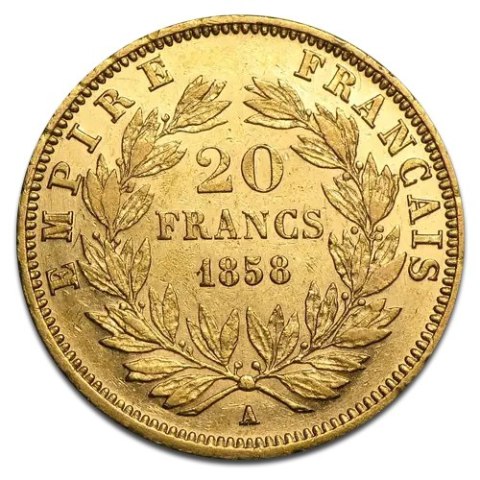
Imperial eagle with crown, EMPIRE FRANÇAIS, 20 FRANCS, year |
| LBMA status |
Not directly (historic coin, not a current bullion issue) |
| VAT in the EU |
Exempt (legal-tender coin, fineness 900 = minimum, struck after 1800, EU Directive 2006/112/EC Art. 344) |
| UK status |
NOT CGT-free (CGT exemption applies only to British legal tender) |
| USA status |
NOT IRA-eligible (IRS admits only American coins and selected bullion) |
| Packaging |
Protective capsule or blister |
Why Napoleon III deserves a place in your portfolio
- Prototype of the LMU 20F standard — historic rank of the coin: The 20-franc piece of Napoleon III, struck since 1853, became the prototype of the standard which the Latin Monetary Union copied on 23.12.1865 for all member states. The parameters 6.4516 g gross, 5.80645 g pure gold, 0.900 fineness — all were taken from the French 20F Napoleon III, which France, as the largest economy of the union, imposed on the remaining states (Belgium, Switzerland, Italy).
- Two portrait types — early collector period: Napoleon III issues come in two obverse variants — bare head (1853-1860, design by Albert-Désiré Barre, classical Roman style without a crown) and laurel-wreathed head (1861-1870, design by Jean-Baptiste Hugues, a reference to the Caesarean tradition). The presence of two types in the 17-year production gives a collector element — vintage collectors distinguish early issues (bare head) and late issues (with wreath).
- Crown-Gold-style alloy 0.900 — historic standard: The 900 fineness (Au 90% + Cu 10%) chosen in 1803 for the French germinal franc (Napoleon I) and continued by Napoleon III later became the LMU standard for all member states. The alloy is harder than pure 999.9 gold and scratch-resistant, which explains the preservation of the coins in good condition after 155-170 years.
- Second-highest secondary liquidity among LMU 20F: Napoleon III is the second most commonly encountered 20-franc coin in European secondary trade after Vreneli — France, as the largest LMU economy, struck millions of these coins in the 17-year production. Typically 3-6% over spot — only marginally higher than Vreneli (2-5%), still among the lowest among historic gold coins.
- Second French Empire — historic context: The 1853-1870 issues span the entire Second Empire of Napoleon III — from the coronation in 1852 to the fall in 1870 after the Franco-Prussian War (battle of Sedan). The coin is a physical witness of the last imperial era of France before the III Republic — a period of industrialisation, Paris modernisation by Haussmann and colonial expansion.
History of the Second Empire and the LMU 20F prototype
Louis-Napoléon Bonaparte — nephew of Napoleon I — was elected president of the Second French Republic in 1848. In the coup of 2 December 1851 he overthrew the republic, and a year later, on 2 December 1852, he proclaimed himself emperor as Napoleon III, inaugurating the Second French Empire. The first 20-franc coins with the portrait of Napoleon III appeared in 1853 — the obverse design was made by Albert-Désiré Barre (1818-1878), Monnaie de Paris chief engraver from 1855 (previously the son of the former graveur général Jacques-Jean Barre).
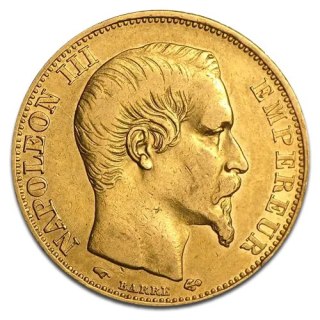
The first portrait type — bare head (tête nue, 1853-1860) — shows Napoleon III without a crown or wreath, with hair styled in the Roman manner, in classical republican stylistics. The obverse inscription NAPOLEON III EMPEREUR (Napoleon III Emperor) identifies the monarch and his title. This portrait type was in force for the first 8 years of the Second Empire and is less numerous than the second type — issues from 1853-1860 have higher collector value while retaining identical technical specifications.
The second portrait type — head with laurel wreath (tête laurée, 1861-1870) — introduced in 1861 refers to the tradition of Roman emperors wearing a laurel wreath as a symbol of power. The design was made by Jean-Baptiste Hugues — although the wreath was added to the existing Barre portrait, formal authorship of the wreath is attributed to Hugues. The second type was in force for 9 years (1861-1870) and is more numerous in secondary trade than the first — most 20-franc Napoleon III coins available on the market today are of the wreath type.
The 20-franc Napoleon III standard was mathematically derived from the parameters of the French germinal franc — the currency introduced by Napoleon I in 1803 (year XI of the revolutionary calendar, month germinal). The germinal franc defined: 1 franc = 5 g of silver at 0.900 fineness or 0.290 g of pure gold (at a ratio Au:Ag = 15.5:1). 20 francs = 100 g of silver or 5.80645 g of pure gold — with 10% copper added gives 6.4516 g gross. These parameters survived from 1803 throughout the 19th century and from 1865 became the foundation of the LMU standard.
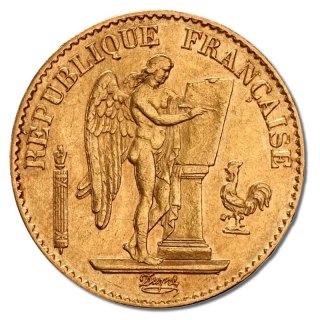
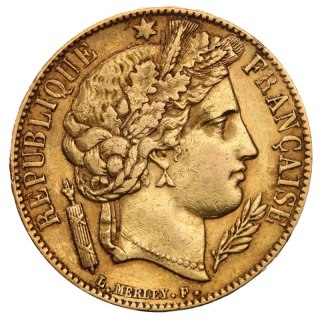
The Second Empire fell in 1870 after the defeat in the Franco-Prussian War — the battle of Sedan (2 September 1870) ended with the capitulation of Napoleon III and his captivity under Bismarck. After the overthrow of the emperor on 4 September 1870 the III French Republic was proclaimed, continuing the minting of 20-franc coins — initially with the Ceres motif (1871-1898), and from 1871 also with the Angel/Genius of Liberty motif (continuation of the Augustin Dupré design). The technical standards remained identical — the LMU retained full interchangeability.
Obverse — Napoleon III (bare head 1853-1860 / wreathed 1861-1870)
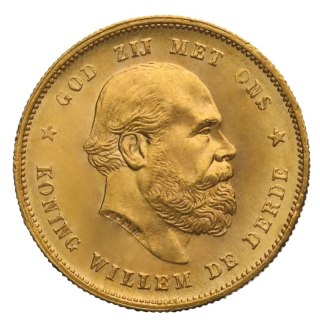
The obverse of the 20 Francs Napoleon III coin appears in two variants depending on the vintage. First variant (1853-1860) — tête nue, bare head — shows the emperor in left profile, without crown or wreath, with hair styled in the Roman manner, with sideburns and the characteristic Spanish goatee (trimmed Spanish style). The inscription around the portrait NAPOLEON III EMPEREUR (Napoleon III Emperor) is the Latin title of the monarch. The design was made by Albert-Désiré Barre, son of the former Monnaie de Paris graveur général.
Second variant (1861-1870) — tête laurée, head with laurel wreath — shows the emperor in left profile with an added laurel wreath surrounding the head. The wreath refers to the tradition of Roman emperors (Caesar, Octavian Augustus) and symbolises imperial power and triumph. The obverse inscription remained unchanged — NAPOLEON III EMPEREUR — the wreath design is attributed to Jean-Baptiste Hugues, while the head portrait remained Barre's. The introduction of the wreath in 1861 was meant to emphasise the imperial character of the monarchy (contrast to the earlier Second Republic).
Albert-Désiré Barre (1818-1878) — French sculptor and engraver, Monnaie de Paris chief engraver (graveur général) from 1855 until his death in 1878. Son of Jacques-Jean Barre (graveur général 1842-1855), continuator of the family tradition in French coinage. Author of the Napoleon III portrait on the 20-franc coins 1853-1860 (bare head) as well as other denominations of the Second Empire. After the emperor's overthrow in 1870 Barre remained in office under the III Republic and designed republican coins (Ceres) — professional continuity despite the regime change.
The Monnaie de Paris — founded in 864 — is the oldest public institution of France and one of the oldest mints in Europe. It has minted French coins continuously for over 1100 years. The mint letter “A” identifies Paris as the mint of striking — French standard used since the 14th century. For Napoleon III issues one also encounters the letters “BB” (Strasbourg, mint closed 1870) and “K” (Bordeaux), although most issues come from Paris.
Reverse — imperial eagle with the Second Empire crown
The reverse of the 20 Francs Napoleon III coin features the imperial eagle of the Second Empire — a stylised eagle with spread wings, holding thunderbolts in its claws (attribute of Jupiter), with an imperial crown above its head. Around the eagle is the inscription EMPIRE FRANÇAIS (French Empire) and the face value 20 FRANCS and the year of minting below. The mint letter “A”, “BB” or “K” is placed next to the year.
The imperial eagle of the Second Empire is stylistically related to the eagle of the First Empire of Napoleon I (1804-1814) — a conscious reference by Napoleon III to his uncle's heritage. The eagle with thunderbolts refers to Jupiter's eagle in Roman mythology and to the eagle of the Holy Roman Empire — a symbolic justification of the continuity of imperial power. The crown above the eagle's head is the imperial crown designed for Napoleon I, used with modifications by Napoleon III.
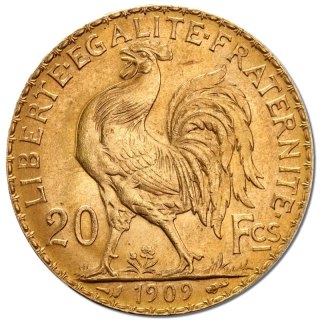
After the fall of the Second Empire in 1870, the III Republic replaced the imperial eagle on the reverses of 20-franc coins with republican motifs — first Ceres (1871-1898), and then the Gallic rooster on the Angel/Genius of Liberty coins (1871-1898 — in parallel with Ceres, two simultaneous types). The imperial eagle disappeared from French coins for 80 years — it returned only in a smaller format on commemorative coins in the 20th and 21st centuries (e.g. 200 EUR Napoleon I Commemorative 2021).
The year of minting placed under the eagle serves as the distinguishing feature between issues in the 17-year Napoleon III series (1853-1870). The most common vintages in secondary trade are the years 1860-1869 (wreath type, highest mintages). The rarest are transitional vintages (1860-1861 — change of portrait type) and the last vintage 1870 (year of the empire's fall, low mintage) — these issues may have numismatic value higher than the precious-metal value itself.
What to look out for when buying
Check the portrait type — Napoleon III appears in two obverse variants: bare head (tête nue, 1853-1860) and wreathed head (tête laurée, 1861-1870). In secondary trade, mixed years usually contains both types in proportions corresponding to historical mintages (most are the wreath type). For vintage collectors, the bare-head type is more sought after (shorter 1853-1860 issue) and has a higher margin — typically +20-40% over mixed years.
The market margin on Napoleon III typically holds in the range of 3-6% over spot — the second-lowest markup after Vreneli (2-5%) among historic gold coins. This results from the mass mintage of the issue (France, as the largest LMU economy, struck millions of these coins) — a single coin has no significant collector value, but the depth of the secondary market ensures reliable valuation. The markup is only marginally higher than Vreneli — a consequence of the lower number of preserved specimens (some were melted in the 20th century for the production of bank reserves).
Check the mint of striking — most Napoleon III issues come from the Monnaie de Paris (letter “A” next to the year), but there are also issues from the Strasbourg Mint (BB, operating until 1870, closed after the annexation of Alsace by Prussia) and the Bordeaux Mint (K). All mints struck identical technical specifications — the difference is only in the mint letter and the collector value (rarer mints have a higher margin).
Check the condition of the coin and authenticity — Napoleon III in the 900/1000 alloy (harder than pure 999.9) retains typical circulation traces after 155-170 years: light wear, fine scratches, natural surface patina. For a buying strategy, VF (Very Fine) and EF (Extremely Fine) grades are acceptable. AU (About Uncirculated) and UNC (Uncirculated) grades are sought after by collectors. Each coin is delivered in a protective capsule or individual blister to preserve the surface.
Why GoldInvest24
- Full cross-section of historic LMU 20-franc coins: in our catalogue you will find all the key LMU 20F issues — Vreneli (Switzerland), Napoleon III (France), Angel of the Third Republic (France), Helvetia (Switzerland) and Leopold II (Belgium) — which allows building a balanced historic-gold portfolio.
- Mixed years for optimal markup over spot: Napoleon III offer in mixed-years format (various vintages 1853-1870, both portrait types) with a 3-6% margin over spot — the second-lowest historic markup available to the individual buyer. For vintage collectors, specific vintages in AU/UNC grades are also available in the higher price range.
- PL / DE / EN language versions: full technical descriptions and specifications in three languages for convenient service of the Polish, German and international markets — particularly valuable for historic coins with numismatic terminology in three languages.
- Current precious-metals quotes: spot data for comparing offer prices with current market valuation — check the current precious-metals prices before purchase to assess the effective margin over spot on historic coins.
- Full precious-metal categories in one shop: access to gold bullion coins, bars, silver, platinum and palladium — all from a single customer account, with full PL/DE/EN support.
Comparison of 5 coins — Vreneli, Napoleon III, Angel, Helvetia, Leopold II
| Feature |
Vreneli (CH) |
Napoleon III (FR) |
Angel (FR) |
Helvetia (CH) |
Leopold II (BE) |
| Mintage years |
1897-1949 |
1853-1870 |
1871-1898 |
1883-1896 |
1867-1882 |
| Mint |
Bern |
Monnaie de Paris |
Monnaie de Paris |
Bern |
Brussels Mint |
| Obverse |
Helvetia (Vreneli) |
Napoleon III |
Genius of Liberty |
Helvetia seated |
Leopold II |
| Designer |
Fritz Ulysse Landry |
Barre / Hugues |
Augustin Dupré |
Antoine Bovy |
Léopold Wiener |
| Pure gold |
5.80645 g |
5.80645 g |
5.80645 g |
5.80645 g |
5.80645 g |
| Fineness |
0.900 |
0.900 |
0.900 |
0.900 |
0.900 |
| Typical markup over spot |
2-5% |
3-6% |
3-6% |
5-10% |
4-8% |
| Secondary liquidity |
Highest |
Very high |
High |
Medium |
High |
See the entire gold bullion coins category available at GoldInvest24.
FAQ — common questions about the 20 Francs Napoleon III
What is the 20 Francs Napoleon III?
The 20 Francs Napoleon III Bonaparte is a historic French gold coin of the Second Empire, struck in 1853-1870 at the Monnaie de Paris (letter A), Strasbourg (BB) and Bordeaux (K). Gross mass 6.4516 g, pure-gold mass 5.80645 g, 0.900 fineness, 21.0 mm diameter. Two emperor-portrait types: bare head (1853-1860, Albert-Désiré Barre) and laurel-wreathed head (1861-1870, Jean-Baptiste Hugues). Prototype of the LMU 20F standard adopted by the Latin Monetary Union in 1865.
What is the technical specification of Napoleon III?
Gross mass 6.4516 g (gold + copper), pure-gold mass 5.80645 g, 0.900 fineness (Au 90% + Cu 10%, Crown-Gold-style alloy), 21.0 mm diameter, approx. 1.3 mm thickness, face value 20 French francs. Mint: Paris (A), Strasbourg (BB), Bordeaux (K). Obverse: Napoleon III in left profile, NAPOLEON III EMPEREUR. Reverse: imperial eagle with crown and thunderbolts, EMPIRE FRANÇAIS, 20 FRANCS.
What is the history of Napoleon III and the LMU 20F prototype?
Louis-Napoléon Bonaparte proclaimed himself emperor on 2.12.1852 — the first 20-franc coins from 1853. Standard 6.4516 g gross, 0.900 fineness, 5.80645 g pure gold — derived from the French germinal franc (1803, Napoleon I). Standard adopted by the Latin Monetary Union on 23.12.1865 for all member states (France, Belgium, Switzerland, Italy). The Second Empire fell in 1870 after the Franco-Prussian War (Sedan), the III Republic continued the minting with the Angel/Ceres motif.
How does Napoleon III differ from Vreneli, Angel, Helvetia and Leopold II?
Napoleon III (France, 1853-1870) — Second Empire, two types (bare head 1853-1860, with wreath 1861-1870), prototype of the LMU standard. Vreneli (Switzerland, 1897-1949) — highest-mintage LMU 20F, lowest margin 2-5%, Helvetia and Alps. Angel (France, 1871-1898) — Third Republic, Genius of Liberty (Dupré), only LMU 20F with a male figure. Helvetia (Switzerland, 1883-1896) — Vreneli predecessor (Bovy), lower mintages. Leopold II (Belgium, 1867-1882) — Belgium as LMU founding member.
For whom is Napoleon III a practical choice?
For individual buyers seeking cheap historic gold with deep secondary liquidity (markup 3-6%, second-lowest after Vreneli), for numismatic collectors due to the two portrait types (bare head vs wreathed) and the prototype role in the LMU standard, and for those building a portfolio of historic LMU 20F coins looking for a complement alongside Vreneli. Napoleon III is the second most popular 20-franc coin on the European market.
What is the LBMA, VAT, CGT and IRA status of Napoleon III?
LBMA Good Delivery — NOT directly (Napoleon III is a historic coin, not a current bullion issue). VAT in the EU — EXEMPT (historic legal-tender coin, 0.900 fineness = minimum, struck after 1800, market price ≤180% of gold value — meets EU Directive 2006/112/EC Art. 344). CGT-free in the UK — NO (CGT-free status applies only to British legal tender). IRA-eligible in the USA — NO (IRS admits only American coins and selected bullion).
How do I buy the 20 Francs Napoleon III at GoldInvest24?
Place an order in our shop with access to the gold bullion coins category, the full range of historic LMU 20-franc coins (Vreneli, Napoleon III, Angel, Helvetia, Leopold II) and the offer of LBMA bullion mints. Check the current gold quotes to compare the margin over spot against the current spot price. Descriptions in PL / DE / EN.
![[{[item.product.name]}]]([{[item.product.photo.url]}] 75w)