Austrian 1 Ducat 1915 — non-circulating
The non-circulating 1 ducat is an Austrian Mint restrike in mint condition: no signs of handling, crisp relief and a bright field. It contains 3.44 g of fine gold at 986/1000 and measures 19.75 mm — the same as a 10 euro cent coin.
This version is often given as a gift — for a christening, communion or birthday — or chosen for collections where appearance matters. If only the gold counts, the same ducat is available as a circulating version. All versions, including the 4 ducat coins, are in the gold ducats category.
History and the 1915 restrike
Austrian ducats were officially struck as trade gold until 1915 and were legal tender in Austria until 1858. Since regular issue ended, the Austrian Mint has produced them as historical restrikes — every coin carries 1915, the year of the last regular issue.
The design was first used in 1872. The date 1915 therefore says nothing about the age of the coin: a ducat struck this year carries the same date as one struck decades ago.
Obverse and reverse in mint condition
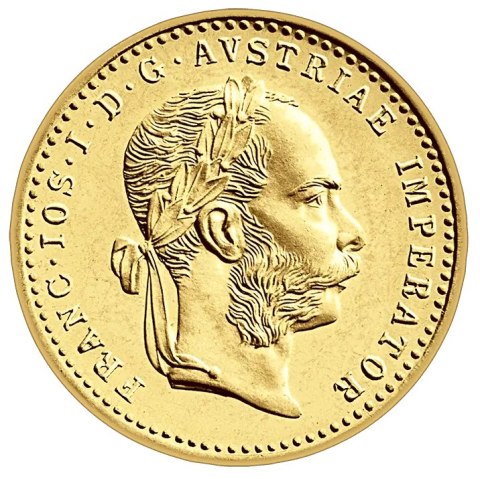
Obverse: Emperor Franz Joseph I with a laurel wreath and the Latin legend FRANC IOS I D G AVSTRIAE IMPERATOR. In mint condition the wreath and beard are sharp — these are the parts of the relief that usually wear first in circulation.
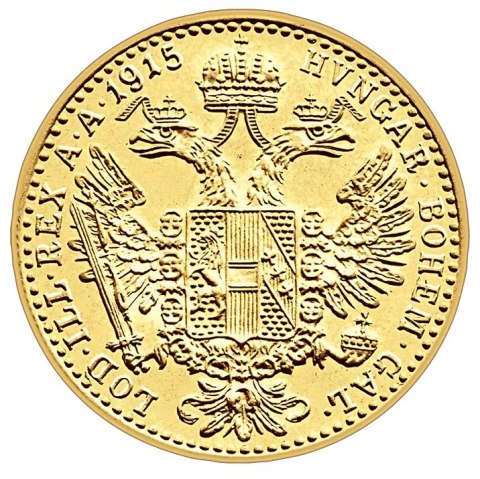
Reverse: the crowned double-headed eagle with a coat of arms, surrounded by the abbreviated titles of King of Hungary, Bohemia, Galicia, Lodomeria and Illyria and Archduke of Austria, with the date 1915.
Non-circulating or circulating
Both versions have identical specifications: 3.49 g, 3.44 g of fine gold, 986/1000, 19.75 mm. They differ in condition and price. The non-circulating coin usually costs a few percent more because it has no contact marks. The circulating ducat may show fine scratches. On resale both are valued mainly by their gold content.
Price and the gold price
The price is the value of 3.44 g of fine gold at the current gold price plus a market premium for minting, distribution and mint condition. The product page shows the current price.
VAT exemption
The ducat meets the EU criteria for VAT-exempt gold coins: fineness of at least 900/1000, struck after 1800, legal tender in the country of origin — in Austria until 1858 — and sold at no more than 80% above the value of its gold. The legal basis is Article 344 of Directive 2006/112/EC, implemented in Poland by Article 122 of the VAT Act.
Comparison with other Austrian Mint coins
| Coin |
Total weight |
Fineness |
Fine gold |
Diameter |
| 1 ducat 1915 |
3.49 g |
986/1000 |
3.44 g |
19.75 mm |
| 4 ducats 1915 |
13.96 g |
986/1000 |
13.77 g |
39.50 mm |
| 4 florins 1892 |
3.23 g |
900/1000 |
2.90 g |
19 mm |
| 20 corona 1915 |
6.78 g |
900/1000 |
6.10 g |
21 mm |
| Vienna Philharmonic 1/10 oz |
3.12 g |
999.9/1000 |
3.11 g |
16 mm |
All coins in the table are Austrian Mint restrikes bearing historical dates. At 986/1000 — about 23.7 carats — the ducats have the highest fineness in this group; the florins and coronas were struck in 900/1000 gold.
Specifications
| Specification |
Value |
| Denomination |
1 ducat |
| Country |
Austria |
| Mint |
Münze Österreich (Vienna) |
| Date on coin |
1915 (historical restrike) |
| Total weight |
3.49 g |
| Fine gold |
3.44 g (0.1106 troy oz) |
| Fineness |
986/1000 |
| Diameter |
19.75 mm |
| Condition |
non-circulating — mint condition |
| VAT |
exempt (Article 344, Directive 2006/112/EC) |
Why GoldInvest24
- Full choice of ducats — single and 4 ducat coins, circulating and non-circulating: gold ducats.
- Transparent pricing based on the gold price.
- No VAT on coins that meet the EU criteria.
- Insured shipping and discreet packaging.
- Service in three languages: English, Polish and German.
Frequently asked questions about the non-circulating ducat
What does non-circulating mean?
It is an Austrian Mint restrike in mint condition with no signs of handling. The metal specifications are the same as the circulating version.
How much does the ducat weigh?
3.49 g, of which 3.44 g is fine gold at 986/1000. The diameter is 19.75 mm.
Why is the ducat dated 1915?
The Austrian Mint strikes ducats as historical restrikes dated 1915, the last year of regular issue. The date is not the year of striking.
Is the ducat a good gift?
Yes. Because of its mint condition and a much smaller outlay than a one-ounce coin, it is often given for a christening, communion or birthday.
How does it differ from the circulating ducat?
Only in condition and price. The circulating version may show scratches; the gold content is the same.
Is the ducat VAT-exempt?
Yes. It meets the criteria of Article 344 of Directive 2006/112/EC: 986/1000 fineness, struck after 1800, formerly legal tender.
See also: gold ducats, the non-circulating 4 ducat coin and historical gold coins.