
For free delivery are missing -,--
Order Summary
Sum 0,00 £
Price includes discounts

American Gold Eagle Coins
Number of products: 10The American Eagle is defined in statute rather than in a mint specification. Title 31 of the United States Code, section 5112(a)(7), sets a fifty dollar gold coin 32.7 millimetres in diameter, weighing 33.931 grams and containing one troy ounce of fine gold; subsection (i) of the same section holds the alloy to within 0.1 per cent of the required gold percentage.
That makes it 22 carat — 916.7 fine, gold with silver and copper — and 2.83 g heavier than the ounce it holds.
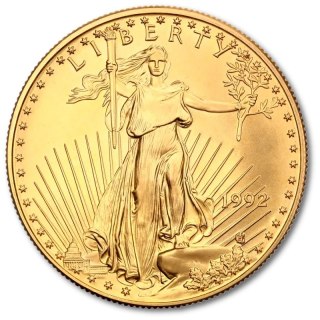
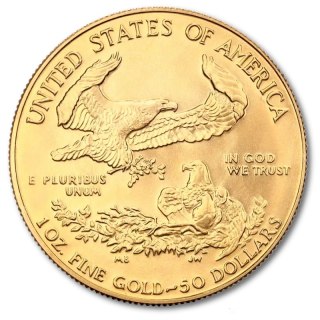
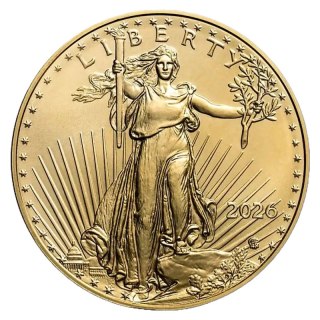
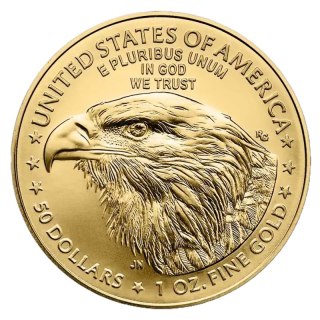

Specification, as legislated
All four fractions are defined in statute rather than left to the mint. The figures below are the statutory ones.
| Fraction | Gross weight | Fine gold | Diameter | Face value |
|---|---|---|---|---|
| 1 oz | 33.931 g | 1 troy oz | 32.7 mm | 50 USD |
| 1/2 oz | 16.966 g | 1/2 troy oz | 27.0 mm | 25 USD |
| 1/4 oz | 8.483 g | 1/4 troy oz | 22.0 mm | 10 USD |
| 1/10 oz | 3.393 g | 1/10 troy oz | 16.5 mm | 5 USD |
22 carat: what the alloy changes and what it does not
The Eagle carries the same troy ounce of fine gold as a 999.9 coin such as the Maple Leaf or the Vienna Philharmonic. The extra 2.83 g of silver and copper make the one-ounce coin heavier and harder, so it takes the knocks of handling better than pure gold, which marks easily. The Krugerrand and the Sovereign use the same 22 carat standard.
What matters at resale is the fine gold content, not the gross weight: a one-ounce Eagle is valued on one troy ounce of gold, exactly like a one-ounce 999.9 coin.
One consequence worth stating plainly: the United States Mint is not on the LBMA Good Delivery list. That list accredits refineries producing bars — some of which, such as The Perth Mint and the Royal Canadian Mint, also strike coins — and no coin of any origin is a Good Delivery product.
Historic US gold coins
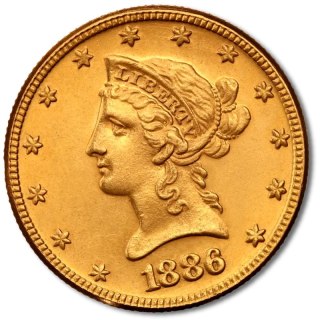
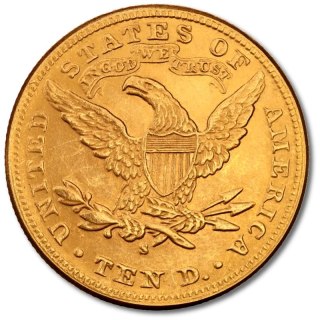
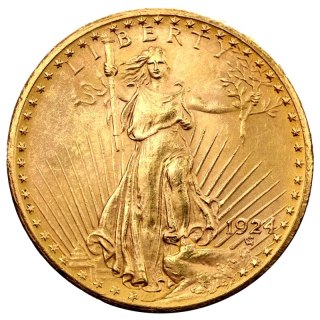
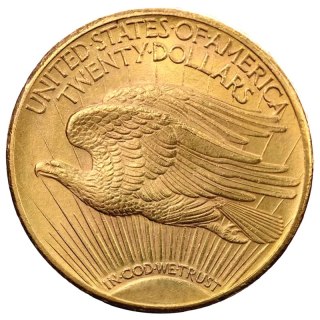
Alongside the modern Eagle, this category lists US gold struck before 1933: the 20 dollar Liberty Head (1850–1907) and Saint-Gaudens Double Eagle (1907–1933), and the 10 dollar Liberty Head (1866–1907) and Indian Head (1908–1933). They were struck in 900 fine gold — the 20 dollar piece weighs 33.436 g and holds 30.09 g of fine gold, the 10 dollar piece weighs 16.718 g and holds 15.05 g. Saint-Gaudens designed both the Double Eagle and the Liberty that the modern Eagle carries on its obverse.
Two reverse designs
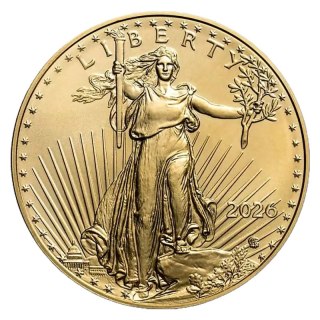
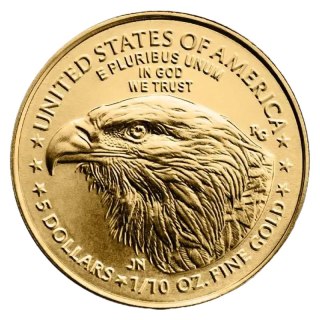
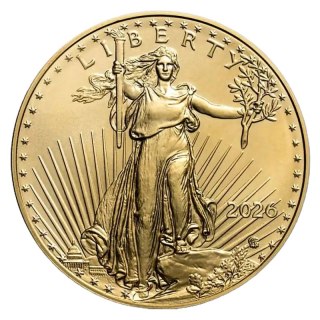
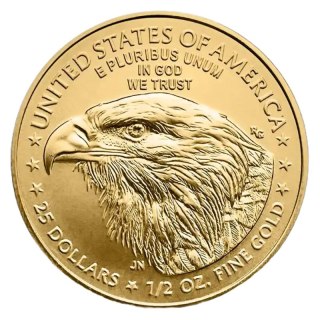
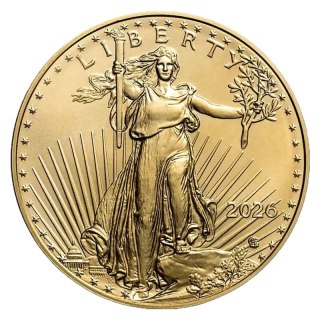
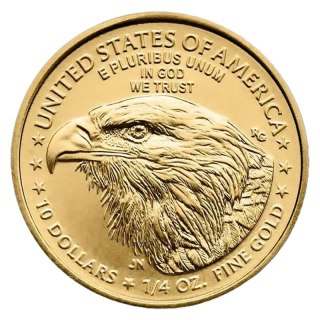
The obverse has been Augustus Saint-Gaudens' Liberty, taken from the 1907 twenty dollar piece, since the series began in 1986. The reverse changed once: the family of eagles by Miley Busiek Frost, sculpted by Sherl Joseph Winter, ran from 1986 to 2021; from 2021 it is a close portrait of an eagle's head by Jennie Norris, sculpted by Renata Gordon.
Coins are commonly described as Type 1 and Type 2 for those two reverses. Both hold the same ounce of gold.
What is in this category
One-ounce Eagles and the 1/2, 1/4 and 1/10 oz fractions — current issues and mixed years — plus historic 10 and 20 dollar gold coins struck before 1933. Prices follow gold plus premium — see the gold price page.
Tax status
Gold bullion is exempt from VAT throughout the European Union under Council Directive 2006/112/EC, Articles 344–346. The exemption covers bars of a fineness of at least 995 thousandths and gold coins of at least 900 thousandths minted after 1800 that are, or have been, legal tender in their country of origin. GoldInvest24 is operated by a Polish company and applies that exemption, so the price shown is the price you pay. This describes how we invoice and is not tax advice — rules in your own country may differ.
Questions buyers ask
Is the American Gold Eagle pure gold?
No. It is 22 carat, 916.7 fine, alloyed with silver and copper. A one-ounce Eagle weighs 33.931 g and holds one troy ounce of gold.
Does 22 carat gold affect the VAT exemption?
No. The EU exemption for gold coins in Council Directive 2006/112/EC requires a fineness of at least 900 thousandths, so a 916.7 fine Eagle qualifies on the same terms as a 999.9 coin.
What is the difference between Type 1 and Type 2?
The reverse. Type 1, from 1986 to 2021, shows a family of eagles by Miley Busiek Frost. Type 2, from 2021, shows an eagle's head by Jennie Norris. The obverse and the gold content are unchanged.
Is the US Mint LBMA accredited?
No. The LBMA Good Delivery list accredits refineries that produce bars, and no coin is a Good Delivery product. Some mints that strike coins do hold the accreditation for their refinery — The Perth Mint and the Royal Canadian Mint among them — but the United States Mint does not.
Is an Eagle exempt from UK capital gains tax?
No. HMRC exempts sterling coins — post-1837 Sovereigns and Britannias — under TCGA 1992 section 21(1)(b). The Eagle is a US fifty dollar coin and stays chargeable for UK taxpayers. This is the published legal position, not tax advice.
Do you buy Eagles back?
Yes, against the current gold price for one troy ounce — the 2.83 g of alloy above that adds weight but no value. See the buyback page.
Other gold coin series
Sovereign · Krugerrand · Britannia · Maple Leaf · Vienna Philharmonic · Australian Kangaroo · Chinese Panda · 1 oz gold coins · historic coins
All series are listed together on the gold coins page. For the same metal without a face value, see gold bars.
Popular in this category
1 oz American Eagle Gold Coin | 2026 · 1/10 oz American Eagle Gold Coin | 2026 · 1/2 oz American Eagle Gold Coin | 2026