20 Dollars, Saint-Gaudens double eagle
33.436 g gross, .900 fine, holding 30.09 g of pure gold — 0.9675 of a troy ounce, so very nearly a full ounce — 34.00 mm across and about 2.4 mm thick.
Commissioned by Theodore Roosevelt and designed by Augustus Saint-Gaudens, it is generally held to be the finest coin the United States has produced.
Specifications
| Property |
Value |
| Metal |
Gold, alloyed with copper |
| Fineness |
.900 |
| Fine gold |
30.09 g (0.9675 troy ounce) |
| Gross weight |
33.436 g |
| Diameter |
34.00 mm |
| Thickness |
about 2.4 mm |
| Face value |
20 US dollars |
| Years |
1907 to 1933 |
| Country |
United States |
| Edge |
Lettered E PLURIBUS UNUM with stars between the words |
Obverse and reverse
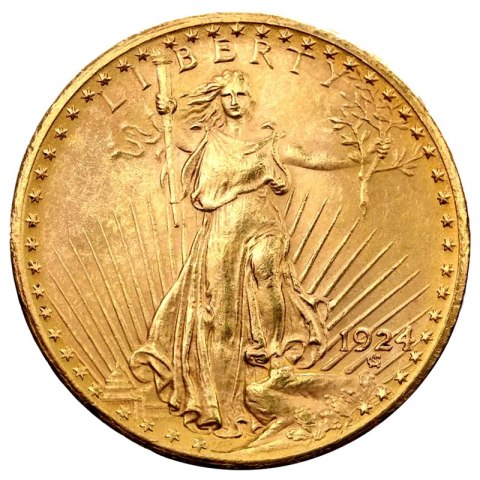
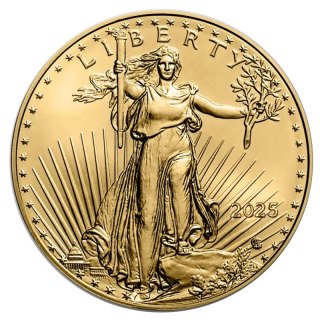
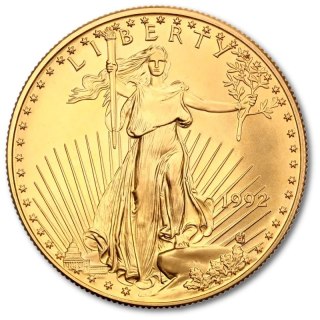
The obverse shows Liberty striding forward over a rocky outcrop, torch in her right hand and olive branch in her left, the Capitol dome and the sun’s rays behind her. Forty-six stars on coins to 1911, forty-eight from 1912.
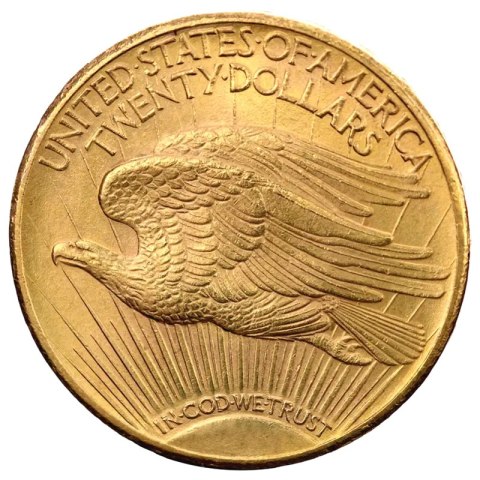
The reverse shows an eagle in flight over a rising sun.
High relief, and why it did not last
The 1907 Ultra High Relief pieces needed up to nine strikes each and only about two dozen were made. The High Relief issue of the same year, with the date in Roman numerals, needed three strikes and ran to just over twelve thousand. Neither could be produced at scale, so Charles Barber flattened the design for regular production.
IN GOD WE TRUST was left off at Roosevelt’s insistence and added by Congress in 1908, so both No Motto and With Motto coins exist.
The 1933 double eagle
Nearly 445,500 were struck in 1933 and almost all were melted. Exactly one has ever been authorised for private ownership; the rest are held by the United States government or the Smithsonian. Any 1933-dated coin offered for sale is not what it claims to be.
1933 and the recall
Executive Order 6102 of April 1933 required Americans to surrender gold coin, and the great majority of the pre-1933 issues were melted. That is why these coins are scarcer than their mintage figures suggest, and why survivors are graded and priced as numismatic items rather than as plain bullion.
Exactly 900, and why that matters
HMRC’s test for gold bullion is a fineness of not less than 900 thousandths. This coin is exactly 900. It clears the threshold, but with nothing to spare — a coin a shade below that line would attract VAT as a collectable rather than being treated as bullion gold.
VAT and UK capital gains tax
HMRC treats a coin minted after 1800 as bullion gold if it is at least 900 thousandths fine, is or has been legal tender in its country of origin, and normally sells at no more than 180 per cent of the open market value of its gold (VAT Notice 701/21A). The coin is .900 fine, was United States legal tender and is sold on the gold price, so it meets all three tests.
Capital gains tax is a separate matter. The UK exemption follows sterling legal tender, so it covers Sovereigns and Britannias but not a United States coin. This is a statement of the published rule, not tax advice — your own position depends on your circumstances.
Questions buyers ask
Is it a full ounce? Almost. It holds 30.09 g of pure gold against 31.1035 g in a troy ounce, so about 3 per cent less.
Why is the edge lettered? Saint-Gaudens designed it that way. E PLURIBUS UNUM runs around the edge with stars between the words.
Which date will I receive? A mixed date as available. Common dates trade near the gold price; scarce dates and high grades do not.
Is it exempt from UK capital gains tax? No. That exemption follows sterling legal tender.
Authenticity checked at GoldInvest24 before dispatch. Other sizes are on the historic gold coins page. Live quotes on the precious metals prices page.
![[{[item.product.name]}]]([{[item.product.photo.url]}] 75w)