Britannia 1 oz 2027 — the anniversary year with a 40 privy mark
The 2027 gold Britannia 1 oz contains 31.1035 g of 999.9 fine gold, with a face value of £100 and a diameter of 32.69 mm. It is an anniversary issue: The Royal Mint has struck the gold Britannia since 1987, and the 2027 coins carry a wave privy mark with the number 40, with the same number worked into the textured background of the reverse. The Royal Mint opened pre-orders for the 2027 year on 5 October 2026.
Technical specification
| Parameter |
Value |
| Mint |
The Royal Mint, Llantrisant (Wales) |
| Year |
2027 |
| Metal and fineness |
gold 999.9 (24 carat) |
| Fine gold content |
31.1035 g — 1 troy ounce |
| Diameter |
32.69 mm |
| Face value |
£100 — UK legal tender |
| Obverse |
King Charles III, portrait by Martin Jennings |
| Reverse |
Britannia, design by Philip Nathan |
| Privy mark |
wave with the number 40 — 40 years of the gold Britannia (1987-2027) |
| Security features |
latent image padlock/trident, surface animation, tincture lines, micro-text |
| Status |
LBMA-accredited mint; exempt from Capital Gains Tax in the UK |
| VAT |
VAT-exempt under EU Directive 2006/112/EC (art. 344-356) |
Why this coin
- The 40th anniversary year — the 40 privy mark and the reworked background mark four decades of the gold Britannia (1987-2027).
- One troy ounce — the unit in which gold is quoted on the London market, so the metal value of the coin needs no fractional conversion.
- 999.9 fineness since 2013 — earlier years were 916.7 (22 carat); the 2027 coin is 24-carat gold.
- Four optical security features struck into the die, used on the Britannia since 2021.
- £100 face value — as UK legal tender, the coin is exempt from Capital Gains Tax (CGT) in the United Kingdom.
40 years of the gold Britannia: 1987-2027
The Royal Mint introduced the gold Britannia in 1987 as a British bullion coin denominated in pounds. For over a quarter of a century it was struck in 916.7 gold, that is 22 carat — the same alloy as the Krugerrand. In 2013 the mint moved to 999.9 gold, placing the Britannia alongside 24-carat coins such as the Maple Leaf and the Vienna Philharmonic.
The 2027 year closes the fourth decade of the series. The silver version celebrates too: the silver Britannia, struck since 1997, turns 30 in 2027 and carries a matching wave mark with the number 30. On the gold coin, the wave with 40 is what sets this particular year apart — weight, fineness and dimensions are unchanged.
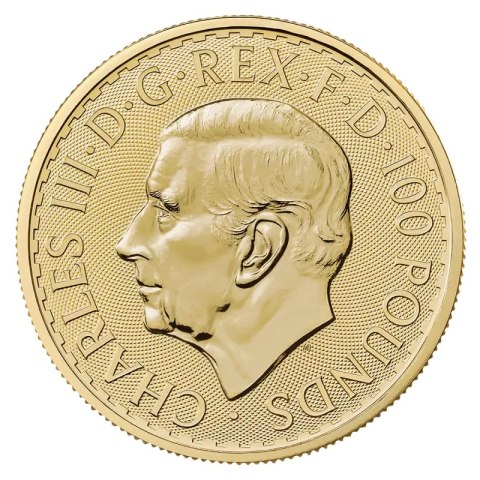
The other change of recent years is on the obverse. After the effigy of Elizabeth II, which appeared on every earlier year, the coin now carries the portrait of King Charles III. The 2027 year therefore combines the new royal portrait with an anniversary reverse.
Obverse — Charles III by Martin Jennings
The obverse shows the portrait of King Charles III by British sculptor Martin Jennings. His initials M.J. sit below the bust — a small detail worth finding during inspection, as counterfeits often lose sharpness in exactly such places. The portrait is shared across The Royal Mint bullion range, so the 2027 obverse matches earlier years; the difference lies on the reverse.
Reverse — the Britannia of Philip Nathan and the anniversary wave
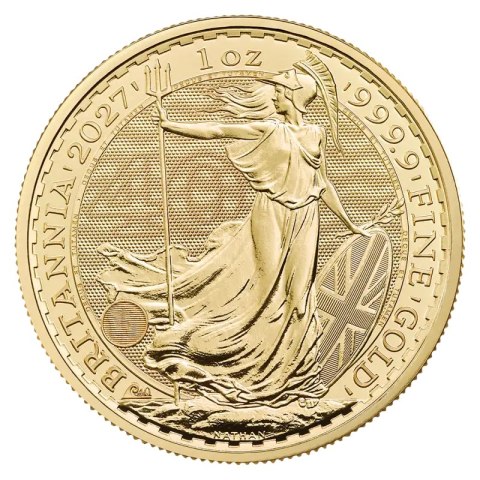
The reverse shows Britannia standing with a trident and a Union Flag shield — the composition by Philip Nathan, who designed this image for the series from its start. The signature NATHAN appears on the reverse.
For 2027 the mint changed two elements. One is the wave privy mark with the number 40. The other is the textured background, which on standard years creates the impression of a rolling wave — this time redesigned so that the number 40 appears in the light and shifts as the coin moves.
The four security features introduced in 2021 remain:
- latent image — switches between a padlock and the trident head depending on the viewing angle,
- tincture lines on the shield — the heraldic marking of the flag colours,
- micro-text with the Latin motto DECUS ET TUTAMEN (an ornament and a safeguard) around the inner field,
- surface animation — background waves that appear to move in the light; in 2027 they carry the hidden number 40.
What to consider before buying
- Year and price. A specific anniversary year usually carries a higher premium than a Britannia of mixed years. The gold content is identical — you pay for the date and the 40 mark, not for more metal.
- CGT is a UK rule. The Capital Gains Tax exemption comes from UK law and applies to UK tax residents. Outside the UK, the rules of your own country of residence apply.
- Thickness. Dealers quote different thickness values for the Britannia 1 oz, so we do not publish one. When checking the coin, rely on fine gold weight (31.1035 g) and the 32.69 mm diameter.
- Soft 999.9 gold. Scratches on the textured background weaken the wave effect and the hidden 40. Keep the coin in a capsule and handle it by the edge.
Why GoldInvest24
We offer coins from LBMA-accredited mints, including our full range of gold bullion coins. Parcels are insured and discreetly packed. You can compare the metal value of the coin with the current gold price.
Britannia 1 oz compared with other one-ounce coins
| Coin |
Mint |
Fineness |
Face value |
Diameter |
| Britannia 2027 |
The Royal Mint |
999.9 |
£100 |
32.69 mm |
| Krugerrand |
Rand Refinery / South African Mint |
916.7 |
no face value |
32.77 mm |
| Maple Leaf |
Royal Canadian Mint |
999.9 |
50 CAD |
30 mm |
| Vienna Philharmonic |
Münze Österreich |
999.9 |
100 EUR |
37 mm |
| American Gold Eagle |
United States Mint |
916.7 |
50 USD |
32.70 mm |
All five coins contain one troy ounce of fine gold. The Krugerrand and the American Gold Eagle are struck in 22-carat alloy, so they weigh more than an ounce — the Krugerrand 33.930 g. The Britannia, Maple Leaf and Philharmonic are 24-carat gold; of these, the Britannia alone carries a sterling face value and UK legal tender status.
Frequently asked questions
How much gold does the Britannia 1 oz 2027 contain?
The coin contains 31.1035 g of fine gold, one troy ounce, at 999.9 fineness. Its diameter is 32.69 mm and its face value is £100.
What does the number 40 on the reverse mean?
The number 40 marks 40 years of the gold Britannia, struck since 1987. It appears twice: in the wave privy mark and in the textured background, where it changes as the coin moves in the light.
Who designed the obverse and reverse?
The portrait of King Charles III on the obverse is by Martin Jennings, whose initials M.J. appear below the bust. The figure of Britannia on the reverse is by Philip Nathan, signed NATHAN.
How does the Britannia 1 oz differ from the Krugerrand?
Both coins contain one troy ounce of fine gold, but the Britannia is 999.9 fine and the Krugerrand 916.7, or 22 carat. The Krugerrand has no face value, while the Britannia has a £100 face value and is UK legal tender.
What security features does the coin have and how do I check them?
The Britannia has a latent image that switches from a padlock to a trident, tincture lines on the shield, the micro-text DECUS ET TUTAMEN and an animated background. Tilt the coin under light to see the latent image and the background movement, and use a loupe for the micro-text.
Is the gold Britannia VAT-exempt?
Yes. The Britannia 1 oz is a 999.9 fine gold coin and is VAT-exempt under EU Directive 2006/112/EC (art. 344-356). The UK Capital Gains Tax exemption is a separate rule for UK tax residents.
Where can I check the current gold value of the coin?
The price of the coin follows the gold price per troy ounce. Current quotes are on the gold price page at GoldInvest24.