Austrian 4 Ducats 1915 — non-circulating
The 4 ducat coin, also called the quadruple ducat, has a face value of four ducats. It contains 13.77 g of fine gold at 986/1000, measures 39.50 mm — exactly twice the single ducat — and is very thin. This version is an Austrian Mint restrike in mint condition with no signs of handling.
A large diameter with a modest weight gives the coin an impressive look, and it presents well in a capsule or case. All ducats are in the gold ducats category; the same coin is also available as a circulating version.
History of the 4 ducat coin
In Austria, 4 ducat coins were struck as trade gold alongside single ducats. Both denominations were legal tender until 1858 and were officially struck until 1915. The design with the portrait of Franz Joseph I was first used in 1872.
Today's 4 ducat coins are historical restrikes by the Austrian Mint. All carry the date 1915, whatever the year of striking. Emperor Franz Joseph I, whose portrait appears on the obverse, died in November 1916.
Obverse and reverse
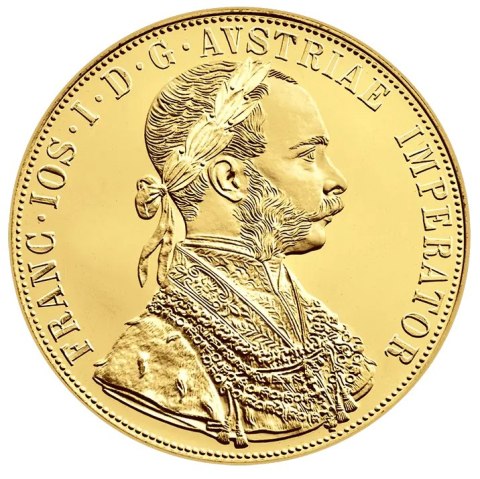
Obverse: bust of Franz Joseph I with a laurel wreath and the legend FRANC IOS I D G AVSTRIAE IMPERATOR. On the large flan the details of the portrait are clearer than on the single ducat.
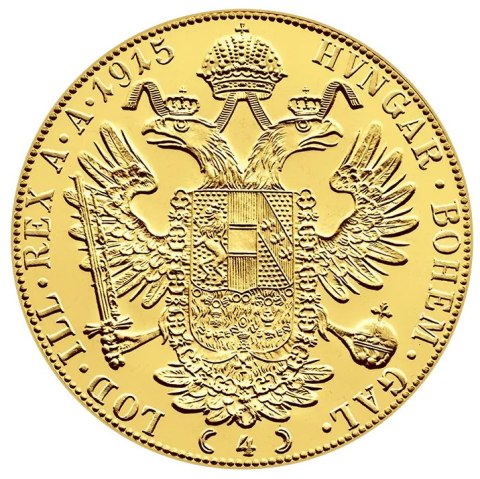
Reverse: the crowned double-headed eagle with a coat of arms, the abbreviated titles of King of Hungary, Bohemia, Galicia, Lodomeria and Illyria and Archduke of Austria, the date 1915 and the numeral 4 for the denomination.
A thin flan — handling and storage
For its diameter the 4 ducat coin is unusually thin — less than 1 mm according to trade data. Such a flan bends or scratches more easily than a thick one-ounce coin, so it is best kept in a capsule and held by the edge. This matters most for the non-circulating version, whose value lies precisely in its mint condition.
Price
The price is the value of 13.77 g of fine gold at the current gold price plus a market premium. The circulating and non-circulating versions may be priced differently depending on supplier availability — both product pages show current prices.
VAT exemption
The 4 ducat coin meets the EU criteria for VAT-exempt gold coins: fineness of at least 900/1000, struck after 1800, legal tender in the country of origin — in Austria until 1858 — and sold at no more than 80% above the value of its gold. The legal basis is Article 344 of Directive 2006/112/EC, implemented in Poland by Article 122 of the VAT Act.
Comparison with other Austrian Mint coins
| Coin |
Total weight |
Fineness |
Fine gold |
Diameter |
| 4 ducats 1915 |
13.96 g |
986/1000 |
13.77 g |
39.50 mm |
| 1 ducat 1915 |
3.49 g |
986/1000 |
3.44 g |
19.75 mm |
| 8 florins 1892 |
6.45 g |
900/1000 |
5.81 g |
21 mm |
| 20 corona 1915 |
6.78 g |
900/1000 |
6.10 g |
21 mm |
| 100 corona 1915 |
33.88 g |
900/1000 |
30.49 g |
37 mm |
All coins in the table are Austrian Mint restrikes bearing historical dates. At 986/1000 — about 23.7 carats — the ducats have the highest fineness in this group; the florins and coronas were struck in 900/1000 gold.
Specifications
| Specification |
Value |
| Denomination |
4 ducats |
| Country |
Austria |
| Mint |
Münze Österreich (Vienna) |
| Date on coin |
1915 (historical restrike) |
| Total weight |
13.96 g |
| Fine gold |
13.77 g (0.4427 troy oz) |
| Fineness |
986/1000 |
| Diameter |
39.50 mm |
| Condition |
non-circulating — mint condition |
| VAT |
exempt (Article 344, Directive 2006/112/EC) |
Why GoldInvest24
- 4 ducat and single ducat coins, circulating and non-circulating: gold ducats.
- Priced by the gold price, shown on the product page.
- VAT-free under EU rules.
- Insured shipping in discreet packaging.
- Service in EN / PL / DE.
Frequently asked questions about the non-circulating 4 ducat coin
What is a 4 ducat coin?
A gold coin with a face value of 4 ducats. It weighs 13.96 g, contains 13.77 g of fine gold at 986/1000 and is 39.50 mm in diameter.
How many ounces of gold does it contain?
13.77 g of fine gold is about 0.4427 troy ounces, just under half an ounce.
Why is the 4 ducat coin so thin?
At 39.50 mm across it weighs only 13.96 g, so the flan is very thin — less than 1 mm according to trade data. A capsule protects it.
Is the 4 ducat coin dated 1915 an original?
No. It is a historical restrike by the Austrian Mint. All modern 4 ducat coins are dated 1915.
How does non-circulating differ from circulating?
The non-circulating version is in mint condition; the circulating one may show signs of handling. The gold content is the same.
Is the 4 ducat coin VAT-exempt?
Yes. It meets the criteria of Article 344 of Directive 2006/112/EC: 986/1000 fineness, struck after 1800, formerly legal tender.
See also: gold ducats, the non-circulating 1 ducat and historical gold coins.