3g Chinese Panda 2026 — fractional balance from the 45th issue of the China Gold Coin series
The Gold Panda 3g 2026 is a small fractional of the official bullion series by China Gold Coin Incorporation with a mass of 3 g of .9999 gold, an 18 mm diameter and a 50 yuan RMB face value as legal tender of the People's Republic of China. The 2026 vintage marks the 45th issue of the series launched in 1982 — with an annually changed panda motif on the reverse and a permanent obverse depicting the Temple of Heaven (Tiantan) in Beijing dating to 1420. VAT-exempt in the EU.
Technical specification
| Parameter |
Value |
| Manufacturer |
China Gold Coin Incorporation (PRC state-owned entity) |
| Vintage |
2026 (45th issue of the series) |
| Gold mass |
3 g |
| Fineness |
999.9/1000 |
| Diameter |
18 mm |
| Thickness |
approx. 0.9 mm |
| Face value |
50 yuan RMB (legal tender China) |
| Obverse |
Temple of Heaven (Tiantan, Beijing, 1420) — permanent motif |
| Reverse |
New panda motif for the 2026 vintage (annual change since 1982) |
| Mints |
Shenyang Mint / Shenzhen Guobao Mint / Shanghai Mint |
| LBMA status |
No (China Gold Coin Inc. is not LBMA-accredited) |
| VAT in the EU |
Exempt (.9999 fineness, legal tender) |
| Packaging |
Individual capsule |
Why this coin earns a place in your stack
- Fractional balance: 3 g is a small Panda fractional sitting between the entry-level 1 g and the mid 8 g — a balance point between per-gram economics and a low unit value convenient for regular planned purchases.
- Popular DCA format: the 3 g unit is chosen in dollar-cost-averaging strategies — quarterly or monthly purchases at this weight allow position building without unnecessary value concentration in a single coin.
- 45th vintage of the Panda series: the series has run uninterrupted since 1982 with an annually changed reverse motif — a feature raising vintage recognition and setting Panda apart from Maple Leaf or Krugerrand with permanent motifs.
- Collector format: 3 g is a convenient unit for collectors building a consecutive vintage set — the low unit value enables assembling a full vintage series without buying larger fractionals.
- VAT-exempt in the EU: .9999 fineness clears the above-900 requirement for bullion coins with margin (Directive 2006/112/EC, Art. 344), and China's legal-tender status completes the criteria — the coin is VAT-exempt across the European Union.
History of the Chinese Panda series — from 1982 to the 2026 vintage
The Gold Panda was introduced in 1982 by China Gold Coin Incorporation — the People's Republic of China state-owned entity in charge of designing and distributing official bullion and numismatic issues. The series debuted in four imperial fractionals (1/20, 1/10, 1/4, 1/2 oz) plus the classic ounce, in response to growing global demand for bullion coins after the success of Krugerrand (since 1967) and Maple Leaf (since 1979).
Production is split between three official state mints — Shenyang Mint (Liaoning), Shenzhen Guobao Mint (Guangdong province) and Shanghai Mint — depending on the vintage and fractional. The mint mark is recognised in collector circulation, does not affect the bullion status of the coin, but can be relevant for numismatists collecting full vintages from a specific mint.
In 2016 China Gold Coin Incorporation introduced the metric system — replacing imperial fractionals (1/20 oz, 1/10 oz, 1/4 oz, 1/2 oz, 1 oz) with gram denominations of 1 g, 3 g, 8 g, 15 g and 30 g. The 3 g fractional replaced the earlier 1/10 oz (3.11 g) in this system — the 0.11 g mass difference is negligible for market calculation but formally distinguishes 3 g Panda products from 1/10 oz Maple Leaf or 1/10 oz Eagle.
The annual change of panda motif on the reverse has been in force without interruption since 1982, except for 2001-2002, when the same design was used twice. The decision to return to annual design changes was made in 2003 after a collector-market reaction — and since then each vintage carries a unique reverse design, most often featuring a panda in a natural setting (bamboo, water, branches).
The 2026 vintage is the 45th issue of the series and a jubilee continuation of the tradition begun in 1982. The mintage of the 3 g Panda 2026 is not officially published by China Gold Coin Incorporation at the time of debut — production adjusts to market demand, which sets Panda apart from series with declared maximum mintages (e.g. Britannia, Eagle).
Obverse — Temple of Heaven (Tiantan) in Beijing
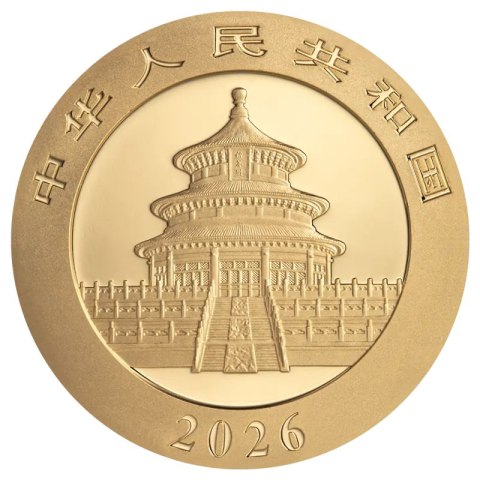
The obverse of all Gold Panda issues since 1982 features the Temple of Heaven (Tiantan) in Beijing — a temple complex built in 1420 during the Ming dynasty, inscribed in 1998 on the UNESCO World Heritage List. The central element of the composition is the Hall of Prayer for Good Harvest (Qiniandian) — a round three-storey building with a characteristic blue-tile roof.
The Temple of Heaven historically served as the site of sacrifice ceremonies to Heaven by Ming- and Qing-dynasty emperors — symbolising the link between earthly imperial power and heavenly order in Confucian Chinese tradition. The motif on the coin underlines the state-sponsored character of the issue and places the Panda series in a deep context of Chinese cultural identity.
The obverse carries inscriptions in Chinese characters 中華人民共和國 (People's Republic of China) at the top and the year 2026 (二零二六) at the bottom, along with the Chinese terms for gold (黃金) and weight (3克). The 18 mm obverse field allows more detailed modelling of architectural elements — roof tiles, columns and foundations of the Temple of Heaven — than the smallest 1 g fractional.
Reverse — new panda motif 2026
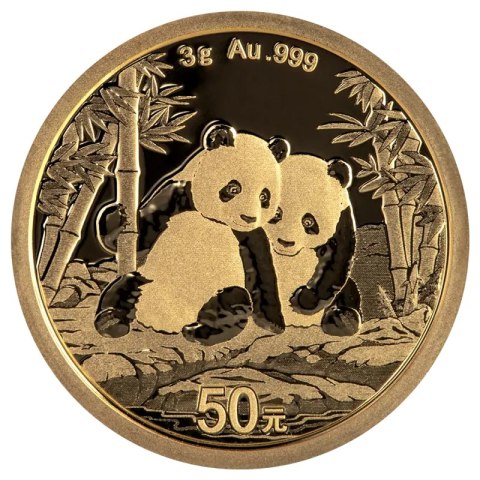
The reverse of the 3 g Panda 2026 features a new composition of the giant panda (Ailuropoda melanoleuca) in a natural setting, designed by the China Gold Coin Incorporation art team. Each vintage carries a unique design — past motifs have included pandas with bamboo, pandas with cubs, pandas by water, pandas on branches and pandas in a sitting position — all rendered in a realistic sculptural convention.
The reverse carries the face-value inscription 50 元 (50 yuan RMB) and the inscription Au .9999 3 g identifying coin mass and fineness. The annual change of panda motif raises the recognition of a specific vintage and can be an argument when building a consecutive collection (successive vintages in a set) — a function not available in series with a permanent reverse motif such as Krugerrand or Maple Leaf.
The sculptural details of the panda — fur texture, modelling of the snout, paw position and bamboo leaves — are kept to the high production standard of Shenyang Mint and Shenzhen Guobao Mint. The 18 mm reverse field allows readable rendering of the panda's anatomical details and plant background — a larger area than the 1 g Panda enables a more elaborate iconographic reverse composition.
What to check when buying
Inspect the integrity of the original China Gold Coin Incorporation capsule — the 18 mm size and 0.9 mm thickness make the 3 g Panda mechanically more resilient than the 1 g, but still susceptible to edge wear when handled without protection. Capsule damage does not affect net gold mass but lowers resale value by a few percent in the collector segment.
The markup on the 3 g Panda 2026 is lower than on the 1 g Panda (25-45%) and typically falls in the 15-25% range in the European retail segment. This reflects the proportionally lower minting cost and better scalability of import logistics from China. For portfolios weighing per-gram gold economics, the 3 g Panda is a practical intermediate choice between 1 g and 8 g.
LBMA Good Delivery status does NOT apply to the Panda series — China Gold Coin Incorporation is not LBMA-accredited. The feature does not affect VAT-exempt status in the EU (the VAT exemption follows from .9999 fineness and China's legal-tender status), but in the wholesale segment between refineries the absence of LBMA can be a factor in valuation.
The annual change of panda motif means that two 3 g coins from different vintages are not interchangeable at the collector level — which sets Panda apart from Maple Leaf or Krugerrand with permanent motifs. The feature is an advantage when building a vintage collection but requires careful verification of the vintage at purchase, especially for buyers targeting a specific year of issue.
Why GoldInvest24
- Manufacturers with LBMA accreditation and China Gold Coin Inc.: the catalogue features coins and bars from mints accredited by the London Bullion Market Association as well as official issues from China Gold Coin Incorporation as a trusted state issuer — the full spectrum of suppliers to the global bullion market.
- Full Panda 2026 size range: 1 g, 3 g, 8 g, 15 g and 30 g versions of the 2026 vintage available in a single shop — allowing the build-out of a portfolio diversified by unit value without sourcing from different suppliers.
- Language versions PL / DE / EN: full technical descriptions and specifications in three languages for convenient service across Polish, German and international markets.
- Current precious-metals quotes: spot data for comparing offer prices with the current market valuation — check the current precious-metals prices before purchase.
- Full precious-metals categories in one shop: access to gold bullion coins, bars, silver, platinum and palladium — all from one customer account.
Comparison of 5 Chinese Panda 2026 fractionals
| Feature |
Panda 1 g |
Panda 3 g |
Panda 8 g |
Panda 15 g |
Panda 30 g |
| Gold mass |
1 g |
3 g |
8 g |
15 g |
30 g |
| Fineness |
.9999 |
.9999 |
.9999 |
.9999 |
.9999 |
| Diameter |
10 mm |
18 mm |
22 mm |
27 mm |
32 mm |
| Face value |
10 yuan |
50 yuan |
100 yuan |
200 yuan |
500 yuan |
| Imperial equivalent |
— |
— |
≈ 1/4 oz (7.776 g) |
≈ 1/2 oz (15.55 g) |
≈ 1 oz (31.103 g) |
| Typical margin over spot |
25-45% |
15-25% |
10-15% |
7-12% |
5-9% |
| Portfolio role |
Entry / gift |
Fractional balance |
Mid fractional |
Metric half-ounce |
Panda flagship |
Browse the full gold bullion coins category available at GoldInvest24.
FAQ — common questions about the 3 g Panda 2026
What is the Chinese Panda 3 g and who strikes it?
The Chinese Panda 3 g is a gold bullion coin struck by the official mints of China Gold Coin Incorporation — Shenyang Mint, Shenzhen Guobao Mint or Shanghai Mint, depending on the vintage. It has 3 g of .9999 gold, an 18 mm diameter and a 50 yuan RMB face value as legal tender of the People's Republic of China. The series has run since 1982, with the 2026 vintage being the 45th issue.
How does the 3 g Panda differ from the 1/10 oz Maple Leaf?
The 3 g Panda carries 3 g of net gold, while the 1/10 oz Maple Leaf carries 3.11 g — a 0.11 g (3.5%) difference negligible for value calculation. Both coins have .9999 fineness and a similar capital entry threshold. Main differences relate to the issuer (China Gold Coin Inc. vs Royal Canadian Mint), LBMA status (RCM has it, China Gold Coin does not) and reverse motif (Panda annual change, Maple Leaf permanent since 1979).
Why is the 3 g Panda popular in DCA strategies?
The low unit value of the 3 g Panda (in the range of 300-400 euro at the 2024-2026 spot) makes regular planned purchases (Dollar Cost Averaging) easier without having to concentrate capital in a single coin. The format enables position building across many Panda vintages — additionally combining the DCA strategy with the collector build-out of a consecutive issue set.
Does the Panda 3 g have LBMA Good Delivery status?
No. China Gold Coin Incorporation does not hold London Bullion Market Association accreditation — no coin in the Panda series is LBMA Good Delivery. The status does not, however, affect VAT-exempt treatment in the EU (.9999 fineness and legal-tender status meet the criteria of Directive 2006/112/EC) or market recognition — Panda is one of the leading world bullion series accepted within the dealer network.
For whom is the 3 g Panda a practical choice?
For portfolios growing their monetary gold exposure, for regular planned purchases with monthly budgets in the range of several hundred euro, and for collectors building a consecutive vintage set of Panda. The unit value allows diversification across several vintages without capital concentration — a function not available in heavier 15 g or 30 g fractionals.
Is the 3 g Panda VAT-exempt in the EU?
Yes. The 3 g Panda meets the criteria for VAT exemption on gold bullion coins in the EU — .9999 fineness exceeds the required 900 (Directive 2006/112/EC, Art. 344), and China's legal-tender status completes the criteria. The absence of LBMA accreditation does not affect VAT status — the exemption follows from fineness and legal status, not from refinery accreditation.
How do I buy the 3 g Panda 2026 at GoldInvest24?
Place an order in our shop with access to the gold bullion coins category, the full Panda 2026 size range (1 g, 3 g, 8 g, 15 g, 30 g) and the offer of LBMA manufacturers and China Gold Coin Incorporation. Check the current gold quotes to compare the markup over spot against the current spot price. Technical descriptions and specifications are available in PL / DE / EN language versions.
![[{[item.product.name]}]]([{[item.product.photo.url]}] 75w)